
The hiring vs scaling dilemma every Series A SaaS faces



After securing Series A funding, SaaS companies often face a sharp acceleration in pace. This includes aggressive growth plans, pressure for speed, and high expectations for scaling. Investors demand quick results like increased ARR, market expansion, and new features.
The instinctive reaction for many founders is simple: "We need to hire more people." But reality hits hard. Hiring doesn't always solve the problem and can sometimes make it worse. It creates a gap between growth demands and team capabilities.
This is the core of Series A SaaS growth challenges. For startups in HealthTech, BioTech, FinTech, Deep Tech, AI, EdTech, or Climate Tech, these issues are acute. This article explores why hiring falls short, uncovers expansion pitfalls, and shares scalable strategies. Gain insights to maintain momentum amid product slowdowns or hiring vs scaling tensions, without team burnout.
The Hiring–Scaling Gap
Growth after Series A demands lightning-fast execution: closing deals, expanding products, and capturing market share. But hiring is a slow process, taking months. Companies are squeezed between the current team overload and ambitious plans.
A Typical HealthTech Example
Imagine a HealthTech startup with $3M ARR and an AI diagnostics platform. Investors push for market expansion and features such as real-time analytics or HIPAA compliance. The 20-person team is already stretched across DevOps, compliance, and UX/UI delivery.
Hiring appears to be the immediate solution. In reality, this scenario often exposes the deeper SaaS hiring vs scaling dilemma: quarterly growth expectations collide with recruitment cycles that require three to six months for senior engineers to join and ramp, widening the gap between strategic ambition and execution capacity.
The Resulting Delivery Gap
This creates a "delivery gap": ARR outpaces team capacity, stalling initiatives and frustrating stakeholders. Cultural agility erodes with rushed hires. For innovative Deep Tech, aligned talent is scarce. Overloaded teams miss deadlines, causing product development slowdowns and customer churn risks. This highlights the essence of scaling SaaS after Series A.
Why Hiring Can’t Keep Up With Growth
Hiring top talent is no easy feat. Several barriers prevent quick team expansion, creating friction in fast-paced growth environments.
Limited Talent Pool
Finding senior roles in DevOps, compliance, or engineering is tough. Startups with unique value propositions compete directly with Big Tech giants.
- They offer equity incentives but often lack the stability or perks of established companies.
- In niche verticals like Climate Tech or BioTech, the talent pool is especially shallow.
- Specialized skills, such as AI integration or regulatory expertise, are rare and highly sought after.
Lengthy Interview Processes
The hiring timeline stretches out significantly. Interviews typically span 40-90 days due to:
- Multiple rounds of assessments.
- Technical tests to evaluate skills.
- Cultural fit evaluations to ensure alignment.
Screening dozens of candidates for a single DevOps role often results in mismatches. Key experiences, like building scalable architectures or implementing CI/CD pipelines, are essential but hard to verify quickly.
Onboarding Friction
Even after hiring, new team members don't hit the ground running. Ramp-up periods last 3-6 months for full productivity, as they must learn:
- The existing codebase.
- Internal processes and tools.
- Domain-specific insights, such as FinTech regulations.
During this time, existing employees divert focus to training, which temporarily dips overall team velocity.
Broader Impacts
McKinsey studies indicate tech hires can take up to six months to contribute at full capacity, leading to short-term productivity drags. In the context of Series A SaaS growth challenges, this means aggressive expansion plans often fall short. Niche requirements, like scaling massive datasets in AI Tech, create bottlenecks. Founders end up over-relying on early employees, heightening burnout risks.
These factors underscore hiring challenges Series A SaaS.
Growth Gets Stalled by Hiring Delays
Hiring delays create far-reaching setbacks in SaaS operations. They transform minor timeline slips into major business risks, affecting everything from product delivery to investor relations in high-pressure post-Series A stages.
Missed Opportunities and Investor Pressure
Delays result in postponed releases and forfeited sales deals, while investors dial up the scrutiny.
- Each month a critical role remains vacant and can inflate roadmap slippage by 10-15%.
- In specialized fields like FinTech or HealthTech, where compliance and scalable architecture are vital, these issues erode hard-won competitive edges.
This illustrates core hiring challenges Series A SaaS in maintaining growth trajectories.
Benchmark Insights
Industry data paints a clear picture of the divide. According to reports like the State of SaaS:
- Efficient scalers maintain 70-80% adherence to their roadmaps.
- Chronic delayers see that drop to 40-50%, highlighting systemic inefficiencies.
Deferred features, which might otherwise generate $100K in MRR, get pushed out by quarters. VCs demand quick traction following $1-5M ARR milestones, leading to strained board dynamics, and potentially down rounds or strategic pivots.
Tangible Business Impacts
Sales pipelines wither without consistent updates. In E-commerce or marketplace models, flawless UX is non-negotiable; lags in UI/UX hires lead to subpar interfaces that alienate users.
- Setbacks compound, turning isolated delays into broad strategic vulnerabilities.
- Overall momentum falters, making it tougher to rebound in fast-paced markets.
This reveals the risks of growth stalled by hiring delays.
Why “Just Hire More Engineers” Is a Trap
The knee-jerk response to scaling issues, simply adding more engineers, often backfires. It introduces complexities that can hinder rather than help velocity in Series A SaaS environments.
Communication Overhead Grows
Increasing headcount doesn't always boost speed. Overhead escalates nonlinearly with team size.
- Use the formula: n(n-1)/2 for communication links.
- Example: Growing from 10 to 20 developers jumps links from 45 to 190, leading to more meetings and less actual coding time.
For a broader analysis of how team structure influences scalability and delivery capacity, explore our article on organizational alignment.
Process and Output Pitfalls
Legacy processes fail to scale under new pressure. Hiring without foundational systems only amplifies chaos.
- Per-developer output can drop 15-30% if modular architecture isn't prioritized.
- Unstructured expansion turns coordination into a nightmare.
Real-World Failures
Many Series A founders ramp up hiring to satisfy investor demands, only to see efficiency plummet.
In fields such as AI and Climate Tech, where features demand precise collaboration, blind team growth invites disaster. The result? Diminished returns despite increased resources.

This trap highlights the risks of SaaS team expansion from unchecked hiring strategies.
Scaling Is More Than Headcount
True scaling syncs multiple elements. Headcount is just one piece. Focus on architecture, processes, and tools too.
Shift to microservices for growth handling. Robust MVPs scale without crashes. DevOps and CI/CD for discipline. Automate deployments to cut errors. Tools like Jira track progress. Clear ownership via squads.
Partner for non-core tasks. UX/UI redesign or backend optimization without internal waits. Crucial for SaaS hiring vs scaling. Maintains delivery velocity. Build high-performance environments. Attract talent with remote tools. For US teams with global aims, this sustains innovation.
View scaling as a system. Sync elements so growth amplifies output. This approach addresses Series A SaaS team scaling.
The Hidden Cost of Delaying Scaling Decisions
Delaying scaling choices in Series A SaaS companies carries steep, often unseen penalties. These extend beyond immediate operations, affecting team health, culture, and financial viability in rapidly evolving markets.
Burnout and Turnover Risks
Procrastination breeds team exhaustion. Industry-wide tech turnover averages 13%, but stressed startups can see rates spike to 20-30%.
Employees depart, worsening resource shortages and compounding operational issues. This cycle accelerates, draining institutional knowledge and morale.
This reflects broader Series A SaaS team scaling struggles in high-pressure environments.
Cultural Erosion
The early innovative spark diminishes under sustained overload.
- Retention plummets as frustration builds.
- Core values and collaboration suffer, making it harder to attract new talent.
Lost Momentum in Fast Markets
Competitive landscapes shift quickly, think EdTech trends evolving overnight. Delays can render products obsolete.
- ARR per employee falls below the $150-300K benchmark, signaling inefficient resource use.
- Burn multiples rise to 2.0-3.0x, indicating wasteful spending amid scaling missteps.
Financial Warning Signals
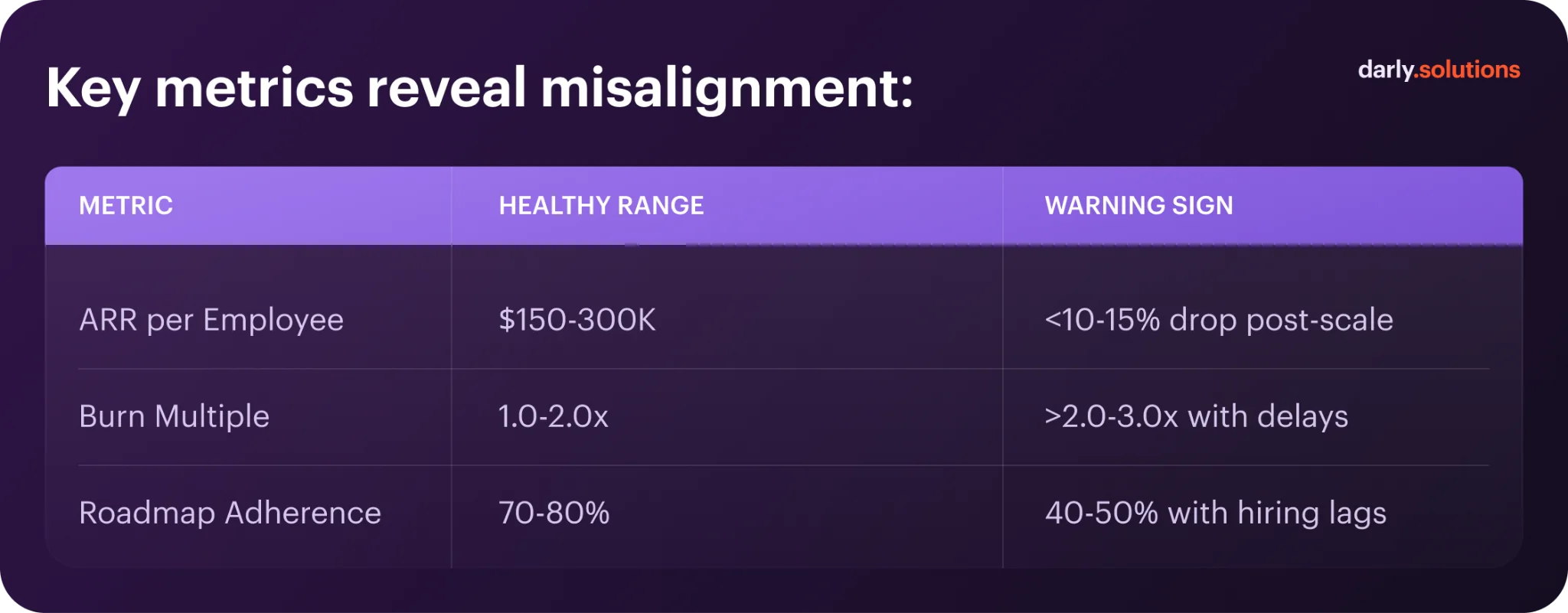
Rising Remediation Expenses
Addressing problems reactively costs far more than proactive measures. Crisis-mode fixes drain budgets and time.
- What starts as minor gaps widens into existential threats.
- Early intervention prevents escalation.
These costs highlight SaaS hiring vs scaling.
In-House vs. External Partner Comparison
To better understand how a hybrid scaling model, combining in-house talent with external partners, stacks up against traditional full-time hiring, consider this cost comparison for a team of 5 senior engineers over one year. Drawing from real industry benchmarks, the table highlights key differences in expenses, timelines, and flexibility, demonstrating how outsourcing can deliver up to 60% savings while accelerating development for Series A SaaS startups facing hiring bottlenecks.

The comparison highlights a structural difference in how capacity is built. Full-time hiring increases fixed cost and extends ramp time, while an external partner model concentrates spend on active delivery and shortens time to contribution.
For Series A SaaS companies balancing speed and capital efficiency, the question is not only how many engineers to add, but how to add capacity without increasing structural drag. A hybrid model can protect roadmap momentum while preserving financial flexibility.
If you are evaluating how to expand delivery without committing to long hiring cycles, contact us to discuss how we can support your scaling phase as a technical partner.
Final Thought
After Series A, the focus shifts to how effectively the organization converts demand into delivery. Sustainable growth depends on structural alignment between headcount, architecture, ownership, and process discipline.
Hiring expands capacity over time. Scaling requires coordinated system design that allows execution to remain predictable as complexity increases. When these elements move together, growth compounds with control. When alignment weakens, costs expand, delivery slows, and strategic flexibility narrows.
Series A rewards companies that design capacity deliberately and scale while maintaining execution stability.


FAQ
Series A ramps expectations. But hiring challenges Series A SaaS stem from shortages, long onboarding, and specialized role needs in tech verticals. Rapid plans clash with slow recruitment.
Growth stalled by hiring delays typically appears first in roadmap slippage and extended release cycles. As key roles remain unfilled, initiatives shift between quarters, teams absorb excess workload, and expansion revenue timelines extend, gradually compressing growth momentum.
No, it's often a trap. SaaS team expansion needs processes and architecture. Avoid efficiency drops from uncoordinated growth.
Effective scaling SaaS after Series A requires synchronizing headcount growth with system design. Modular architecture, automated testing, DevOps maturity, and selective external partnerships increase delivery capacity while reducing dependency on long engineering hiring delays in SaaS environments.
Related articles
.webp)


Connect with us
.webp)
We are a tech partner that delivers ingenious digital solutions, engineering and vertical services for industry leaders powered by vetted talents.

