
When your current team structure can’t support your growth plans



Growth rarely stalls overnight. Headcount grows, initiatives expand, and progress starts feeling heavier instead of faster. That friction often signals one thing: the current team structure can’t support growth at the company’s current size.
This shift commonly appears after Series A, when ownership spreads and coordination replaces execution as the main constraint. Delivery stops progressing linearly and begins reflecting organizational design rather than effort. This article explains how that transition happens, which signals appear first, and when team structure blocking growth becomes the real limiter.
The First Signs Your Team Structure Is Failing
Structural issues surface before delivery fully breaks. They appear in how decisions move, how work is divided, and how ownership is defined. Founders usually sense the shift before they can clearly name it.
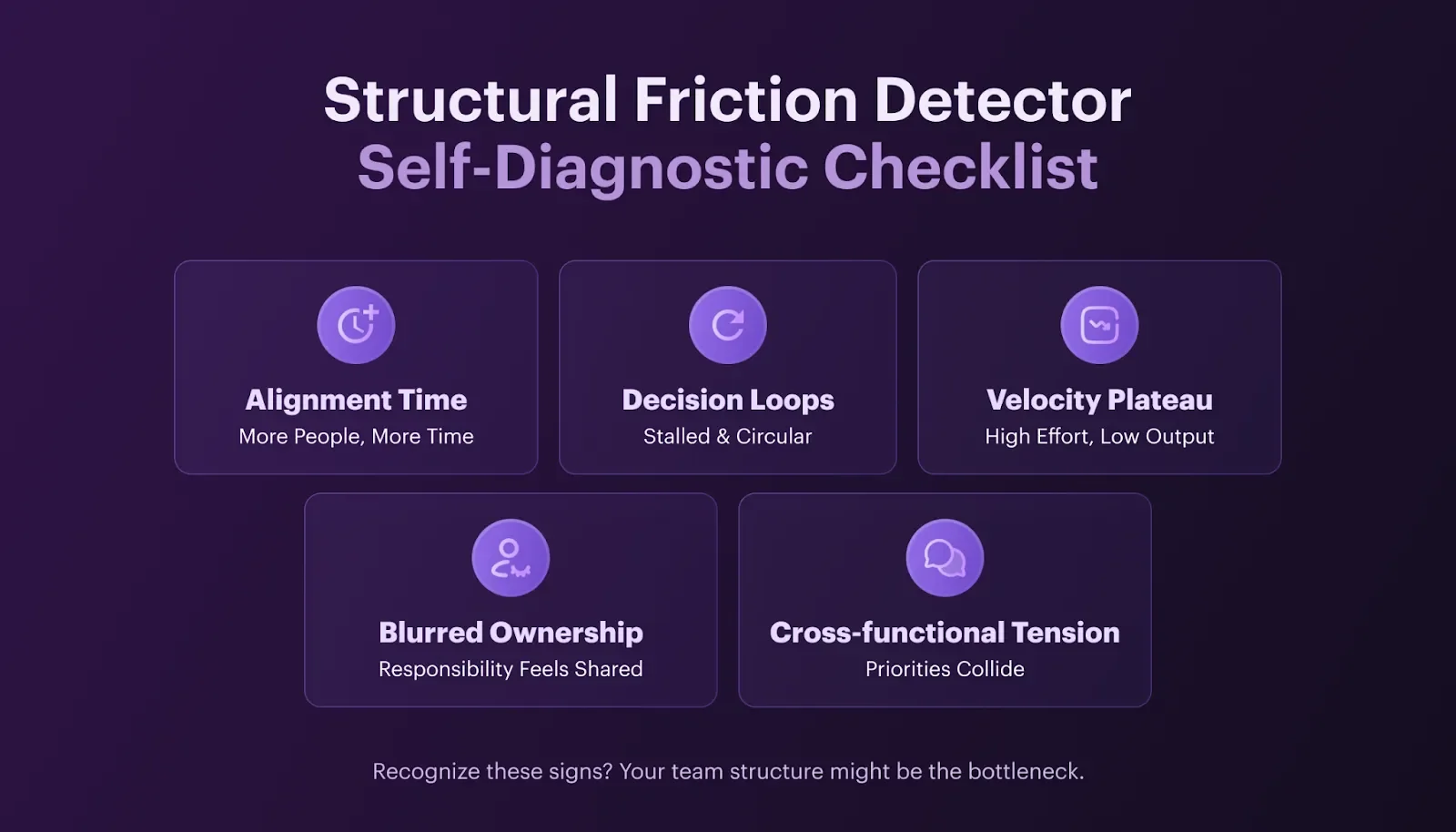
Early signals include:
- Alignment requires more people and more time than before
- Decisions slow down or loop as ownership spreads
- Responsibility feels shared, yet outcomes lack clear owners
- Teams stay active while progress across initiatives slows
- Tension increases between functions as priorities collide
These patterns point to outgrowing your team structure, even while delivery continues.
Why Structures That Worked Before Stop Working After Series A
Early teams rely on proximity. A small group shares context, decides quickly, and executes directly. Speed comes from alignment rather than process.
As organizations expand, coordination replaces execution as the primary constraint. More people work in parallel, scope increases, and external commitments rise. Informal alignment reaches its limits, revealing why a wrong team structure for Series A slows progress even with a capable team.
What changes as complexity grows:
- Coordination becomes the bottleneck
- Ownership spreads across teams and roles
- Decisions require explicit alignment
- Shared context fragments
How Team Structure Blocks Growth
As teams expand in size and scope, delivery follows coordination paths rather than intent. When organizational design remains unchanged, it becomes a limiting factor.
Common patterns surface together:
- Coordination paths multiply, slowing delivery
- Dependencies spread across teams and workstreams
- Accountability diffuses across roles
- Growth plans translate into delivery pressure rather than momentum
At this stage, outcomes follow structure beneath the work.
Common Structural Traps in Scaling Engineering Orgs
As organizations grow, recurring engineering org design problems emerge. These setups supported early momentum but stop aligning with the company’s operating reality.
Flat Structure Beyond 15–20 Developers
Flat setups work when everyone can see the whole picture. However, communication overhead grows quadratically. According to Metcalfe’s Law, a team of 5 has 10 potential conversation paths; a team of 20 has 190.
Beyond 20 developers, a flat structure forces engineers to spend up to 50% of their week on synchronization rather than deep work. Without clear domains, your "agile" team becomes a bottlenecked committee.
No Clear Domain or Product Ownership
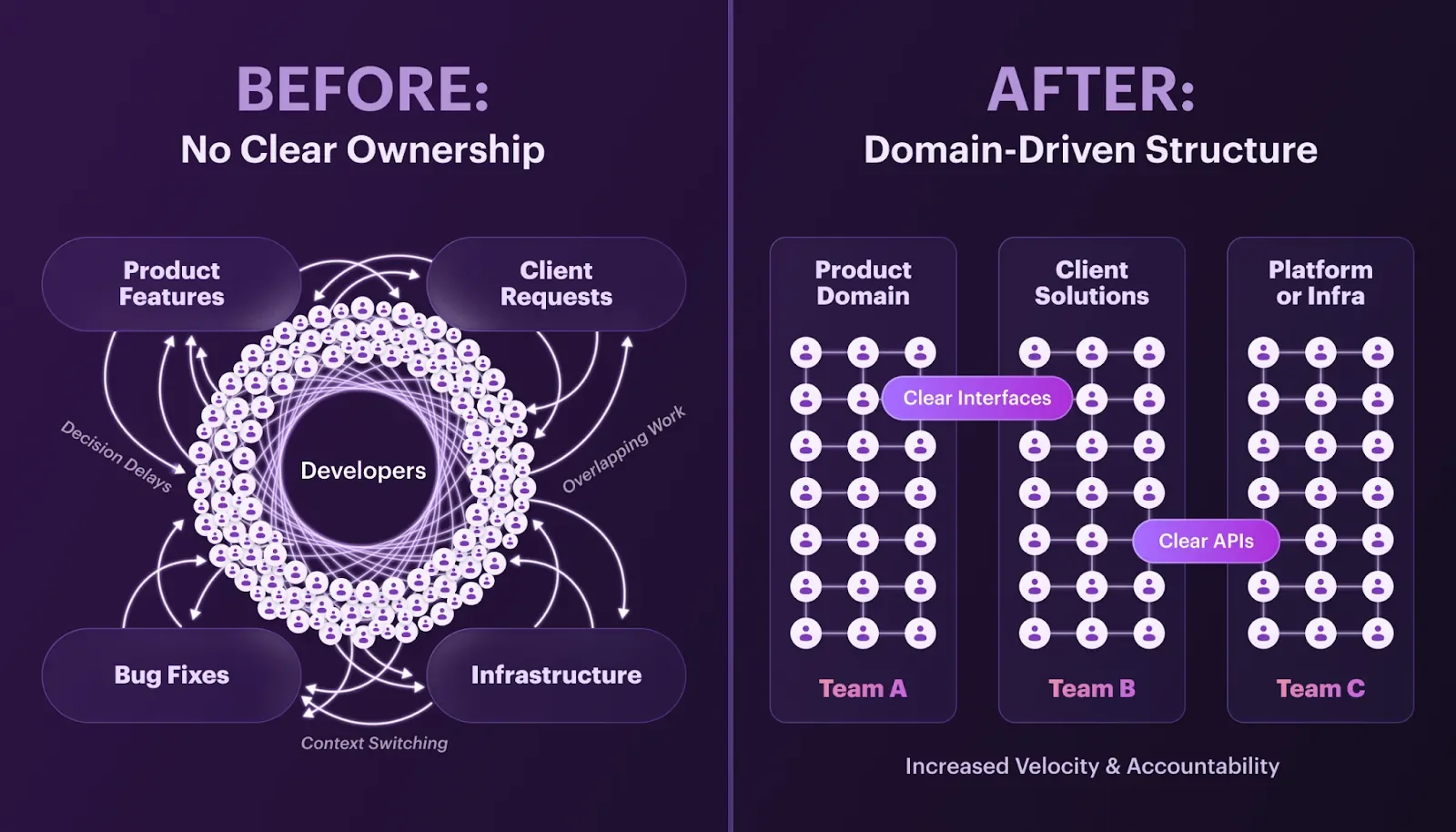
Without clear ownership, decisions slow and work overlaps.
- Multiple teams touch the same areas
- Decisions stall while ownership gets clarified
- Rework increases due to overlapping responsibility
These are classic startup team structure issues.
Engineering Managers Acting as Individual Contributors
When managers stay embedded in execution, coordination and ownership fail to expand. Throughput reflects leadership availability rather than team capacity, constraining a scaling engineering organization.
Over-Reliance on Hero Generalists
Relying on a few developers for context concentrates risk. Decisions queue around individuals, and delivery depends on availability instead of flow — another signal of team structure problems.
No Separation Between Product Work and Client Work
When product development and client work share capacity, priorities collide. Roadmaps slow, planning loses credibility, and urgency replaces strategy — an indicator of a weak team structure for scaling startups.
Cause–Effect Patterns in Engineering Org Design
Delivery outcomes increasingly follow organizational structure as complexity grows. The same org design decisions produce repeatable results, which explains why engineering team structure for growth becomes a limiting factor at scale.
The pattern is direct:
- Flat teams → coordination bottlenecks
- Ownership gaps → duplicated work and delayed decisions
- Missing architecture oversight → tech debt and fragile delivery
- Informal processes → misalignment and rising attrition
These effects compound. Predictability drops, coordination overhead rises, and progress depends more on alignment than execution.
Case Study: To resolve resource friction, we migrated a scaling SaaS platform to an optimized Webflow setup, separating marketing from core dev. This reclaimed 40+ engineering hours per month, increased site speed by 25%, and boosted conversions by 15%, allowing the dev team to focus 100% on the product roadmap.
Why Hiring More People Doesn’t Fix a Broken Structure
Hiring increases capacity and complexity at the same time. Each new hire expands coordination paths and dependencies faster than output.
As headcount grows:
- Dependencies rise ahead of delivery capacity
- Alignment replaces execution
- Delivery risk increases before structure adapts
This is where teams realize they can’t scale current engineering org through headcount alone. Structure defines throughput.
What Happens If You Ignore the Signals
When early warnings go unresolved, the organization begins outgrowing your team structure. The impact shifts from temporary friction to long-term constraints on delivery and growth.
- Delivery velocity plateaus or declines as coordination paths saturate and dependencies dominate execution.
- Planning turns political when teams negotiate priorities instead of executing against clear goals.
- Senior developers burn out or leave after absorbing ownership gaps, firefighting, and constant context switching.
- Growth momentum slows at a critical stage, right when execution confidence carries the most weight.
Case Study: This pattern often surfaces outside engineering as well. In one AI startup, delivery friction inside the team delayed critical go-to-market assets, including a marketing website and brand rollout, until responsibilities and decision ownership were clarified.
Is This a Common Phase for Series A Startups?
Yes. Many B2B SaaS teams reach this transition as complexity accelerates. What looks like delivery friction often reflects a wrong team structure for Series A rather than execution gaps.
At this stage, growth requires a different operating model: explicit ownership, clear interfaces, and coordination designed for scale.
Case Study: We rebuilt an AI startup’s digital identity to match its technical maturity for Series A. By implementing a scalable design system, we reduced content deployment time by 63% and drove a 3x increase in lead generation, providing the professional credibility required to secure their next funding round.
Final Thought
Series A turns delivery into a system shaped by structure, ownership, and coordination, where outcomes increasingly reflect organizational design rather than individual effort.
McKinsey’s 2025 research shows that performance constraints emerge when operating models fail to keep pace with rising complexity, making delivery the bottleneck.
If this feels familiar, take a look at your team structure and contact us to talk next steps.


FAQ
Scale changes the primary constraint. As headcount and scope grow, coordination becomes central to delivery. Informal alignment loses leverage with parallel work, and outcomes begin reflecting organizational design. This marks outgrowing your team structure.
Hiring increases capacity alongside coordination load. Dependencies and handoffs expand faster than throughput when structure remains unchanged. Many teams reach a point where growth highlights they can’t scale current engineering org through headcount alone.
Ownership clarity erodes first. Decision flow slows, responsibility spreads across roles, and outcomes move through negotiation. These startup team structure issues appear early, while teams stay active.
Redesign becomes relevant when growth repeatedly exceeds coordination limits, leads to delayed decisions, or blurs ownership. These signals point to a wrong team structure for Series A, where delivery follows structure rather than ambition.
Related articles


Nearshore Software Development: The In-Depth Guide 2025 | Darly Solutions

%2520is%2520Revolutionizing%2520the%2520Fintech.webp)
Connect with us
.webp)
We are a tech partner that delivers ingenious digital solutions, engineering and vertical services for industry leaders powered by vetted talents.

