
Why product development speed determines who wins in B2B SaaS



Imagine sealing a major enterprise deal only to lose it because your product couldn't iterate fast enough, while a nimble rival delivers custom features in weeks. In B2B SaaS, where sales cycles average 84 days, long evaluations and layered buying committees amplify every delay. Delays in product development speed B2B SaaS teams sustain aren't just setbacks; they're deal-breakers in a $1.43 trillion market surging 15.2% by 2026, per Gartner.
This article explores how development pace influences enterprise outcomes, why growth often slows delivery, and what allows teams to maintain speed as complexity increases.
Speed Is a Competitive Advantage in B2B SaaS
Enterprise buyers evaluate vendors through responsiveness as much as through feature depth. A clear development speed advantage allows companies to adapt to changing requirements during evaluation cycles and pilots. When feedback translates into releases within weeks, the signal extends beyond engineering capacity. It reflects organizational alignment.
For Series A startups, delivery pace often defines market positioning. In regulated sectors such as FinTech and HealthTech, where compliance layers and integrations increase complexity, execution speed influences deal progression and expansion timing. Velocity becomes a strategic capability embedded in processes, structure, and decision cadence.
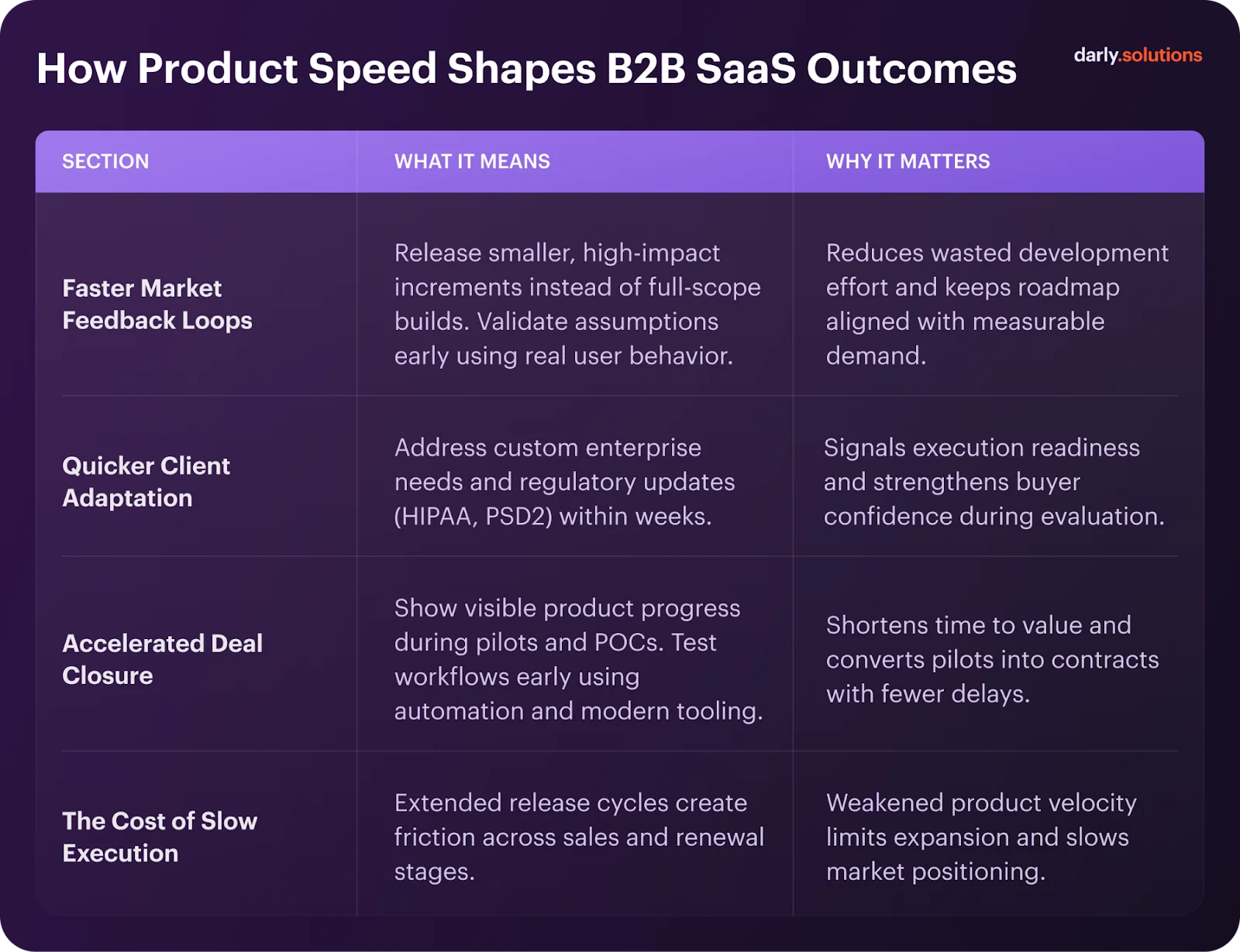
Faster Market Feedback Loops
Teams that maintain strong SaaS product velocity shorten the gap between assumption and proof. Instead of planning full-feature releases, they focus on high-impact increments that deliver most of the intended value with minimal scope. The logic resembles the 90/10 principle often discussed in early-stage product strategy: capture the majority of value with a small portion of effort, then expand based on evidence.
Early releases surface real usage patterns, integration constraints, and adoption friction while commercial conversations are still active. This reduces sunk development cost and keeps direction aligned with measurable behavior rather than internal forecasts.
Quicker Client Adaptation
In sectors like FinTech and HealthTech, quicker client adaptation means addressing custom needs and regulatory changes, such as evolving HIPAA requirements or PSD2 updates, within weeks. When compliance updates, data handling rules, or integration adjustments move quickly into production, buyers interpret this as execution capability rather than roadmap intention.
Organizations with strong speed to market B2B SaaS capabilities convert pilots into contracts with fewer stalled approvals and clearer internal alignment.
Accelerated Deal Closure
Velocity changes the dynamics of a deal. During a proof-of-concept, buyers assess more than functionality, they evaluate how the product evolves under real conditions. When updates appear while the pilot is still active, confidence increases across technical and commercial stakeholders.
Modern development environments, automation pipelines, and simulation tools allow teams to test workflows earlier and reduce iteration cycles before full rollout. This shortens validation phases and lowers implementation risk without expanding scope.
Stronger execution reduces time to market SaaS initiatives require to demonstrate value. Instead of prolonged evaluation loops, progress becomes visible, and visible progress moves contracts forward.
Momentum Loss for Slow Teams
Slow teams lose momentum gradually. Stagnant releases signal coordination friction and weaken confidence among buyers and investors. Delays compound across sales cycles, expansion conversations, and renewal decisions.
When execution slows, competitors gain space. Emerging players that maintain stronger product velocity in SaaS move faster during evaluations and capture attention while others remain in internal alignment loops.
Over time, reduced delivery pace limits growth potential and constrains market position.
How Slow Product Development Loses Deals
Mid-market B2B SaaS sales cycles often run 3-6 months. Enterprise deals extend to 9-18 months. During that time, buyers evaluate roadmap clarity, technical readiness, and delivery capability alongside product features. When SaaS product development speed slows, the impact surfaces directly inside active deals.
Sales teams commit to timelines. Prospects request adjustments during pilots. If updates stall, confidence declines. What begins as a minor delivery delay can shift internal perception from “reliable partner” to “execution risk.”
Slow iteration creates friction across the pipeline. Pilots stretch, approvals pause, and internal champions lose momentum. Over time, stalled deals increase customer acquisition cost and reduce predictable growth. In competitive evaluations, execution pace often weighs as heavily as feature depth.
Broken Promises
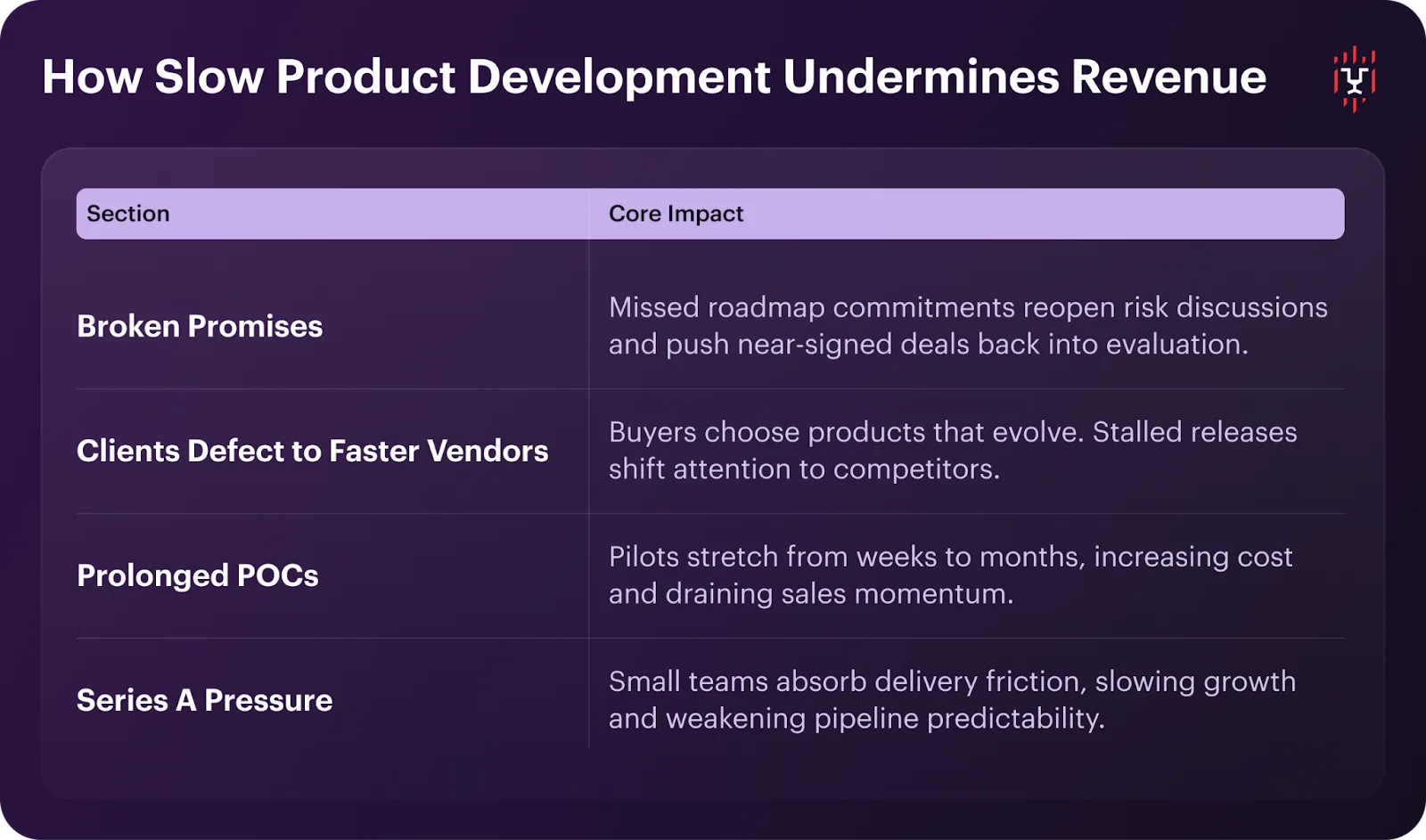
In complex B2B sales environments, 20-30% of qualified opportunities typically drop during extended evaluation cycles, often due to shifting timelines rather than product fit. When sales teams commit to roadmap updates and product execution speed fails to support those commitments, promised features slip by weeks or months. Internal stakeholders reopen risk discussions, technical reviews restart, and deals that were close to signature return to comparison mode (increasing customer acquisition cost and absorbing commercial effort without generating revenue).
Clients Defect to Agile Rivals
Buyers increasingly choose “living” products, solutions that evolve through frequent updates rather than sit unchanged for quarters. In fast-moving fields like AI and Deep Tech, responsiveness shapes vendor perception as much as feature depth. Companies prefer SaaS precisely because it evolves: new automation, AI-driven capabilities, and workflow improvements appear regularly without forcing disruptive migrations. When SaaS delivery speed slows, attention shifts. Clients compare alternatives that show visible progress, and stalled releases quietly translate into churn and lost expansion potential.
Prolonged POCs and Stalled Pipelines
In mid-market and enterprise, acquiring a single account typically costs between $10,000 and $30,000, often more when you factor in sales time, engineering support during the pilot, and legal rounds. When a POC stretches from six weeks to four months, those costs don't disappear, they compound.
ICP Tie-In: Series A Pressure
For teams that have raised $2-10M and converted their first paying customers, pressure comes from multiple directions at once. The board expects growth metrics ahead of the next round. Runway is finite. Senior engineers are still being hired or onboarded. In this environment, inconsistent delivery pace isn't just an operational problem — it's a risk signal for investors and buyers simultaneously.
At this stage, founders are typically still involved in technical decisions directly. That slows both product and sales. Technical debt accumulated during the pre-revenue phase now competes with roadmap priorities, but deferring it is no longer an option, because enterprise clients are starting to ask questions about security, integrations, and scalability. Without external structural support or a defined delivery system, these forces erode momentum faster than headcount grows.
Why Speed Declines as SaaS Companies Scale
Most slowdowns are structural. Research from McKinsey shows that 60-70% of scaling bottlenecks come from organizational friction rather than product issues. As teams grow, product development speed declines because coordination replaces direct decision-making.
Typical pressure points:
- More approval layers and shared ownership
- Expanding integrations and release dependencies
- Security and compliance reviews extending deployment cycles
- Technical debt limiting safe iteration
- Risk sensitivity increasing as the customer base grows
For Series A companies between $50K–$150K MRR, roadmap scope often expands faster than delivery capacity. Without mature CI/CD, clear ownership, and defined release boundaries, execution slows even as headcount increases.
Velocity Over Volume: Why Feature Count Isn't the Goal
Feature expansion often creates the illusion of progress. In practice, complexity slows delivery and reduces adoption. Industry research consistently shows that 60-80% of features in enterprise software are rarely used. At the same time, Gartner reports that products built around focused, iterative enhancements achieve materially higher adoption rates than feature-heavy alternatives.
More features introduce:
- Additional maintenance overhead
- Longer regression testing cycles
- Higher onboarding friction
- Slower release cadence
- Increased cognitive load for users
Enterprise buyers increasingly prefer “live” products — solutions that evolve through steady improvements rather than large, infrequent releases. What signals maturity is consistent product execution speed, not a growing feature list.
High-performing teams prioritize high-impact items and defer low-leverage additions. Velocity compounds through repeated value delivery. Feature volume dilutes attention and stretches resources.
How Consistent Speed Builds Unbreakable Customer Trust
Trust in B2B SaaS grows through observable execution. Industry benchmarks show that average annual retention in B2B SaaS is around 75%, while top-performing companies achieve net revenue retention above 120% by expanding existing accounts. These outcomes rarely come from feature volume alone. They come from consistent delivery that reinforces value over time.
Predictable SaaS delivery speed signals operational stability to enterprise buyers. When roadmap commitments translate into regular releases, confidence among stakeholders increases. When updates slow or slip, renewal conversations become harder.
For Series A teams, reliable execution becomes a lever for retention. Consistent progress strengthens long term relationships and supports the expansion of revenue instead of constant replacement of churned accounts.
Building Speed as a Sustainable System
Sustainable delivery emerges from structure, coordination, and disciplined execution. In competitive markets, product velocity determines SaaS success when speed becomes embedded in the operating model. Scalable organizations design delivery systems that increase release frequency while preserving stability.
Speed as a system rests on three foundations:
- Process discipline through CI/CD, automated testing, and predictable release cadence
- Structural clarity enabled by modular architecture and reduced cross-team dependencies
- Decision frameworks that align refactoring and prioritization with measurable outcomes
Teams that implement these foundations often move from monthly releases to weekly or even daily deployments as coordination friction decreases. Release cycles shorten, reliability improves, and planning becomes more predictable.
For Series A companies, embedding these practices early supports stable growth. Scalable infrastructure and clear ownership preserve delivery pace as enterprise demand and product complexity expand.
Speed or Sink in the B2B SaaS Arena
Delivery pace becomes visible long before it shows up in revenue reports. Buyers see it during procurement reviews, technical due diligence, and live pilots. Investors see it in the predictability of milestones between rounds.
For a company at Series A with paying customers already in place, this translates into a concrete question: can your team or a development partner you trust with part of the delivery, ship updates while the deal is still open? Does a client who just signed a contract see their first real output within weeks, not a quarter from now?
When delivery is embedded into the operating model, buyers observe consistent roadmap progress during active evaluations, feedback incorporated within the same quarter, clear ownership over release timelines, and steady movement from pilot to production. The opposite pattern is equally visible and it costs deals.
Final Thought
If sustaining delivery pace feels harder than it should, and you already have paying customers, active deals, and investors expecting results next quarter — this is a question of structure.
Teams that maintain development speed through this stage typically share one trait: a development partner who understands the codebase and the stage. Someone who can operate inside an existing product, build a transparent delivery process, and move in sync with your commercial cycle, alongside your internal team.
If you want to understand exactly where your delivery system is losing momentum, we run a structured review and return a concrete action plan with prioritized next steps.


FAQ
Enterprise buying cycles average around 84 days and typically include technical validation, security reviews, and integration assessments, which makes timing decisive during active evaluations; the product development speed B2B SaaS teams sustain determines whether requested adjustments, workflow refinements, or integration clarifications happen inside the decision window, and companies operating with agile delivery models demonstrate up to 30% higher revenue growth according to McKinsey because they adapt while opportunities remain open — a clear example of how speed to market in B2B SaaS shapes competitive outcomes.
When delivery momentum weakens, proof-of-concept phases extend, approval rounds multiply, and sales cycles stretch by 15-20%, while deal slippage can exceed 30% in complex enterprise pipelines; declining product development speed B2B SaaS environments increases customer acquisition cost and reduces win probability as buyers prioritize vendors who demonstrate consistent release cadence and execution clarity, underscoring how SaaS delivery speed directly influences pipeline conversion and commercial trust.
In structured enterprise environments, product development speed B2B SaaS organizations maintain strengthens quality through shorter feedback loops, faster iteration cycles, and controlled CI pipelines, and research from ProductPlan shows that 78% of product leaders prioritize time to market as a strategic lever because accelerated delivery improves responsiveness while preserving disciplined testing standards; sustained SaaS product velocity therefore enhances both reliability and strategic positioning.
As companies expand from early teams of 10–50 employees into cross-functional structures, the product development speed B2B SaaS systems rely on often erodes under growing dependencies, compliance layers, architectural debt, and approval complexity; McKinsey estimates that approximately 65% of scaling friction originates from organizational design gaps such as fragmented ownership, manual deployment processes, and unclear release authority rather than engineering capacity alone, illustrating how product velocity in SaaS ultimately depends on structural alignment across teams.
Related articles
A Step-by-Step Guide to Ensuring Optimal Time to Market for Medical Apps

.webp)

Connect with us
.webp)
We are a tech partner that delivers ingenious digital solutions, engineering and vertical services for industry leaders powered by vetted talents.

