
Technical Due Diligence: What Investors Can Learn About Your Startup From the Codebase



A strong founding team, large market opportunity, product-market fit, traction and growth metrics… Yes, investors will consider all of this before deciding whether they should take a chance on your startup.
But they will also look at your codebase. For one, technical due diligence is a standard practice for 70% of private equity firms.
What do investors look for in a startup’s technology? Let’s answer this question — and break down what your codebase tells them about your business.
Your Codebase Is Part of Your Investment Story
Startup technical due diligence doesn’t mean checking whether your code works. It’s the investors’ opportunity to see whether you have an investment-ready technology foundation.
That’s why investors go beyond validating the functionality. They use the codebase to assess:
- Hidden technical risks
- Scalability potential
- Future running and one-off engineering costs
- Development velocity
- Security and compliance exposure
- Alignment with the business plan
- Knowledge distribution to avoid overreliance on individual developers
What Can Investors Really Learn From a Codebase?
Yes, sometimes, investors discover that the code for most of the advertised functionality doesn’t exist yet. But that’s an extreme example. More often, deals fall through at the software due diligence stage because the codebase clues investors in to technical and organizational risks.
In our experience with software product discovery services, these are the five technical due diligence questions investors typically ask to uncover those risks.
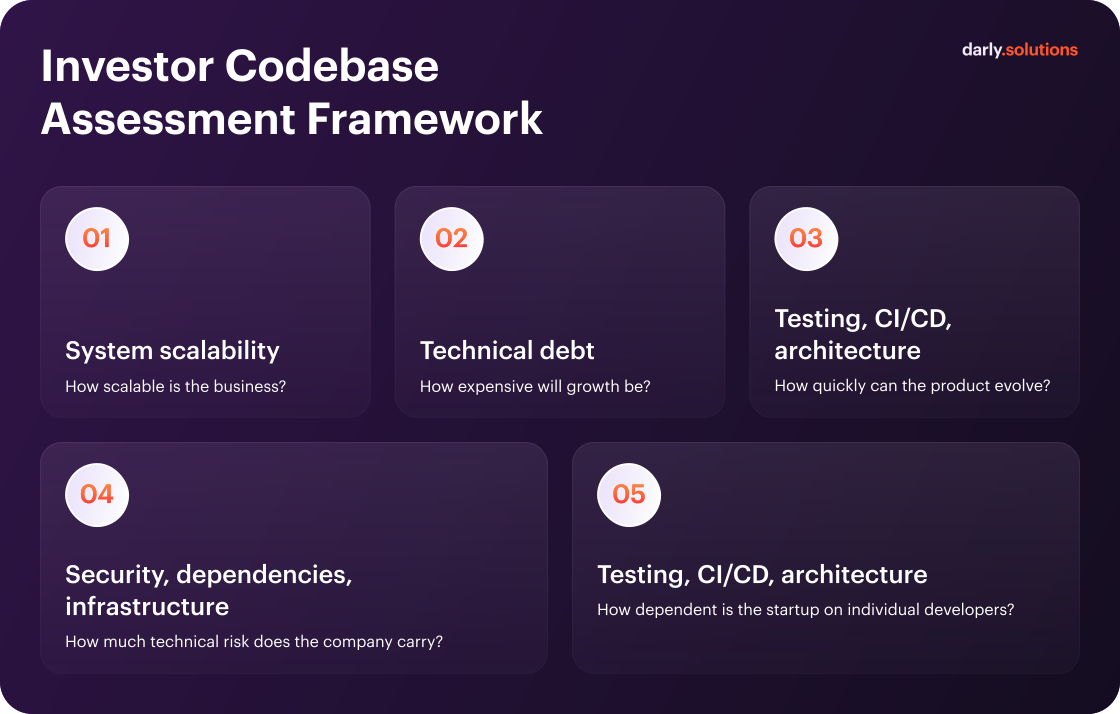
How Scalable Is the Business?
The codebase is more than just the variables and functions. It reflects your product’s architecture. That, in turn, tells investors a lot about its long-term scalability — and whether you’ll have to rewrite it sooner rather than later.
Key questions:
- Can the system handle 10x growth?
- Where are the bottlenecks?
- Is the database architecture scalable?
- Are there single points of failure?
How Expensive Will Future Growth Be?
Technical debt isn’t inherently evil. You have to take shortcuts to fix critical issues, put together an MVP on a budget, or roll out features faster than your competitors. But fixing it isn’t free. So, investors include it in the scope of technical due diligence.
Key questions:
- Is the debt intentional?
- Do you understand it and its trade-offs?
- Is it manageable long-term?
How Quickly Can the Product Evolve?
If your code is unnecessarily complex, changes take longer. If you rely mostly on manual testing or deployment, deployments take longer. If most of your code is undocumented at the time of SaaS technical due diligence, onboarding takes longer.
Key questions:
- Is the codebase modular?
- Is the code unnecessarily complex in some places?
- Can testing scale with the product?
- Is the deployment process automated?
- Is the code documented?
How Much Technical Risk Does the Company Carry?
When it comes to technical risks in startups, the codebase is where all the bodies are buried. An overlooked vulnerability may turn into a security incident. A tangled web of dependencies will make mundane changes riskier. The list goes on.
Key questions:
- What are the security and compliance risks?
- Do dependencies create integration or vendor lock-in risks?
- Does the infrastructure address downtime and security risks?
- Does it prevent integration bottlenecks?
How Dependent Is the Startup on Individual Developers?
As the product grows in complexity, no documentation can mean that only a handful of people understand how it works. Investors see it as an organizational risk: a single resignation can derail the roadmap because all the undocumented knowledge will leave with that person.
Key questions:
- Is critical product knowledge documented?
- How will departures impact knowledge retention?
8 Signals Investors Look for in Your Codebase
So, what makes a good startup codebase, one that’s ready for a technical due diligence? Here’s what investors look for in a codebase.
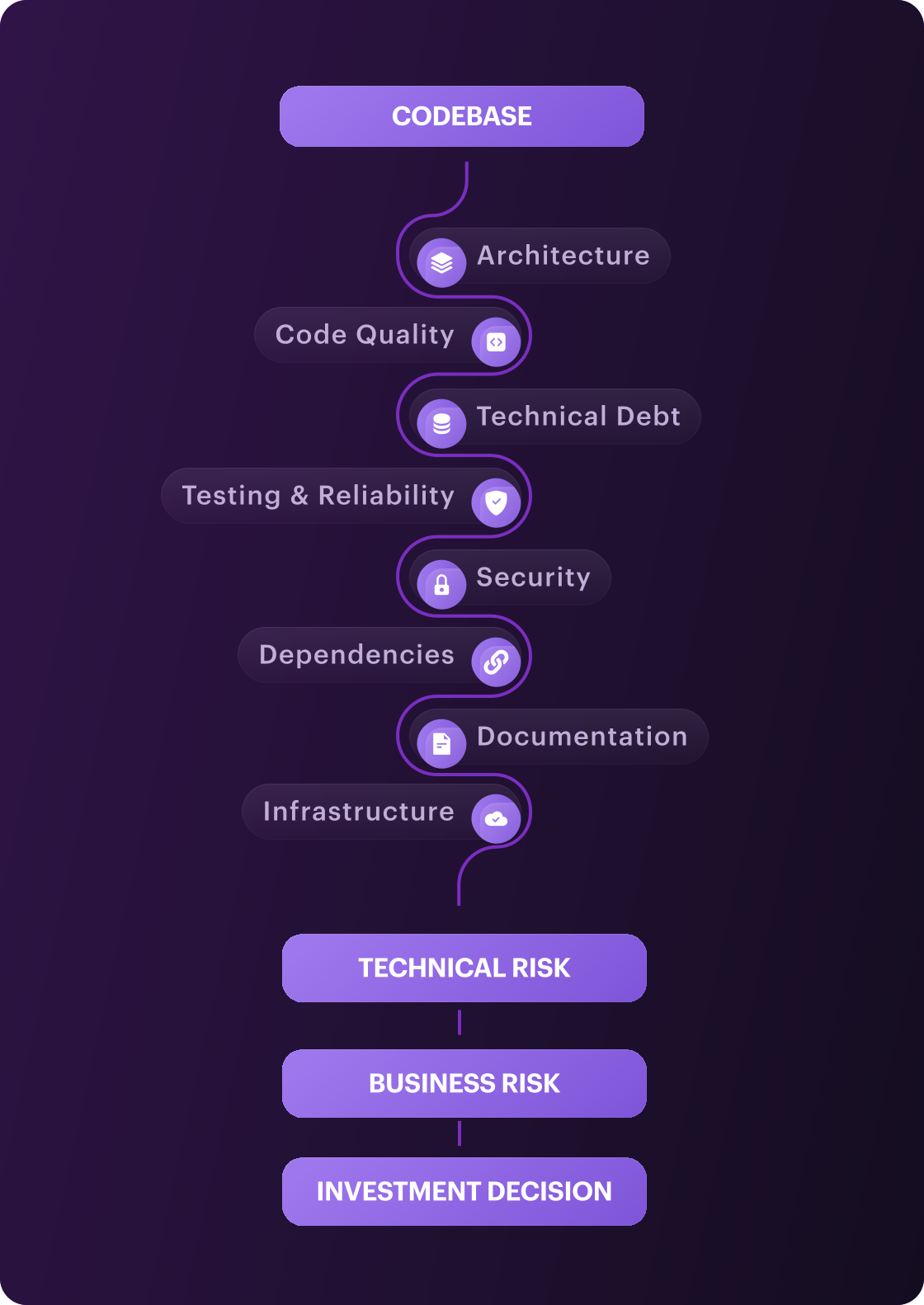
1. Architecture & Scalability
Can your product handle 10,000 or 100,000 users as well as a hundred? That’s what investors want to know. An ideal product has a scalable, modular architecture with statelessness, loose coupling, and async processing. Managed infrastructure also helps prevent scaling bottlenecks.
What investors look for:
- Scalable architecture with clear boundaries
- Good system observability
- Scalable database design with sharding, caching, horizontal/vertical scaling, etc.
- Addressed performance bottlenecks (CPU, memory, disk I/O, network)
- Scalable infrastructure (segmentation, scaling, governance, etc.)
2. Code Quality & Maintainability
Poor startup code quality creates high maintenance, change, and onboarding costs in the long run — and wastes up to 42% of developers’ time. Clean code that’s easy to read, consistent, and reusable sends a message: you’re in it for the long haul.
What investors look for:
- Readability
- Consistency
- Minimal complexity
- No duplicated code
- Modularity
3. Technical Debt
Yes, it’s impossible to have a codebase with zero technical debt and remain competitive in a fast-paced market. That’s why the mere existence of startup technical debt won’t make the deal fall through. During software technical due diligence, investors want to see that your technical debt is intentional, documented, and manageable instead.
What investors look for:
- Intentional over accidental debt
- Documented over unknown debt
- Manageable over structural debt
4. Testing & Reliability
Sparse test coverage, incomplete requirements, regression failures, manual-only processes, and outdated scripts are a sure recipe for defects sneaking into production. That’s why investors verify you have the right mix of automated and manual testing with comprehensive coverage.
What investors look for:
- Unit tests
- Integration tests
- End-to-end (E2E) testing
- Critical-path coverage
- Regression protection
5. Security
Exposed secrets and credentials, vulnerable dependencies, and authentication issues paint you as someone who doesn’t care about security and compliance. That’s why investors check the startup codebase for those — and verify you have vulnerability scanning and incident response procedures in place.
What investors look for:
- Data encrypted at rest and in transit
- Secure credentials
- No critical, unknown vulnerabilities
- Managed dependency risks
- Strong access controls (authentication, authorization, password policy)
6. Dependencies & Technology Choices
If you use technologies that will become outdated in a year or two (or are already unsupported), that’s a crimson red flag for investors. They also want to be reassured you’ve made technology stack choices with a clear rationale — and that they are viable in the long run.
What investors look for:
- Outdated dependencies
- Unsupported frameworks
- Vendor lock-in
- Unnecessary complexity
- Technology longevity
7. Documentation & Knowledge Distribution
You can’t effectively scale the engineering team without a well-documented codebase. Besides, if key team members leave, that knowledge will be lost. That’s why investors check documentation and knowledge management during the technical due diligence process.
What investors look for:
- Architecture documentation
- README
- API documentation
- Onboarding
- Knowledge silos
8. CI/CD & Infrastructure
If your release cycles slow down to a snail’s pace at deployment, you won’t be able to iterate fast. That’s why investors are looking for standardized, automated deployment processes — complete with infrastructure monitoring and incident response to prevent downtime, of course.
What investors look for:
- Deployment automation
- Environment separation
- Monitoring
- Rollback procedures
- Disaster recovery
What Red Flags Can Make Investors Nervous?
Several things in a technical due diligence report can make investors stop in their tracks and go, “Oh, that does not look good.” In our experience, these 10 startup codebase red flags are the most likely to cool down investor interest.
Red Flag #1: “It Works, But Nobody Knows Why”
How it manifests: They see no documentation, no comments in the code — or sparse one-liners that say, “Don’t delete this line or everything will break.”
Why it’s a red flag: Debugging and maintenance become a nightmare, and the worst kind of technical debt — unintentional and undocumented — grows exponentially.
Red Flag #2: Critical Business Logic in One Place
How it manifests: The entire application runs on a single instance, database, or server.
Why it’s a red flag: A single hardware or regression failure brings all critical functionality down. Scaling and disaster recovery become hard to implement.
Red Flag #3: Zero or Minimal Testing
How it manifests: Testing stops at the individual debugging level. Or, tests check only a few key points (e.g., payment flows are tested for successful transactions, but not for expired cards).
Why it’s a red flag: It’s a well-established fact that fixing a defect in production can be six times more expensive than in testing.
Red Flag #4: Production Credentials in the Repository
How it manifests: API keys, database passwords, or private keys are committed as .env files, hardcoded in the configuration files, or mentioned in the comments.
Why it’s a red flag: It shows that you don’t understand that embedding production credentials goes against compliance frameworks and security best practices.
Red Flag #5: Outdated Dependencies With Known Vulnerabilities
How it manifests: The code runs on technologies that are no longer supported by their creators and have documented security vulnerabilities (e.g., Node.js 14 and below, React 16 and below).
Why it’s a red flag: It’s a sign you’re not investing in maintenance. Plus, outdated dependencies create security risks and compatibility issues.
Red Flag #6: Architecture That Can’t Handle Growth
How it manifests: Your product is built on a monolithic architecture, with single points of failure, inefficient database queries, and no caching or async job queues.
Why it’s a red flag: Scalability isn’t something you can bolt on when you need it. You’ll have to rebuild your database, architecture, and/or data layers — and that’s an extra expense.
Red Flag #7: One Developer Knows Everything
How it manifests: One person authors all PRs and answers all codebase-related questions.
Why it’s a red flag: The “expert” becomes a single point of failure, stalling incident response, code reviews, and delivery.
Red Flag #8: Years of Unmanaged Technical Debt
How it manifests: You don’t track technical debt anywhere. Technical debt work isn’t part of the roadmap, either.
Why it’s a red flag: During technical due diligence for investors, unmanaged technical debt shows you’re blind to the trade-offs of your own technical decisions.
Red Flag #9: No Clear Technical Roadmap
How it manifests: The startup has only the product roadmap. Or, the technical roadmap exists — but no one looked at it since it was created.
Why it’s a red flag: This shows a lack of strategic thinking on the technology front — and casts doubt on whether you can connect technical decisions to business outcomes.
Red Flag #10: AI-Generated Code Nobody Fully Understands
How it manifests: No one on the team can explain why this component was built this way or how different parts of the system work together.
Why it’s a red flag: This comprehension debt can slow down incident response and code changes — and serves as evidence of irresponsible use of AI during technical due diligence for SaaS.
What AI-Generated Code Can Tell Investors About Your Startup
A 2026 Google report estimates that 41% of new code is now AI-generated, and that’s changing how investors evaluate startup technology. AI-generated code reviews are now part of technical due diligence best practices, and technical reviewers start asking questions like:
- How much of the startup codebase was generated by AI?
- Did developers review AI output, and if so, how?
- Are there any hallucinations in the code (e.g., in the APIs or packages)?
- Who owns the generated code? Is there clear ownership to begin with?
- Does AI-generated code create inconsistencies, duplicated logic, or vulnerabilities?
- Is AI-generated code sufficiently covered by tests?
Let’s be clear: the fact that your product is built using AI-generated code doesn’t automatically mean it’ll fail startup technical due diligence. But what if you added it without review and can’t explain or maintain it? That’s a huge red flag because it means that:
- You don’t understand — or don’t care about — the security and compliance risks (45% of AI-generated code carries one of the OWASP Top 10 vulnerabilities)
- You won’t be able to maintain and evolve it long-term without disrupting business
So, if your product is built with AI, consider preparing your codebase for review with a thorough product audit for fast-built apps.
How Technical Debt Affects Startup Valuation
Technical debt makes investments riskier — and creates extra costs after you seal the deal. Here’s how code quality affects startup valuation:
- Technical debt makes changes more and more complicated, reducing engineering velocity.
- More engineering effort required means slower releases and innovation.
- Slower roadmap progress can impact growth and undermine the competitive advantage.
- Speeding up releases by increasing the headcount entails higher engineering costs. Addressing technical debt, in turn, delays revenue and ROI.
Be warned: reviewers won’t just take stock of your technical debt. They’ll translate it into concrete costs for the investor. Instead of “significant refactoring needed,” it’ll be “$2.3 million in remediation costs over 18 months to reach target scalability.”
The result? Unaddressed technical debt can:
- Increase your estimated engineering budget
- Reduce your valuation through reduced growth multiples or increased perceived risk
- Change investment terms (e.g., equity stake, funding amount)
- Extend funding timeline or tie it to technical debt work milestones
- Postpone or stop acquisition negotiations during M&A technical due diligence
What a Strong Codebase Tells Investors
If your code isn’t perfect, it’s not a death sentence. Perfection isn’t what investors look for in a startup. In reality, they want to see:
- A clear, well-documented architecture
- Sound technology choices — with documentation
- Reliable testing and QA
- Automated deployment pipelines
- Documented, intentional, manageable technical debt
- Adherence to security best practices
- Documented technical knowledge
- An up-to-date technical roadmap
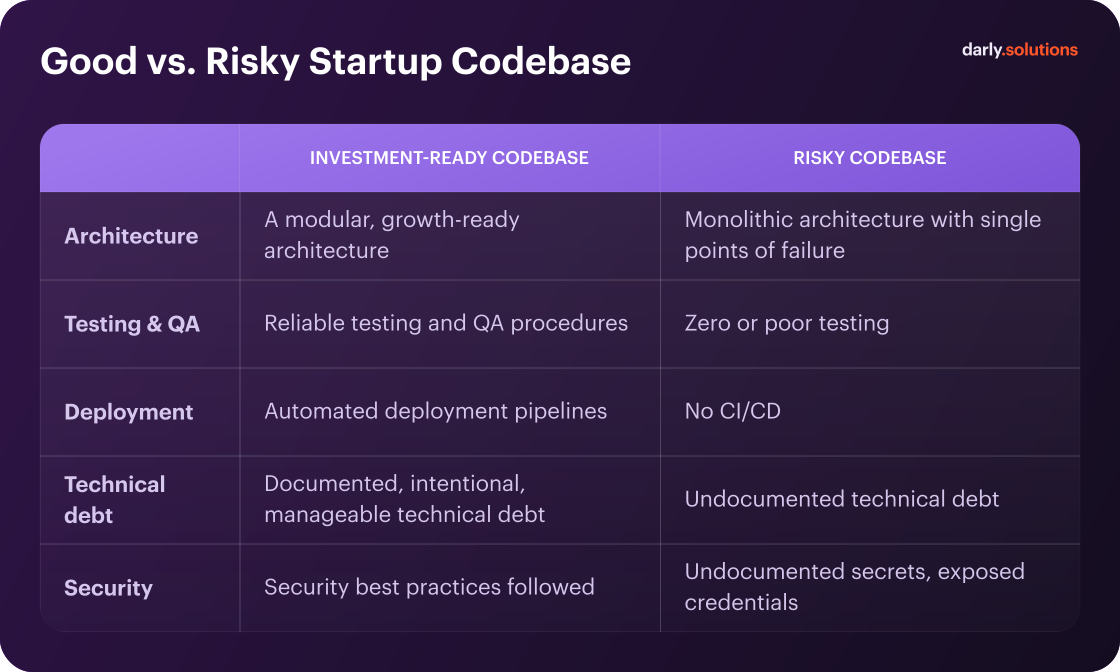
A strong codebase tells investors that you understand the trade-offs of your technical decisions, factor in future growth when making them, and have a strategic mindset.
What Investors Don’t Expect From an Early-Stage Startup
Startups have to move fast and innovate — and do so without burning through cash too fast. Investors know it. That’s why they don’t go into startup technology evaluation expecting to see:
- Enterprise-level architecture
- 100% test coverage (60% to 80% is usually fine for a startup)
- Massive, sophisticated infrastructure
- Perfect documentation
- Microservices used at every step
Instead, they expect to see a team that opted for the most suitable engineering solution at a given stage — and that sees a credible path to scale.
How to Prepare Your Codebase Before Fundraising
Don’t throw your hat in the race before preparing your codebase for the review. Don’t know where to start? Here’s your high-level technical due diligence checklist.
1. Identify critical technical risks
Audit your codebase, infrastructure, database, and documentation. Perform an AI-generated code review if you used AI tools to build the product. Take stock of risks. Identify:
- Which ones have to be solved before the deal
- Which ones will have to be addressed soon after the deal
- Which ones can be addressed as part of the roadmap
2. Fix deal-breaking issues first
Get rid of common deal-breakers like:
- No version control
- Hardcoded credentials
- Zero automated testing
- No CI/CD pipeline at all
- Outdated dependencies with public vulnerabilities
Consider hiring software development services if you don’t have the capacity to balance these tasks with roadmap items.
3. Document known technical debt
First, use issue trackers like Jira to document and keep track of debt items. Then, dedicate a share of every sprint (e.g., 15%) to addressing them.
4. Validate scalability
Make sure:
- You’ve performed load testing
- It supports horizontal scaling
- Your database can scale
- You monitor performance
- You understand cost scaling
5. Review security
Perform a security audit; pay attention to:
- Authentication and authorization controls
- Data encryption at rest and in transit
- Input validation
- Secrets management
- Compliance
Make sure you have an incident response plan, comprehensive audit logging, and regular security testing in place.
6. Check dependencies
Inventory all external services and libraries and track dependencies in one place. Replace outdated ones; create fallback plans for critical dependencies.
7. Document architecture
If you don’t have system and database architecture diagrams, create them. If you do, verify they’re up to date and have the right level of detail.
8. Prepare your technical roadmap
Create or review your technical roadmap; make sure it contains:
- Themes and initiatives
- Objectives and success metrics
- Dependencies
- Resource allocation
- Timeline
How to Perform a Pre-Investment Codebase Audit
Want to prepare for technical due diligence? You have three options to choose from.
DIY Review
The benefit: You don’t need to hire a technical due diligence consultant. You already know where the bodies are buried, too.
The trade-off: Your internal reviewer might have blind spots since they don’t necessarily know how investors evaluate a startup codebase. They may not be able to remain impartial, too.
When to choose: You have a senior engineer who can stay objective — and you need basic visibility.
Independent Startup Technical Audit
The benefit: You get a fresh perspective and an objective, more thorough technical code audit.
The trade-off: It’s not free; in fact, it’s the most expensive option on the list. It also takes more time than the other approaches.
When to choose: You don’t know what exactly will count as a deal-breaker and what investors will deem acceptable. Plus, you want an impartial evaluation.
Note: If your product is AI-powered, partner with an experienced AI development services vendor for a review.
Automated Code Analysis
The benefit: It’s not as expensive as an external audit and can reveal key issues in a matter of minutes.
The trade-off: Automated tools don’t have the human intuition or expertise in technical due diligence for startups. So, they don’t always pick up on certain issues.
When to choose: You need a quick security, quality, and dependency check to pinpoint main issues. For a more thorough audit, combine the automated analysis findings with an experienced engineering review.
What Should a Pre-Investment Startup Codebase Audit Report Include?
A pre-investment audit should look at your product from every angle. That’s why, when we prepare the report for our clients, we include our findings across:
- Executive summary with key findings (critical technical risks, etc.)
- Architecture assessment
- Code quality and technical debt
- Security
- Scalability
- Infrastructure
- Dependencies
- Testing maturity
- Key-person risks
- AI-generated code risks
- Risk severity classification
- Pre-deal remediation roadmap with effort estimates
In Closing: Your Codebase Is a Signal of Business Risk
So, what do investors look for in a startup’s technology? Don’t fret: the answer isn’t “perfect code.” The real answer is “hidden liabilities.”
Not sure what liabilities investors might see in your codebase? Head into investment talks with peace of mind with Darly Solutions’ technical due diligence consulting. We’ll audit your product from A to Z, identify potential deal-breakers, and remove them before you show investors your code.


FAQ
Investors perform technical due diligence to understand whether your product can scale and catch hidden business risks. They typically turn to external technical due diligence for investors services to review the codebase.
Yes. Shortcuts are often visible in the codebase itself — but they’re not always a deal-breaker.
It depends on the kind of technical debt we’re talking about. If it’s not manageable in the long run (and/or you don’t even know it’s there), it can bring down your valuation. If you show technical debt discipline, it can have no impact on the valuation.
Not on its own. Properly reviewed and validated AI-generated code is fine. Unreviewed AI output that contains hallucinations and that no one understands will be a deal-breaker, though.
You can use automated tools to catch obvious issues or turn to an experienced engineer for a more thorough audit.
Hardcoded secrets, zero automated testing, outdated dependencies, and unmanageable technical debt are likely to throw a wrench into the works.
No. Startups have to ship fast to succeed, and perfection requires too much time. Investors know it.
A messy codebase doesn’t always make investors run, but it can lower your valuation or change investment terms.
Absolutely. Some deal-breakers are relatively easy to fix before heading into investment talks, and a code audit will reveal them. For others, the code audit will help you prepare a remediation plan.
Related articles


Why Healthcare App Time to Market Matters: The Risks of Delays in Medical App Launch


Connect with us
.webp)
We are a tech partner that delivers ingenious digital solutions, engineering and vertical services for industry leaders powered by vetted talents.

