
AI Development for Startups: What Actually Matters & How to Approach It



Yes, AI-native startups grow twice as fast as startups overall. Yes, AI pulled about half of U.S. venture funding in Q4 2025. But as lucrative as AI may seem, building a successful product takes more than uttering, “Let’s build an AI assistant for call center agents.”
For the record, the days of AI wrappers stirring genuine investor attention are over, too.
To succeed, your product has to solve a real problem — and that’s easier said than done. You have to ensure AI is actually a must, decide on the right technology and/or model, properly evaluate model quality, and keep a grip on inference costs.
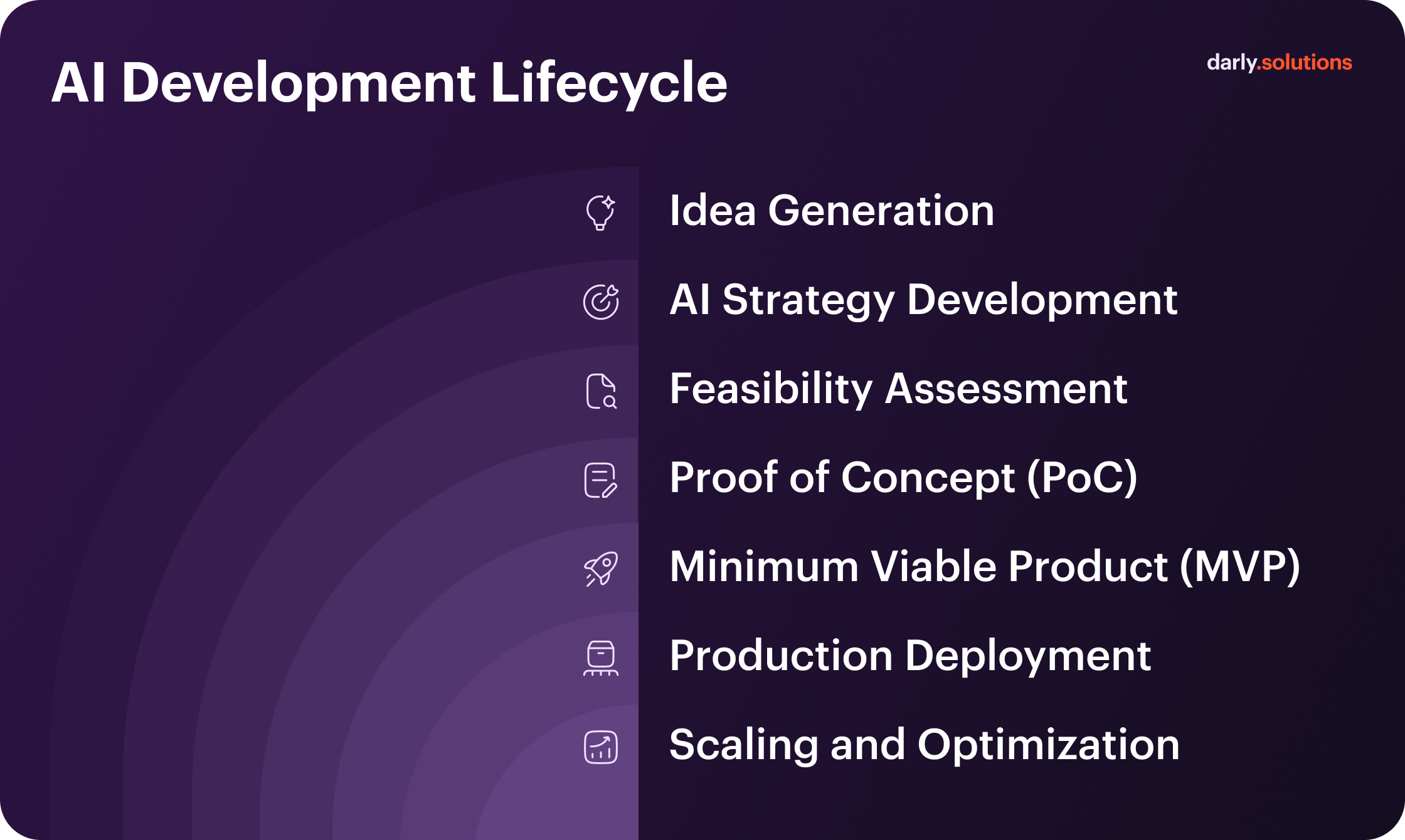
In this guide, we’ll break down every decision you have to make across the five main stages of AI startup development: idea, validation, MVP, production, and scaling.
What Are AI Development Services for Startups?
AI development services can involve anything from readiness assessment and product discovery to data engineering and RAG application development. But here’s what it’s not: it’s not adding an OpenAI or Anthropic API to the code and calling it a day.
Of course, every vendor has its own range of AI development services for startups. It can include:
- AI strategy for startups
- AI consulting and readiness assessment
- AI proof of concept and MVP development
- Generative AI/LLM/RAG development
- AI agent development
- Machine learning development
- AI automation
- Data engineering
- AIOps and MLOps
- Model monitoring and optimization
Why Startups Need a Different AI Development Approach
Not every vendor can be a reliable AI development company for startups — even if its AI expertise is strong. That’s because startup needs aren’t the same as enterprise needs.
Limited Runway
Enterprises can afford to invest in a pilot that eventually gets abandoned. Startups can’t. They have to make every decision count — and minimize inference costs during scaling.
Unvalidated Product Assumptions
Running out of capital may be the leading reason startups fail, but poor product-market fit is a close second. So, before jumping into building an AI capability, startups need to make sure users actually need it.
Small Engineering Teams
Large enterprises can afford to hire ML engineers, data scientists, and MLOps specialists. Startups have to keep their engineering teams lean.
Rapidly Changing AI Technology
Since 2022, OpenAI alone has released 16 versions of ChatGPT. APIs and pricing are prone to quick change, too. Startups need to keep up with all those changes — and adapt to them on the fly.
AI Is Probabilistic
Under the hood, any AI model is a giant probability calculator. That means you can’t verify its effectiveness with traditional pass/fail tests.
Consider Your Stage Before Picking AI Development Services
Which services you’ll need will depend on the stage. For example, pre-MVP, look into AI consulting for startups and AI PoC development — not MLOps.
Here’s your decision-maker guide to AI services:
What Kind of AI Solution Will You Build?
Building a RAG-enabled enterprise search won’t require the same set of skills as implementing predictive analytics or computer vision. Here’s your starter guide to the seven common types of AI solutions for startups.
AI Assistants and Copilots
AI assistants like ChatGPT, Siri, and Alexa generate output based on prompts, whether they’re typed in or spoken. AI copilots, in turn, suggest actions or offer contextual help to speed up specialized workflows.
AI Agents
AI agents carry out specific multi-step tasks to achieve the goal set by the user — all on their own. To that end, AI agents can reason, access data, use tools, and execute actions.
RAG and AI-Powered Search
AI-powered search goes beyond keyword matching and parses the user’s intent and context to identify relevant results. RAG enables the LLM to rely on proprietary data from live sources (e.g., in documents, knowledge bases, customer records).
Document Processing
AI document processing uses OCR, NLP, and machine learning to automatically extract data, classify documents (invoices, contracts, forms, reports), and make them searchable.
Predictive AI
Predictive analytics discerns patterns in data to forecast events, behaviors, or outcomes. For example, it can be used to forecast demand, churn, or fraud risk.
Recommendation and Personalization
Recommendation and personalization engines analyze data to understand users and define the most relevant financial product suggestions, upselling opportunities, or media content.
Computer Vision
Computer vision turns images or video footage into insights machines can use. It can recognize and classify images, detect and track objects, and automate visual inspections. That makes it valuable in manufacturing, healthcare, and security.
How to Decide If Your Startup Actually Needs AI
Not every product needs AI to solve the crux of the problem for its users. That’s why we strongly advise you to slow down and make sure AI is actually the right technology for your product.
Green Flags
AI is a strong fit if:
- The solution hinges on analyzing unstructured data.
- Pattern recognition is a must.
- Workflows can’t be automated with simple if-then rules.
- Personalization or forecasting are part of the product’s UVP.
- Manual work increases linearly together with the user count.
- Using AI will create a measurable competitive advantage.
Red Flags
Consider other technologies if:
- You can solve the users’ problem with simple business rules.
- You want to add AI because other companies have.
- You don’t have much usable data for the AI model.
- It’ll be impossible to evaluate the model output.
- AI will add more complexity but not much value.
AI Development Process for Startups
Not sure how to go from the idea to a live product when AI is involved? Here’s your step-by-step playbook.
Step 1. Define the Business Problem
What’s the problem you’re trying to solve? That’s the question any startup founder has to ask themselves before kicking off the AI development process.
To define the problem, zero in on a single business metric your AI product will improve. “Cut support resolution time in half” is good problem framing. “Add AI to customer service” is not.
Problems ripe for AI solutions usually meet three criteria: they’re repetitive, judgment-heavy, and data-rich.
Step 2. Assess Data and Technical Feasibility
Any AI solution is data-hungry. But what matters is quality, not quantity: data quality issues are guaranteed to lead to unreliable output. Quality data means it’s accurate, complete, consistent, relevant, and timely. Make sure you can legally use this data, too.
Gathering and preparing data can take longer than building the system itself. You need to inventory data, identify gaps, assess quality, and clean relevant assets.
Apart from data, evaluate technical feasibility for AI products across:
- Privacy and other regulations
- Integrations required
- Infrastructure
- Model requirements
Step 3. Build a Proof of Concept
Yes, proof of concept (PoC) development isn’t always a must. That said, it’s the way to test your idea’s technical feasibility before committing. A PoC can also help validate that:
- AI offers an actual advantage over non-AI alternatives
- Available data is suitable for the use case
- The model shows acceptable performance
A good PoC focuses on a single metric and problem/workflow. After it’s built, you get a clear go, revise, or no-go recommendation for your idea.
Step 4. Build the AI MVP
Think of an MVP as the bare-bones version of your product that puts its core value front and center. Its purpose is simple: launch as fast as possible to test product-market fit, viability, usability, cost, and output quality under real-world conditions.
To build an AI MVP, define the functionality your product can’t make do without. Think about it this way: if your product loses all value without this feature, it’s a must-have.
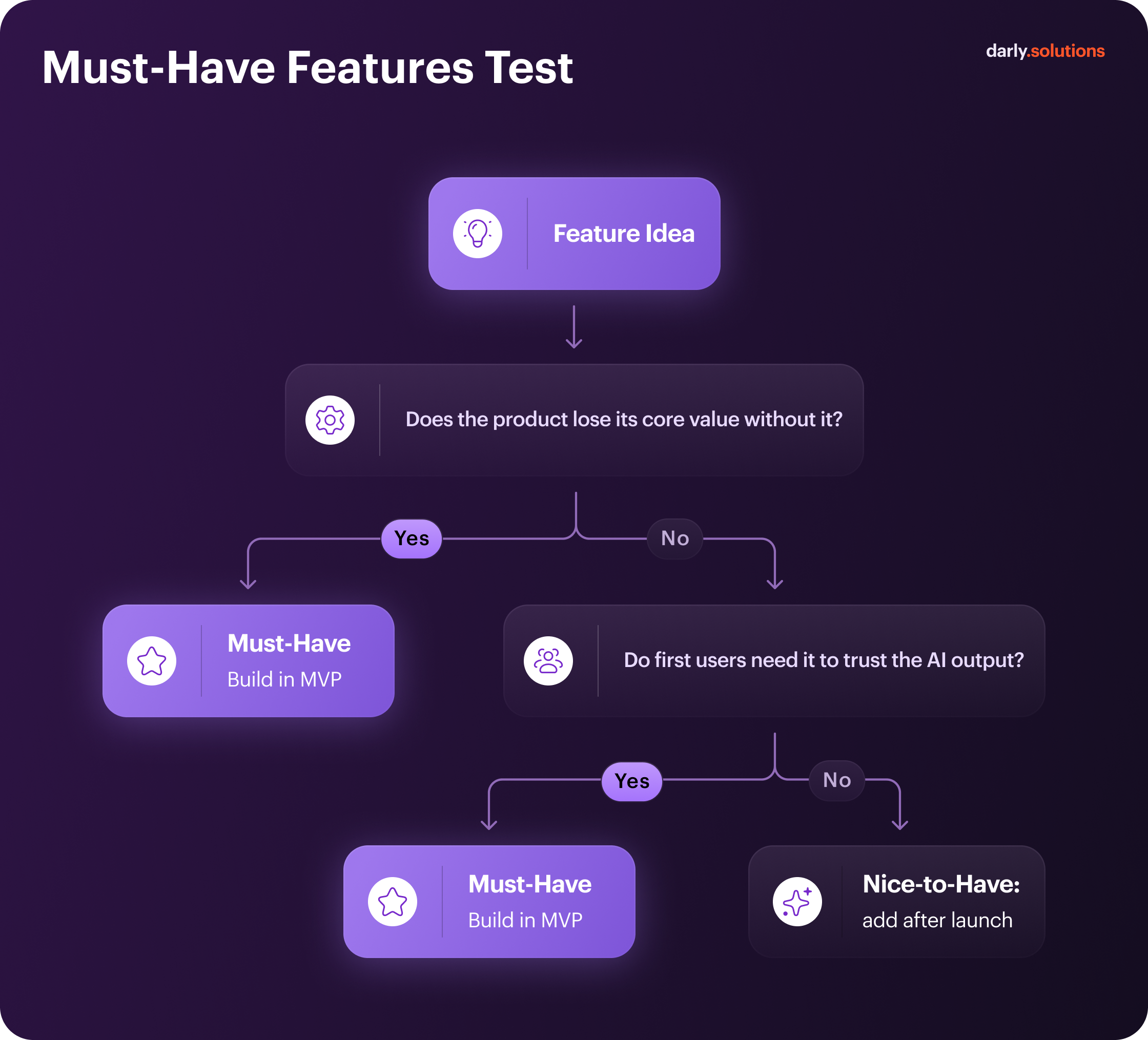
Note: If you hire AI MVP development services, your partner can help you prioritize features.
Overall, AI MVP development involves:
- Gathering and preparing data
- Choosing the tech stack
- Defining benchmarks and preparing an evaluation set
- Designing the architecture
- Creating or selecting the simplest working model
- Adapting it to your use cases (e.g., via RAG or fine-tuning)
Step 5. Evaluate AI Performance
This step involves running the model on a dataset that resembles real-world inputs. You’ll have to compare the output against your benchmarks like:
- Quality thresholds
- Accuracy rate
- Hallucination rate
- Latency
- Human escalation rate
- Cost per request
Step 6. Integrate AI Into the Product
Once the AI system passes all tests, it’s ready to be connected with:
- Frontend and backend
- Databases
- Third-party APIs
- Analytics tools
- Authentication tools
- Cloud infrastructure
Integration is more than connecting two endpoints via an API. It has to ensure AI functions as intended within real system constraints (e.g., latency limits, fallbacks).
Important: Design the UI/UX around AI. Otherwise, users will get frustrated if they don’t understand when or how AI is involved.
Step 7. Productionize and Monitor
You can move into production once your whole system is ready to provide repeatable, consistent outcomes. Don’t productionize unless you have:
- Clear success criteria
- Stable data flows
- Error handling
- Logging
- Access control
- Cost monitoring and controls
- Evaluation pipelines
- Fallback plan for failures
With traditional software, you can focus on user feedback, engagement, uptime, and bug tracking post-launch. With AI products, you have to do all that and monitor the model itself to catch drift, failures, or slips in performance.
Production monitoring involves:
- Observability monitoring
- Consistent logging
- Security monitoring and incident detection
- Real-time cost monitoring per model/provider/customer/request/task
- Prompt versioning for LLMs
- Failure modes and fallback/rollback mechanisms in place
Step 8. Scale What Works
Start with a small customer segment to understand what works and what doesn’t. Don’t go with your gut — look at what data says about adoption, engagement, and churn.
Once you see tangible proof your AI product resonates with customers, you’re ready to commit to scaling. Further AI product development can involve:
- Optimizing models to improve performance and reduce costs
- Improving infrastructure to handle more users, requests, or AI capabilities
- Introducing custom models
- Adding AI agents
- Fine-tuning a pretrained model to adapt it to narrower contexts/use cases
Build vs. Buy vs. Partner: When to Choose Which?
Not every AI product has to start with a custom model. In fact, it might make more sense to start with an API integration or a pretrained model.
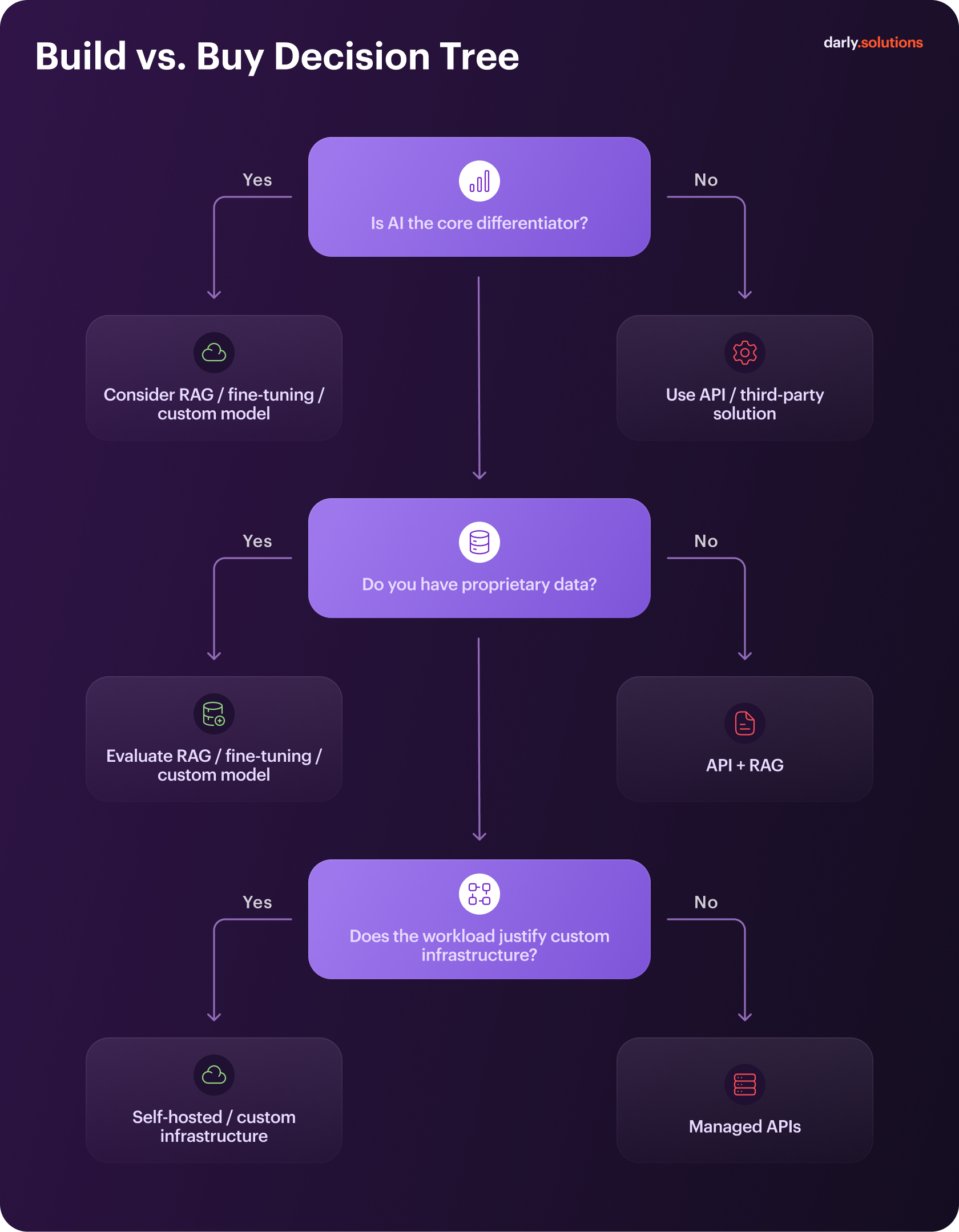
AI API Integration
The principle is simple: take a live AI model like OpenAI’s ChatGPT or Anthropic’s Claude and hook it up to your product via an API.
Choose if:
- Speed matters the most.
- Your use case is fairly standard.
- You haven’t proven the product-market fit yet.
- The AI capability isn't the moat.
RAG
In this case, you take an off-the-shelf model, connect it via API, and build a RAG layer on top of it. RAG will direct the model to use proprietary knowledge as the ground truth.
Choose if:
- Proprietary knowledge is at the heart of your product’s value.
- AI needs access to rapidly changing data from other systems.
- Fine-tuning would be too complicated or too expensive.
Fine-Tuning
Fine-tuning means you take a pretrained model and “teach” it a new capability by training it on a specific dataset.
Choose if:
- Consistent behavior or formatting is important.
- The task is highly specialized.
- Prompt engineering would consume too many tokens.
- You have enough quality training data.
Custom AI/ML Development
As far as approaches go, this one is the most time-consuming and resource-intensive. Custom AI development isn’t exactly cheap, but in exchange you get a model that’s completely yours.
Choose if:
- Off-the-shelf AI tools and pretrained models don’t meet your requirements.
- The proprietary algorithm is the moat.
- You have enough data for training a brand-new model.
- The estimated ROI justifies the investment.
AI Development Services
No matter which of the four approaches above you choose, you don’t have to handle the project in-house from A to Z. Instead, you can turn to an AI development partner.
Choose if:
- You lack AI expertise internally.
- You need to move quickly.
- Hiring a full AI team is a premature investment.
- You need expertise in AI, data engineering, and architecture.
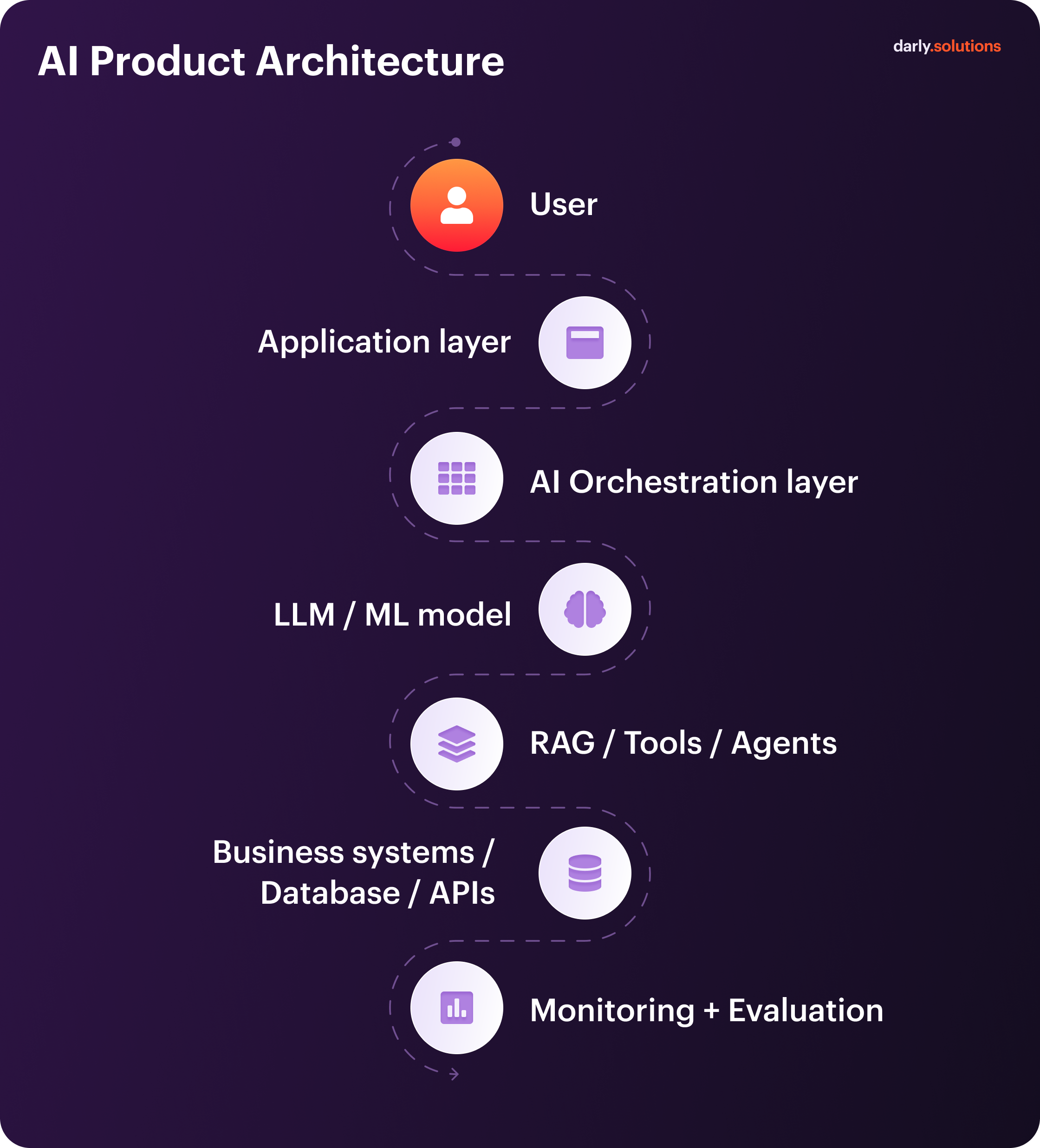
AI Startup Tech Stack: 7 Building Blocks to Know
A good AI startup technology stack is lean and simple. Don’t go for the biggest names without a good reason. Pick technologies that let you both quickly validate the product and migrate to a more stable stack when the time comes.
Foundation Models
Unless you decide to start with a custom AI/ML model right off the bat, you’ll have to rely on an already-trained, multi-purpose model. You can use closed-API models (OpenAI, Anthropic), open-weight models (Llama), or open-source ones (Qwen, Mistral).
Application Layer
This is what the users will be interacting with: your mobile app, website, etc. Besides frontend technologies (React, Angular, Vue.js), you’ll also need to pick the right backend frameworks (Node.js, Express) and APIs for third-party integrations.
AI/ML Frameworks
Consider AI/ML frameworks if you decide to build a custom model or fine-tune a pretrained one. Python is king here (PyTorch, TensorFlow, Scikit-learn), although some frameworks run on C++, Java, R, C#, or Scala.
Retrieval
Unless you opt for vectorless RAG, you’ll have to store information as embeddings in vector databases. RAG pipelines require tools for ingestion (document processing, chunking, embedding, vector database) and retrieval (query understanding, reranking, hybrid search).
Orchestration
This layer is the conductor that routes queries, supplies relevant context, and constructs prompts. You can use LangChain or LlamaIndex to build repeatable workflows and control data flows.
Infrastructure
AI has to live in the cloud, and AWS, Azure, and Google Cloud dominate this market. Containers (Kubernetes, Docker) and serverless computing are two popular ways to reduce costs for cloud-hosted applications.
Observability
How will you be keeping track of your model’s performance? This is the tool stack that should answer this question for you. Make sure to include logging, evaluation, monitoring, and cost tracking tools in the stack.
How Much Will AI Development Cost You?
You’ll find plenty of guides that answer this question with ranges. The problem is, they are, at best, ballpark estimates or educated guesses. At worst, they’re pulled out of thin air and have no leg to stand on.
Cost Drivers to Factor In
Project complexity, required services, and vendor pricing all impact the AI development cost for startups. Project complexity is a multi-dimensional factor that hinges on:
- Data preparation needed
- AI/ML model approach
- Integration requirements
- UI/UX complexity
- RAG layer or AI agent requirements (if applicable)
- Security, compliance, and evaluation requirements
- Infrastructure requirements
- Expected traffic and inference volume
How Development Stages Impact Costs
It may come as no surprise, but the PoC cost won’t match the AI MVP cost. The same rings true for AI MVP development cost structure compared to production and scaling costs.
Each development stage has its place in the roadmap because it reduces a specific type of risk. Discovery will make sure you have the right data and validate unit economics. AI MVP development verifies there's actual demand for your product.
Ultimately, the duration and complexity of discovery and PoC development can impact your total costs more than MVP development or scaling.
How Fast Can You Build an AI Product?
In a similar vein, the AI development timeline varies from project to project. As a rule of thumb, a PoC is the fastest to build. An MVP will take more time — but not as much as a full-fledged, production-ready AI solution.
Note: Yes, you can speed up development with AI coding tools, but fast-built apps can break in production or during scaling. You’d have to invest in product audit and remediation in that case. You can go this route if time is of the essence — but only if you’re willing to accept the trade-offs.
7 Factors that Will Affect Your Timeline
Your project’s timeline can hinge on:
- Data readiness
- AI model approach and complexity
- Integrations required
- UI/UX complexity
- Evaluation and compliance requirements
- Number of workflows
- Team size
8 Questions to Ask to Pick the Right AI Development Company
The AI application development vendor you pick can make or break the product. Literally. So, make sure to assess them across these eight dimensions.
1. Startup Experience
What to ask: Have you shipped AI products for startups?
We’ve already covered why startup product development isn’t the same as enterprise AI development. So, start with the vendor’s experience with startups in your industry and market — and at your current stage.
2. Relevant Technical Experience
What to ask: Do you have experience with technologies we need?
To ask this question, you’ll need to know which technologies your product will require, at least in broad strokes. Those can include:
- LLMs
- RAG
- AI agents
- ML algorithms
- Computer vision
- Cloud infrastructure
3. Product Engineering Experience
What to ask: What is your experience with product engineering (frontend, backend, security, cloud, APIs, etc.)?
AI development services don’t start and stop with AI model development and integration. Your partner should also know the ins and outs of building an AI product, including:
- UI/UX design
- Frontend and backend development
- APIs and integrations
- Cloud infrastructure
- Security and compliance
- Analytics and monitoring
4. AI Evaluation Methodology
What to ask: How do you decide whether the model is working as it’s supposed to?
Choosing the right metrics and testing the model is one way to evaluate the model’s performance. But what about red teaming? Bias and fairness testing? Deployment readiness?
5. Cost Control
What to ask: How can you help us track and optimize costs in the long run?
Effective cost management starts with model/API selection, architectural and infrastructure decisions, and only then cost visibility tools. Make sure the vendor can help you scale while keeping inference costs under control.
6. IP and Data Ownership
What to ask: Who will own code, data, prompts, models, documentation, and infrastructure?
All artifacts created by your vendor for you should be your IP. Ensure the contract reflects that — and that you get full-access credentials. Otherwise, switching development vendors can turn into a nightmare.
7. Post-Launch Support
What to ask: Can you help us monitor, update, and optimize the AI system post-rollout?
If you don’t have the expertise for post-launch caretaking in-house, you’ll need your vendor to do it. Make sure they’re ready to monitor, evaluate, optimize, and update your AI capabilities — and the product as a whole.
8. Ability to Scale
What to ask: Can you build an MVP that will scale into production and growth?
Poorly thought-out MVP architecture can force you to resort to a rewrite down the road. Verify that the vendor can design the architecture that supports future growth — and will let you switch vendors or technologies when needed.
10 Common AI Development Mistakes to Avoid
An estimated 92% of AI and tech startups fail, either due to operational challenges (54%) or lack of market need (38%). These mistakes will increase your risk of joining them.
Building AI Before Validating the Problem
Is the problem you’ve picked actually a problem for your target audience? Make sure you’re targeting a real pain point — and that AI is the right technology to eliminate it.
Treating a ChatGPT Wrapper as a Product
Why would users come to you if they could just open ChatGPT directly? If you don’t have a good answer, you don’t have a real product idea.
Fine-Tuning Too Early
Think of fine-tuning as a last-resort solution. Most products can start with prompt engineering and/or a RAG layer.
Building a Custom Model When an API Is Enough
Yes, some startups have to start with a custom model, but they’re the exception rather than the rule. Most capabilities can be implemented via APIs, which is usually easier and less expensive.
Ignoring AI Evaluation
Without evaluation, you’ll have no idea whether your model is actually bringing value or whether it fails silently. You also can’t make informed decisions about the roadmap without its results.
Underestimating Inference Costs
Every action your AI model takes generates inference costs. So, they can grow exponentially if you don’t take cost control seriously from the very start.
Ignoring Data Quality
Even the smartest AI model can’t give you accurate answers if it has only bad data to rely on. So, don’t skip data discovery, engineering, preparation, and validation.
Building an Overcomplicated MVP
No, complex solutions aren’t inherently better. They’re not guaranteed to produce better results. In reality, more moving parts amp up the risk of something going wrong.
Locking the Product to One AI Provider
Yes, this one vendor can genuinely be your best option today. But what if they hike up API costs tomorrow? You’ll have to pay if you can’t switch vendors easily.
Treating Security and Privacy as Post-Launch Problems
Investors pay attention to security and privacy. So do users and regulators. Playing fast and loose with these two aspects of AI software development for startups can cost you the trust of both.
How to Build AI Products Without Burning Through Your Runway
Just having a revolutionary idea isn’t enough. Your success will hinge on how you implement it — and how you manage costs.
Start with Existing Models
Building a brand-new model is expensive. Fine-tuning a pretrained one isn’t cheap, either. Don’t choose either of the options without a good reason.
Validate Before Optimizing
Once your MVP hits the market, you might be tempted to start optimizing your infrastructure. Don’t. Instead, focus on validating the product-market fit — and invest in infrastructure after you’ve done it.
Build Modular Architecture
At some point, you will outgrow your initial stack. Make sure you’re ready for that. Your architecture should support switching out models, providers, frameworks, and vector database frameworks as painlessly and fast as possible.
Track AI Unit Economics
Cloud bills won’t tell you whether that spend was worth it. Unit economics will. So, keep an eye on the cost per user, request, workflow, and/or transaction in real time.
Prioritize High-Value Workflows
No matter how technically impressive your AI feature is, if it doesn’t offer real value to users, they won’t pay for it. So, before you build your MVP, identify the workflows where AI could make the biggest difference.
Keep Humans in the Loop Where Necessary
AI shouldn’t make high-stakes decisions all on its own. So, design workflows with human approval and oversight in mind — especially if your product is destined for finance, healthcare, security, or legal.
AI Development by Startup Stage
To recap, here’s your big-picture outline for AI-powered product development:
AI Capabilities for Different Startup Types
Not sure which AI capabilities could be the most valuable for your startup? Here’s what’s trending across six types of startups.
What Will AI Development for Startups Look Like in the Future?
In 2022, OpenAI had no major rivals. In 2026, you need both hands to count them all.
Likewise, four years ago, launching a ChatGPT wrapper or using it as a foundation model would’ve made you innovative. Today, it’s hardly impressive, and foundation models are becoming largely interchangeable.
So, having an AI model powering this or that feature won’t be enough to help you stand out. Real differentiation lies in your product’s design, proprietary data, integrations, and workflows.
That’s why capabilities like agentic workflows, AI personalization, and smaller specialized models are increasingly drawing investors’ attention. Multimodal AI, AI SaaS, and AI-powered development are also reshaping what AI startups build — and how they operate.


FAQ
An AI development company can help startups validate the idea, build the PoC or MVP, launch and iterate the product, and monitor and maintain the production system.
Every MVP is different. How much it'll cost will depend on its complexity, the vendor you pick, and the model approach you go for.
AI PoCs and MVPs are faster to build than full-fledged products, but the actual timeline will depend on your team, product complexity, and discovery needed.
It depends. APIs can help you quickly prove the product-market fit or add AI for fairly standard use cases. Go for a custom model only if existing models don’t meet your requirements.
No. At the outset, you’ll need one (in-house or not) only if you’re building a custom model or doing deep statistical work on proprietary data.
Use RAG if you need the model to “know” new facts or get real-time, up-to-date information from external sources. Fine-tuning is useful only if you need to “teach” the model new behaviors or skills.
It depends. If AI agents are the moat and are genuinely the best solution for the users’ problem, use them on one narrow, repeatable workflow. If simpler alternatives exist, prioritize them.
Optimize the system to reduce token usage, cache common prompts and responses, and keep track of costs in real time. Consider model routing, too.
The source code is your IP. As for the AI model, it depends. If you built one from scratch, it’s yours. If you used a pretrained or foundation model, check its license.
Hiring an AI development company is usually more cost-effective for startups with limited resources—and it helps them go to market faster.
Test the AI feature on realistic, representative inputs to verify the output quality passes the predefined thresholds. Also check failure modes, bias and accuracy risks, inference costs, and privacy and security compliance.
Related articles


Connect with us

We are a tech partner that delivers ingenious digital solutions, engineering and vertical services for industry leaders powered by vetted talents.

