


.svg)

Project overview
Managing shared finances across a business team has always been unnecessarily complicated. Whether it is a startup splitting operational expenses across co-founders, a marketing team pooling budget for campaigns, or a distributed company managing petty cash across time zones, the existing solutions force businesses to route everything through a single account owner, creating bottlenecks, approval delays, and a lack of visibility for everyone involved.
A US-based fintech startup set out to solve this with a B2B payment platform built around a concept they called group wallets: shared, permission-based crypto and fiat wallets that multiple team members can contribute to, spend from, and monitor in real time. Each wallet comes with configurable spend limits, role-based approvals, and a full transaction audit trail, giving business teams the financial autonomy of individual accounts with the controls of a corporate treasury.
Beyond group wallets, the platform needed to function as a complete business payment solution: multi-currency fiat accounts, custodial and non-custodial crypto wallet support, integration with major CRM tools for financial workflow automation, Stripe-powered payment processing, and an AI layer to surface spending insights and flag anomalies without requiring a finance team to interpret the data manually.
By the time the founders reached out to Darly Solutions, the project was already underway and already in trouble.
Client’s Review
Services


.webp)
Challenges
When the client first came to us, the platform had been in development for several months with a previous team. Progress had been slow, the codebase was inconsistent, and the deadline for launching before a key investor demo had already slipped twice. The client needed a team that could absorb an incomplete project quickly, assess what was salvageable, and move without losing more time.
Our first task was an honest technical audit. What we found was a mixed picture: some frontend work was directionally sound but needed significant refactoring; the backend architecture had structural issues that would have caused scaling problems under real load; and the crypto wallet integration had not been started in any meaningful way. We presented our findings transparently, scoped the remediation work, and agreed on a revised delivery plan with the client before writing a single new line of code.
The group wallet feature, the startup's core differentiator, presented unique engineering challenges that had no off-the-shelf solution. Designing a permission model flexible enough to handle varied team structures, while ensuring that multi-party transactions remained atomic, auditable, and reversible under partial approval scenarios, required careful data modeling and a custom approval engine built from scratch.
Compliance added another layer of complexity. A platform handling both fiat and crypto transactions for business entities in the United States is subject to overlapping regulatory requirements: FinCEN registration, KYB (Know Your Business) verification for onboarding, AML transaction screening, and IRS 1099 reporting obligations. Every product decision had to be evaluated against these constraints, and the compliance layer had to be built into the architecture rather than retrofitted at the end.
Running web and native mobile development in parallel while maintaining feature parity across platforms without doubling the engineering effort required disciplined API design and close coordination between our frontend, mobile, and backend teams throughout the entire project.
Strategic business needs
01 Recover the project from a previous vendor and restore confidence with investors and stakeholders
02 Deliver a functional, demo-ready build within 10 weeks of engagement start
03 Ship the full platform to App Store and Google Play within 7 months
04 Differentiate from incumbents through a genuinely novel group wallet feature with enterprise-grade controls
05 Build a compliance-ready architecture that supports US regulatory requirements from day one
06 Design for scalability to 50,000+ active business accounts without re-platforming
Technical requirements
01 Conduct a full audit of the existing codebase and deliver a remediation and delivery plan within two weeks
02 Build a custom group wallet engine supporting role-based permissions, spend limits, and multi-party transaction approvals
03 Implement ACH, wire transfer, and card payment processing with sub-3-second transaction confirmation UX
04 Connect HubSpot for automated financial event logging and CRM workflow triggers
05 Deliver AI-powered spend analytics and real-time anomaly detection without exposing raw financial data to third-party models
06 Enforce KYB/KYC onboarding via Persona with automated approval workflows for straightforward cases
07 Achieve full feature parity between the web platform and iOS/Android applications
08 Pass App Store and Google Play review on first submission
Stuck with a stalled build and a looming deadline?
We’ll audit your existing code, refactor what’s salvageable, and ship a demo-ready product in 10 weeks to restore investor confidence and meet your launch goals.

.avif) Talk to an expert
Talk to an expertSolutions
Rather than starting over entirely, we made the strategic decision to preserve and refactor what worked from the previous build, eliminating wasted time while resolving the structural issues that would have blocked progress. From that foundation, we delivered the platform in parallel workstreams: backend, web frontend, and mobile, coordinated through two-week sprints with the client's founders attending every sprint review.
Technical audit and project rescue
Our engagement began with a structured two-week audit covering the existing frontend, backend, and infrastructure. We categorized everything into three buckets: retain as-is, refactor, or replace. The audit report gave the client a clear picture of where the previous build had gone wrong and an honest assessment of the new timeline, which we met.
Retaining salvageable work, roughly 30% of the frontend, reduced the recovery timeline significantly. The backend was re-architected around NestJS modules with clear domain boundaries, making the codebase easier to extend as new features were added. This audit-first approach set the tone for the entire engagement: no surprises, full transparency.
Group wallet engine
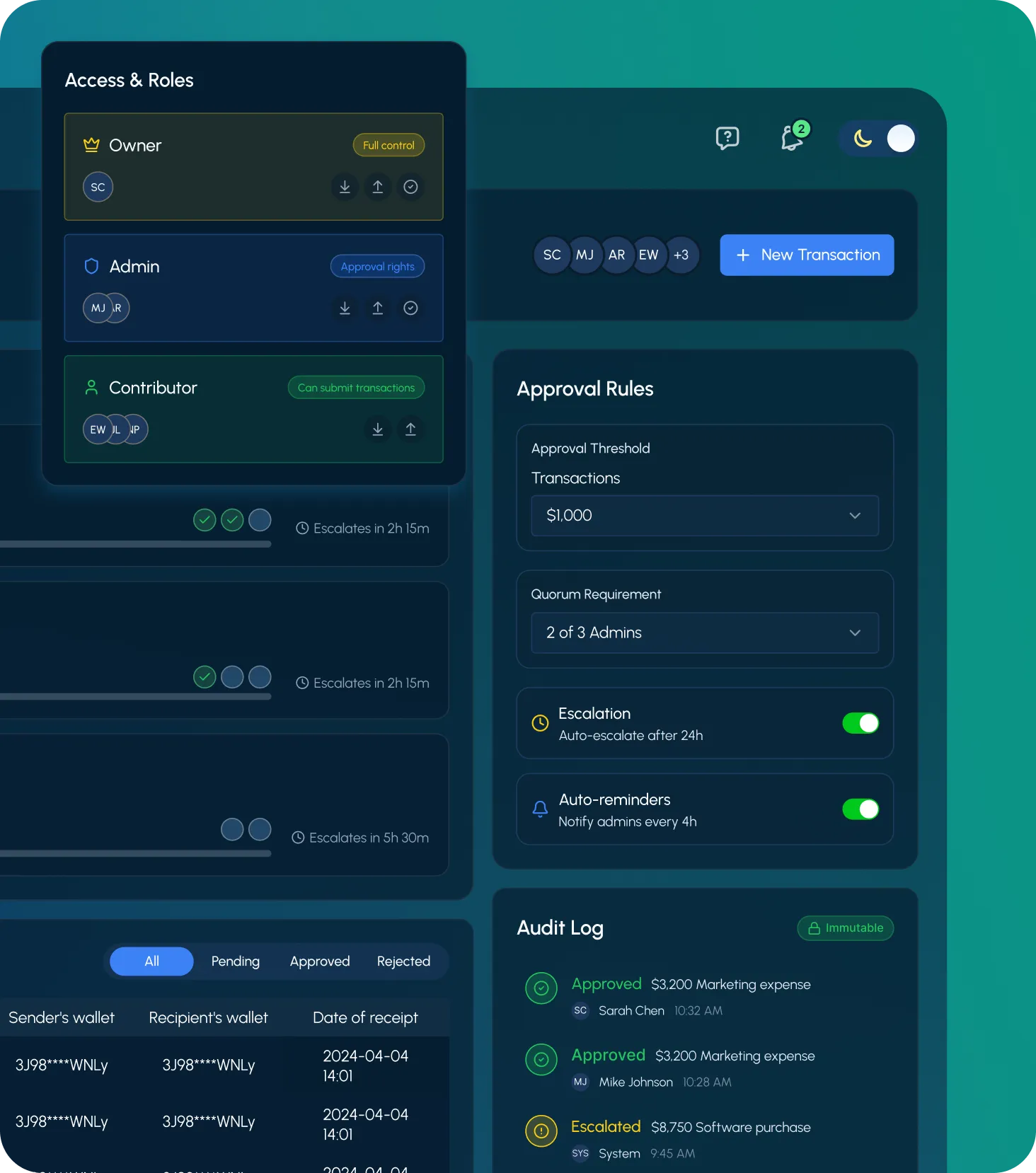
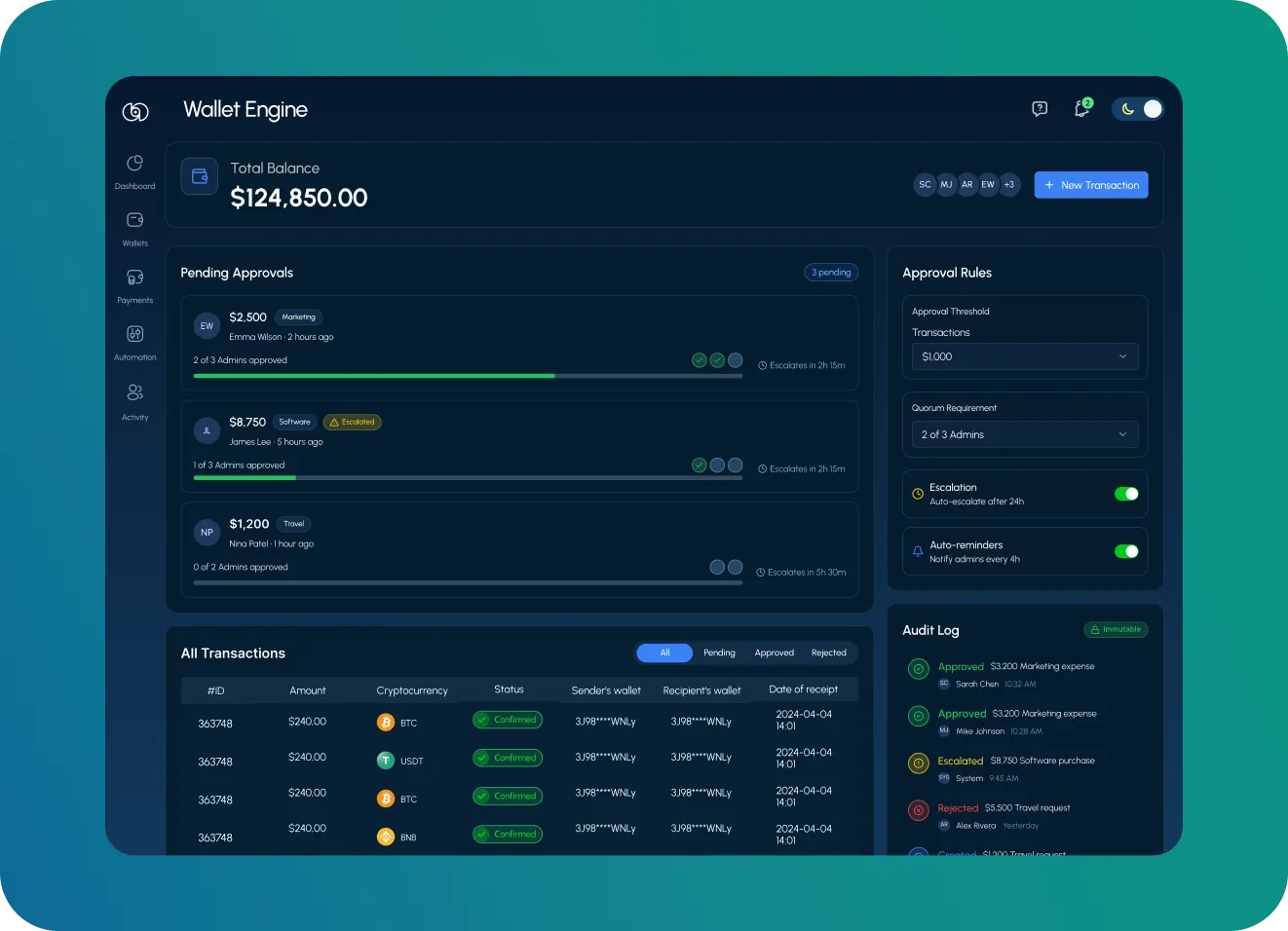
The group wallet is the feature that sets this platform apart from every other B2B payment tool on the market, and it required the most original engineering work. We designed a wallet permission model with four role tiers: Owner, Admin, Contributor, and Viewer, each carrying a distinct set of rights over deposits, withdrawals, and approval authority.
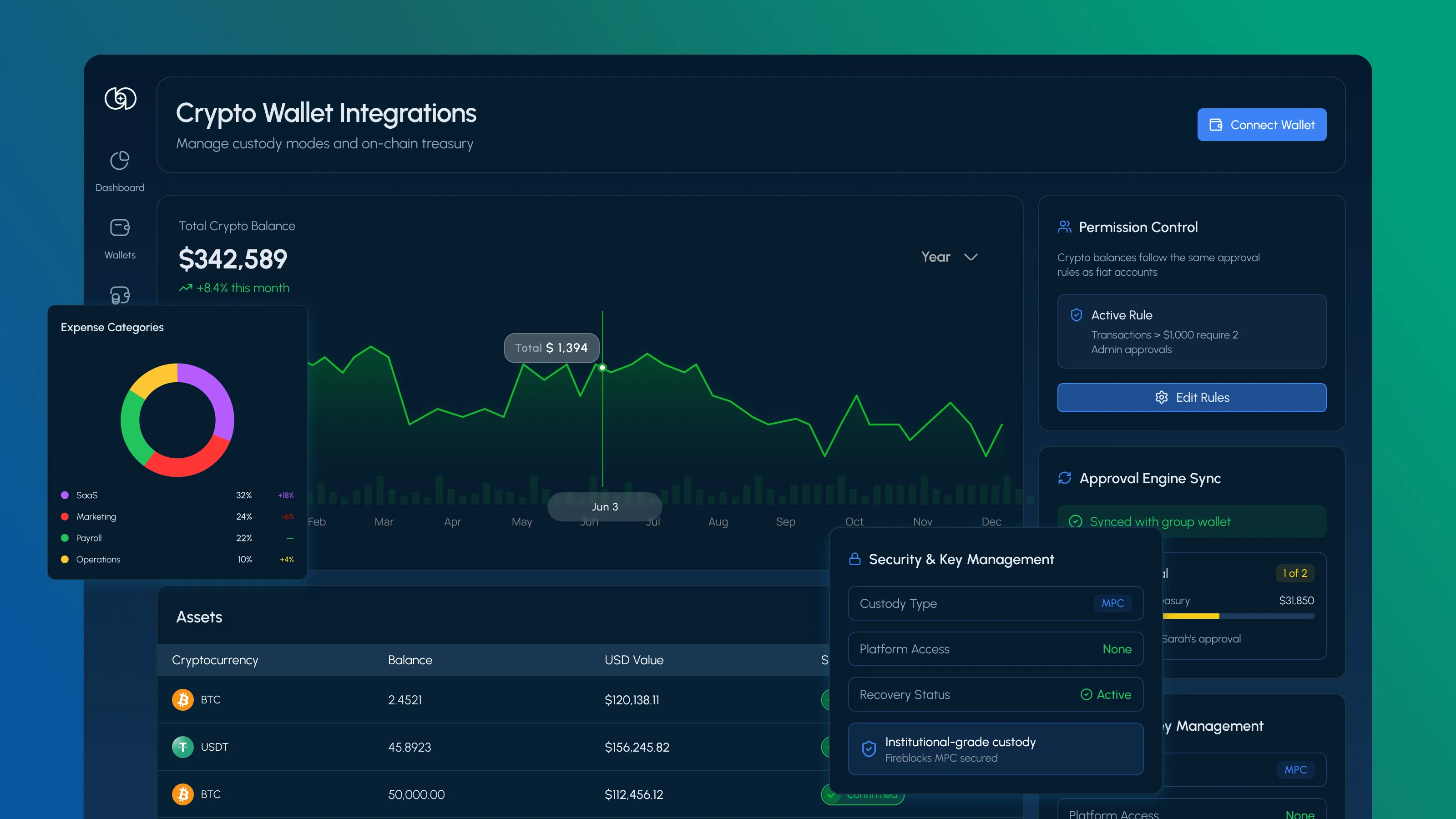
The approval engine supports configurable quorum rules: a transaction above a defined threshold requires sign-off from a specified number of Admins before it executes. Pending transactions are held in an escrow-like state, with real-time notifications sent to required approvers via push, email, and in-app alerts. If a required approver does not act within a defined window, the transaction escalates automatically. Every state transition is written to an immutable audit log, giving finance teams and auditors a complete, tamper-evident transaction history.
Crypto wallet integrations
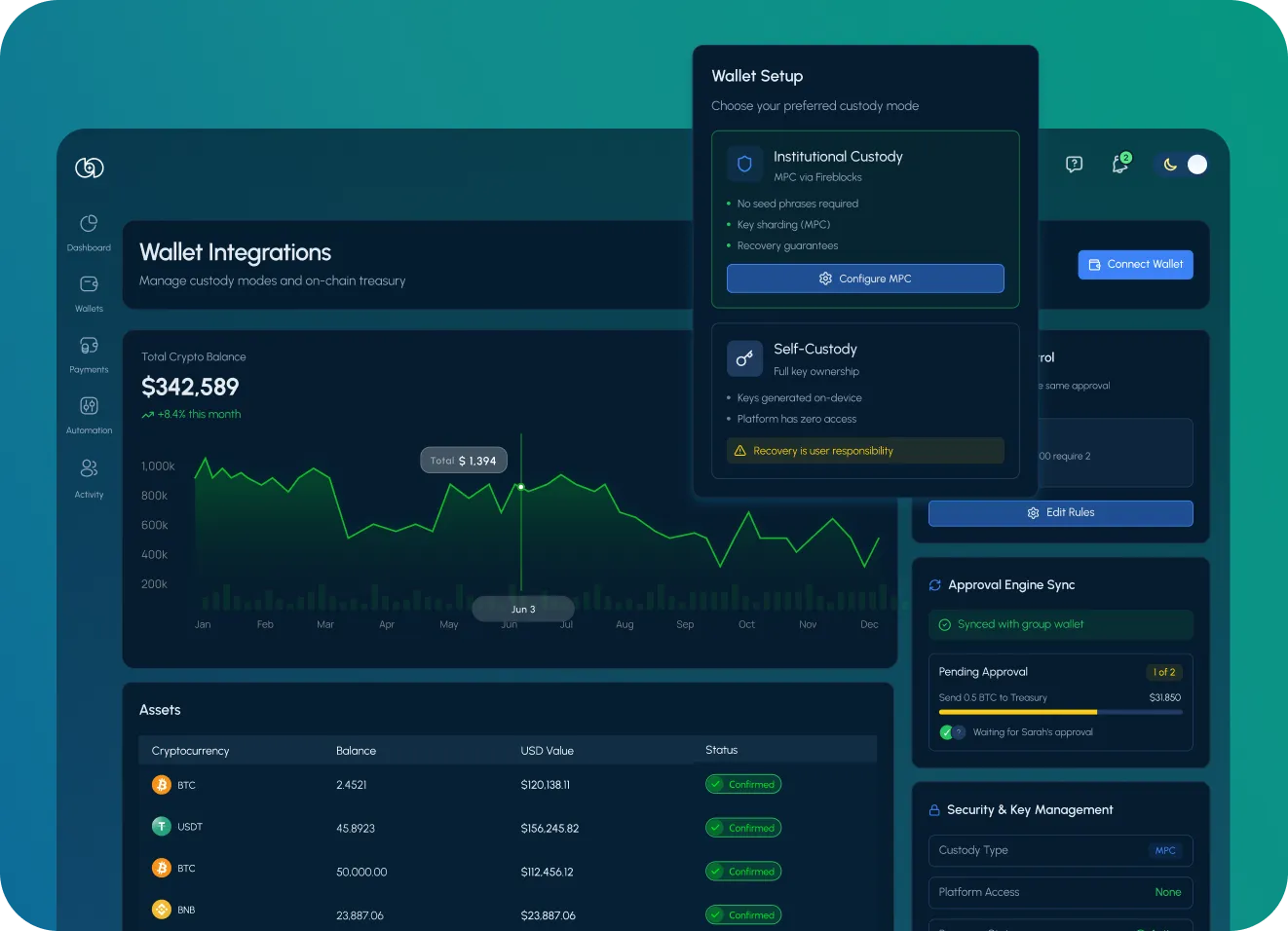
We implemented two wallet modes to cover the full spectrum of the client's target users. For businesses that want custody and recovery guarantees, we integrated Fireblocks MPC, an institutional-grade custody solution that eliminates single points of key failure without requiring users to manage seed phrases. For teams that prefer self-custody, we built a non-custodial flow where private keys are generated and stored on-device, with the platform never having access to them.
Both modes support BTC, ETH, and the major ERC-20 stablecoins (USDC, USDT), with on-chain transaction status reflected in the platform UI within seconds of confirmation. Crypto balances are fully integrated into the group wallet permission and approval model, meaning a team's on-chain treasury is subject to the same controls as their fiat accounts.
Fiat payments and multi-currency accounts
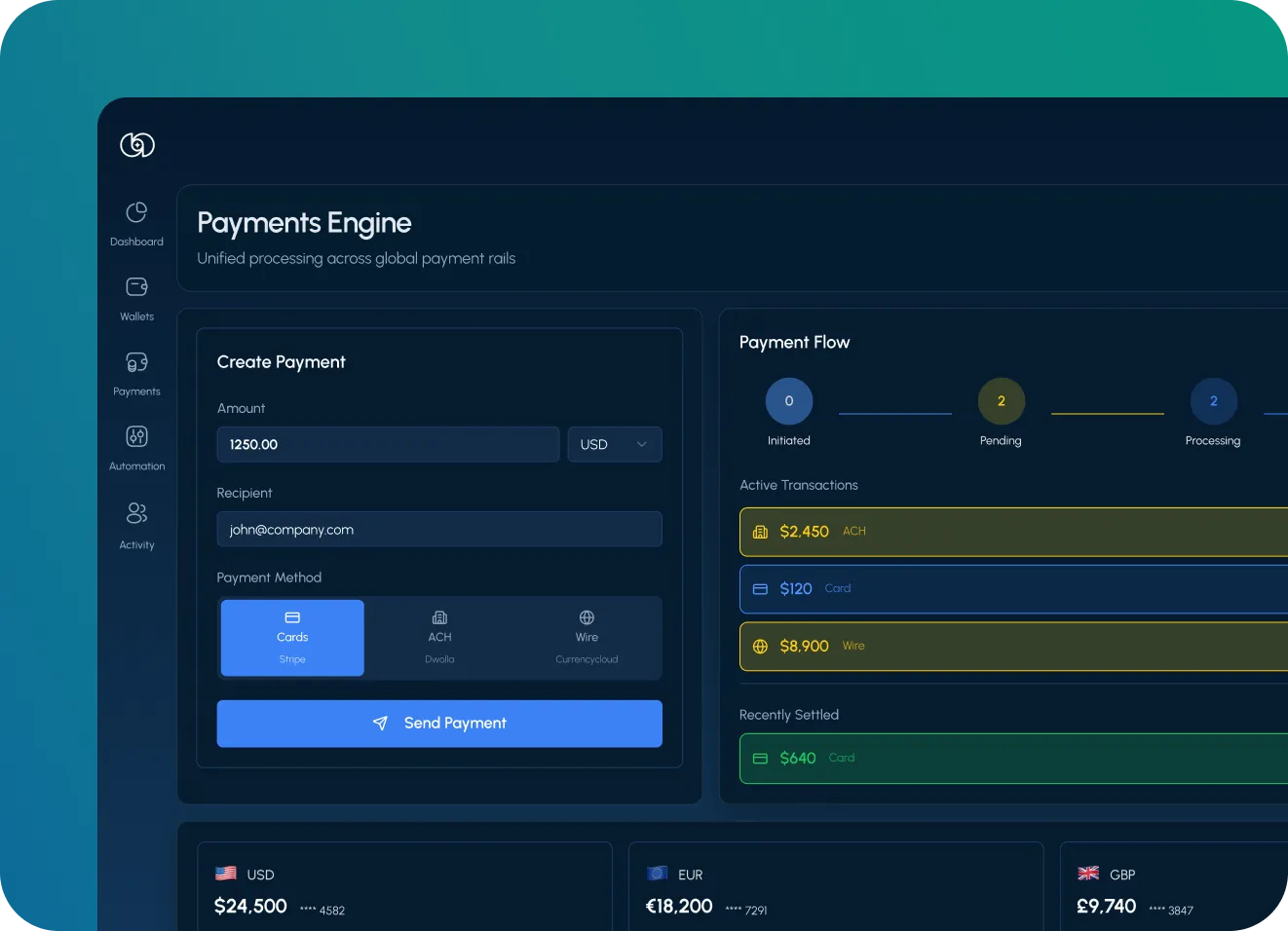
We integrated Stripe Connect for card-based payment processing, Dwolla for ACH transfers, and Currencycloud for international wire transfers and multi-currency account management. Each integration was abstracted behind a unified internal payments API, so the frontend and mobile apps interact with a single interface regardless of the underlying payment rail.
Transaction processing was optimized for perceived speed: ACH initiations, wire instructions, and crypto sends all return immediate confirmations to the user with a pending status, updating asynchronously as the payment rail confirms. This gave the platform a responsiveness that belied the inherent latency of financial networks.
CRM and workflow integrations
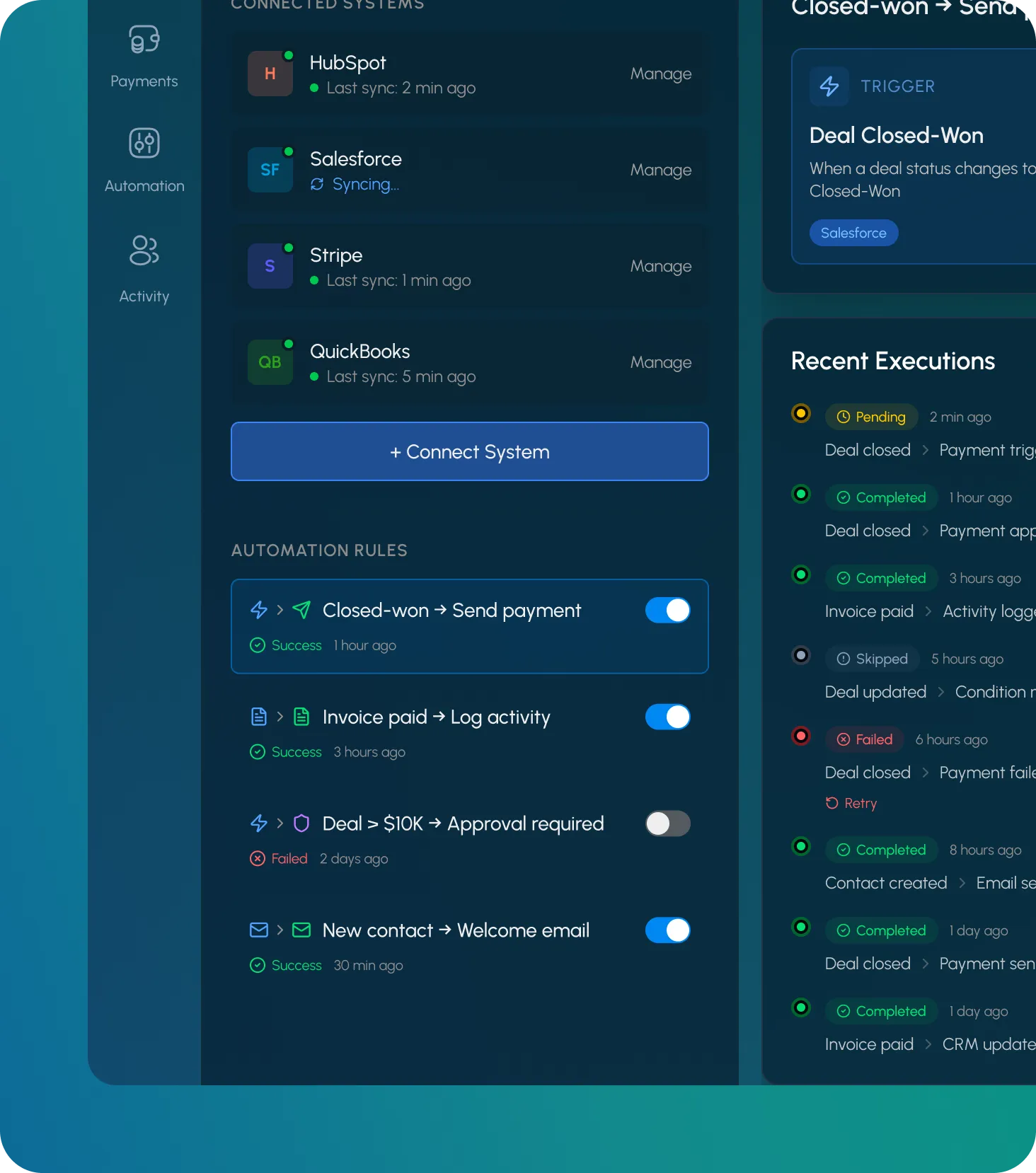
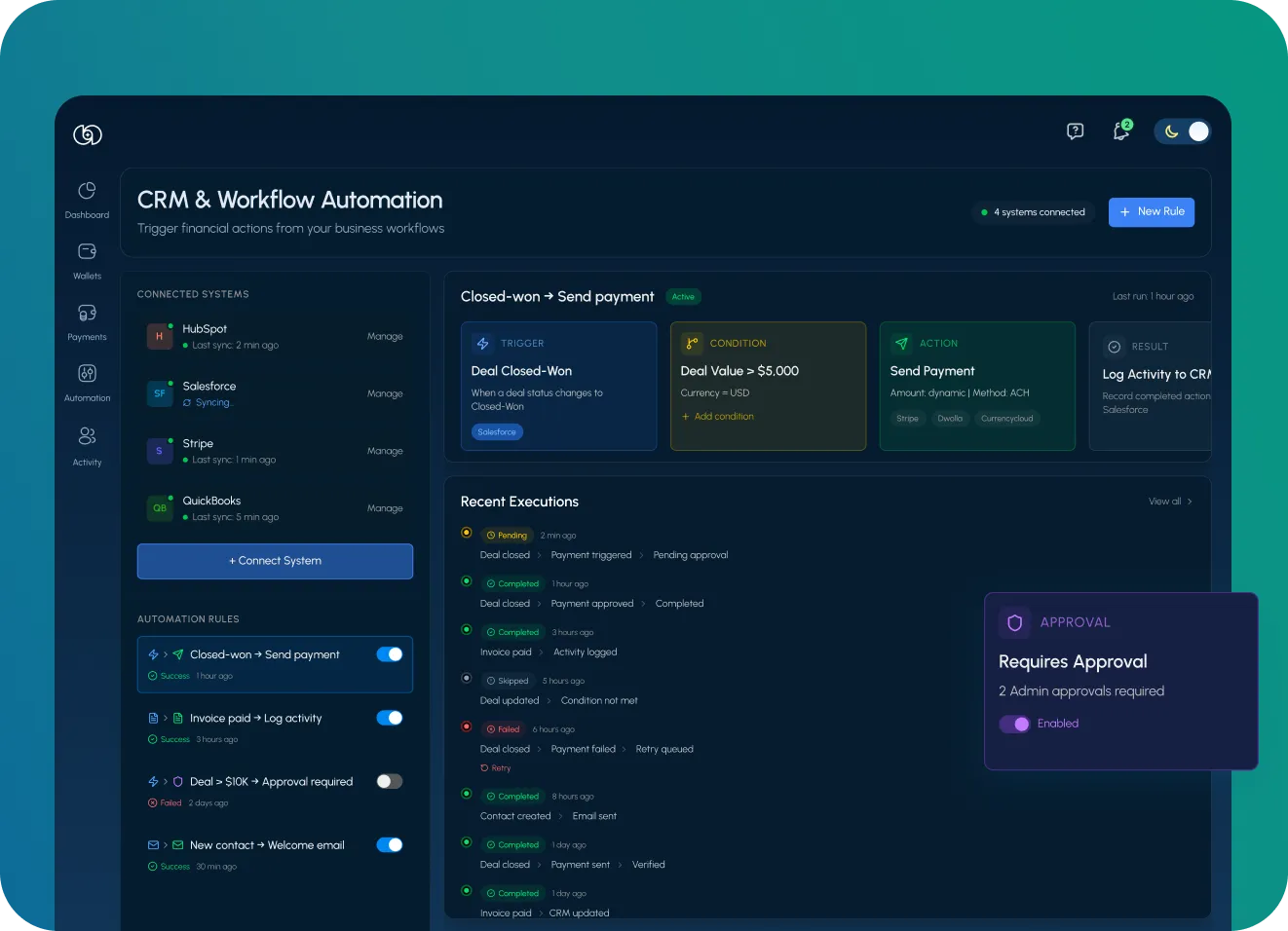
Business users do not operate their finances in isolation from their sales and operations workflows. We connected HubSpot and Salesforce via their REST APIs, enabling the platform to log financial events, invoice payments, wallet top-ups, and large transfers directly as CRM activities against the relevant contact or deal record.
Outbound triggers allow CRM workflow automations to initiate payment actions: a closed-won deal in Salesforce, for example, can automatically trigger a vendor payment or release a budget allocation from a designated group wallet. These integrations were built to be configurable by the client's customers through a no-code rules editor, without requiring developer intervention for each new workflow.
AI-driven spend analytics and anomaly detection
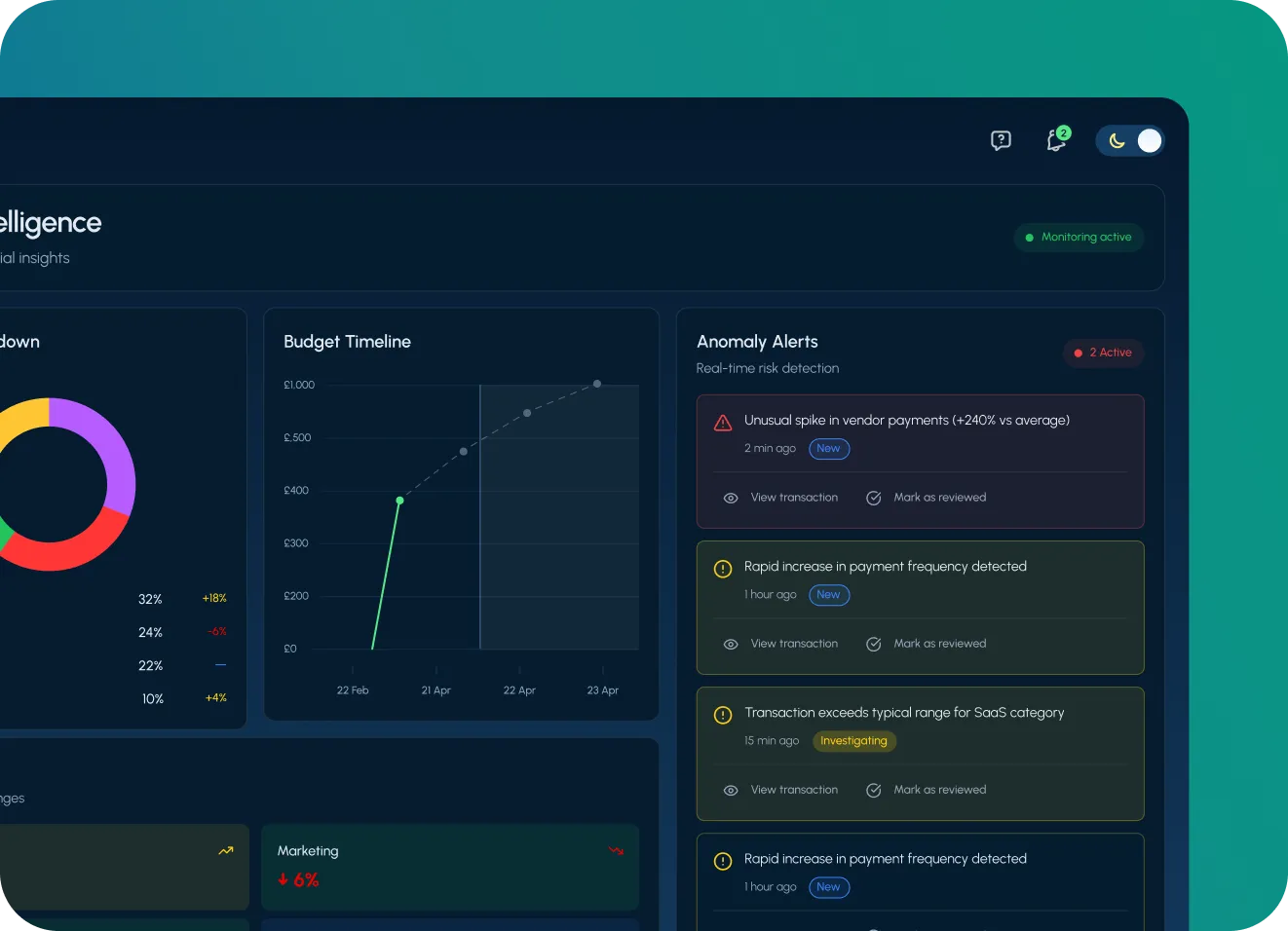
We built the AI layer with a strict data boundary: no raw transaction records, account numbers, or identifiable business information are sent to any external model. Instead, the system generates anonymized, aggregated numerical representations of spending patterns category distributions, velocity metrics, and peer-group benchmarks, which are passed to the OpenAI API alongside structured prompts.
The result is a natural-language spend summary that appears in each team's dashboard at the end of every week: plain-English observations about where money went, how it compares to the previous period, and whether any category warrants attention. A separate anomaly detection layer monitors transaction velocity and amount distributions in real time; when a statistical outlier is detected, it generates an in-app alert and notifies the wallet's Admins. This approach kept the AI features genuinely useful without creating compliance or data residency exposure for the client's business customers.

Mobile applications and App Store launch
We developed native iOS and Android applications in React Native, maintaining full feature parity with the web platform. The mobile apps were designed for the specific context of business finance on the go: quick wallet status checks, one-tap transaction approvals, and biometric authentication for secure access without friction.
Both applications passed App Store and Google Play review on first submission, an outcome that required careful attention to financial app review guidelines, particularly around crypto feature disclosure and KYC flow presentation. The web platform, iOS app, and Android app all launched within the same two-week window.

.webp)
Tech stack


.webp)


Impact
The platform launched on schedule and has been live in production since, with the client's team actively onboarding business customers and expanding the carrier and currency coverage. Key outcomes from the engagement and the first months post-launch:
Building a complex B2B payment engine?
We’ll engineer a custom multi-tier permission model and integrate secure custodial solutions, ensuring your platform is both compliant and ready for global scaling.
Contact usTestimonials

I love it! The team was thinking about the logic of the app first, instead of just making a code. They supported my vision.

I love it! The team was thinking about the logic of the app first, instead of just making a code. They supported my vision.
Anna Vashchuk
Startup Founder
Darly made me an app owner! The price we agreed is what I paid. I've already decided to work with them on my next project.
Darly made me an app owner! The price we agreed is what I paid. I've already decided to work with them on my next project.
Oliwia Kowalska
App Owner
We’ve been working together for over 2 years. Since then, our webpage has been ranking high on Google and bringing us leads.
We’ve been working together for over 2 years. Since then, our webpage has been ranking high on Google and bringing us leads.
Anastasiya Shitikova
Head of Marketing
We got the website ready and out of the gate in record time! Darly helps us maintain and refine the website for SEO purposes.
We got the website ready and out of the gate in record time! Darly helps us maintain and refine the website for SEO purposes.
Kavya Khattar
Product Owner
The responsiveness, attention to detail and high-level communication from Darly Solutions was outstanding. Communication with the team was all online and was absolutely seamless. They were highly responsive, worked to tight deadlines and provided great feedback and communication throughout the entire project to ensure it remained on schedule and all quality requirements were being met. They exceeded all of our expectations, from design through to delivery.

The responsiveness, attention to detail and high-level communication from Darly Solutions was outstanding. Communication with the team was all online and was absolutely seamless. They were highly responsive, worked to tight deadlines and provided great feedback and communication throughout the entire project to ensure it remained on schedule and all quality requirements were being met. They exceeded all of our expectations, from design through to delivery.
Kieran Donovan
Managing Director, Corporate Advisory Firm
LLC Darly Solutions's team performs well since the collaboration started. They are fluent in specific programming languages, they are also fluent in English, and they have a great response time. What is most unique and impressive about Darly Solutions is that everyone in the team is inherently communicative and understands the expertise of their respective fields. The team is very agile and can predict stress situations in which we work together to fix and maintain.

LLC Darly Solutions's team performs well since the collaboration started. They are fluent in specific programming languages, they are also fluent in English, and they have a great response time. What is most unique and impressive about Darly Solutions is that everyone in the team is inherently communicative and understands the expertise of their respective fields. The team is very agile and can predict stress situations in which we work together to fix and maintain.
Carol Arao
Product Owner, Software Development Company
Darly Solutions' work so far inspires confidence, as they're skilled and trustworthy. The health platform is incredibly happy with their work. The team at Darly is communicative, responsive, and responsible. I’d recommend them to people looking to do more than build a simple little software.

Darly Solutions' work so far inspires confidence, as they're skilled and trustworthy. The health platform is incredibly happy with their work. The team at Darly is communicative, responsive, and responsible. I’d recommend them to people looking to do more than build a simple little software.
Jürgen Bröker
Executive Director, Healthcare Platform Co.
By collaborating with Darly Solutions, there is a significant improvement in the project's quality of codes compared to their original codebase. They lead efficient project management and keep the client updated with their reports. They're a flexible team that delivers promising results. They don't just do as they're told, they actively participate in the design process, which is going to yield us a much better platform in the end.

By collaborating with Darly Solutions, there is a significant improvement in the project's quality of codes compared to their original codebase. They lead efficient project management and keep the client updated with their reports. They're a flexible team that delivers promising results. They don't just do as they're told, they actively participate in the design process, which is going to yield us a much better platform in the end.
PJ Fisher
Head of Tech, Software Consulting Firm
Darly Solutions was able to develop the site with all functions running. The team was responsive throughout the engagement. They excelled at scheduling and delivered projects on the specified timeline. The whole team was a pleasure to work with. I am very glad that I entrusted them with my project, this is the best company for me!

Darly Solutions was able to develop the site with all functions running. The team was responsive throughout the engagement. They excelled at scheduling and delivered projects on the specified timeline. The whole team was a pleasure to work with. I am very glad that I entrusted them with my project, this is the best company for me!
Inna Netudikhata
CEO, Mama Travel
The quality of their work is very high, and we get very good customer feedback on what our site looks like. They're very reliable and have a great overview of the technologies they're using. They meet our deadlines and are very accurate with their time estimations on a project. In addition, they're responsive and great with communication with a great command of English — it's very easy to talk to them. Moreover, we've integrated them into our development and scrum process, where we have daily stand-ups with their project manager and developers through Slack.

The quality of their work is very high, and we get very good customer feedback on what our site looks like. They're very reliable and have a great overview of the technologies they're using. They meet our deadlines and are very accurate with their time estimations on a project. In addition, they're responsive and great with communication with a great command of English — it's very easy to talk to them. Moreover, we've integrated them into our development and scrum process, where we have daily stand-ups with their project manager and developers through Slack.
Felix Leontyev
Head of Technology, PSS AG
LLC Darly Solutions are highly skilled at UI/UX and follow very good engineering standards, and have been very professional in its approach to all the work to date (including the initial consultancy, which was the deciding factor). They have taken ownership of the work in way that demonstrates how much they value the work they are doing and consequently the work we are doing. I am gaining confidence that the decisions they make are good decisions and that this will result in a product that will exceed our initial expectations.

LLC Darly Solutions are highly skilled at UI/UX and follow very good engineering standards, and have been very professional in its approach to all the work to date (including the initial consultancy, which was the deciding factor). They have taken ownership of the work in way that demonstrates how much they value the work they are doing and consequently the work we are doing. I am gaining confidence that the decisions they make are good decisions and that this will result in a product that will exceed our initial expectations.
Gordon Lang
CTO, Vidina Solutions Ltd
Darly Solutions developed the app in a quick manner, and the code quality was excellent. The professional team was committed to building a successful product. The code quality was good, and the app has been built in a little more than 1 month, which is a result I'm very happy with. They were laid back but professional at the same time.

Darly Solutions developed the app in a quick manner, and the code quality was excellent. The professional team was committed to building a successful product. The code quality was good, and the app has been built in a little more than 1 month, which is a result I'm very happy with. They were laid back but professional at the same time.
Piotr Nowakowski
Founder, 79 Characters, Inc.
Darly Solutions’ work helped my business tremendously. They were able to identify key areas for growth and improvement. The team was communicative and professional throughout the entire engagement. LLC Darly Solutions is a solutions-oriented vendor that drives results. They’re really professional and they know what they’re doing. The team knows how to identify my problems and solve them.

Darly Solutions’ work helped my business tremendously. They were able to identify key areas for growth and improvement. The team was communicative and professional throughout the entire engagement. LLC Darly Solutions is a solutions-oriented vendor that drives results. They’re really professional and they know what they’re doing. The team knows how to identify my problems and solve them.
Maiza Simeon
Founder, Food App Startup
Related case study


Connect with us
.webp)
We are a tech partner that delivers ingenious digital solutions, engineering and vertical services for industry leaders powered by vetted talents.

