
Reducing risk, ensuring quality, and accelerating time-to-market in custom software development



Custom development carries numerous hidden software development risks, ranging from intellectual property concerns to architectural issues and security gaps in third-party components. As if it weren’t enough, development teams face constant pressure. On the one hand, each week of project delay can translate into lost revenue and reduced market share. Meanwhile, project managers must balance quality, utility, and speed no matter what.
So, how to handle it all? Find the answers in this article.
Why Risk, Quality, and Delivery Speed Define Project Success
Software delivery speed shapes how teams make trade-offs between planning, validation, and execution long before a product reaches the market.
Market dynamics force organizations to launch products before competitors claim market share. The speed becomes critical. And the speed alone introduces vulnerabilities. Among other things, it comes with rushed code. In practical terms, it means security gaps, architectural flaws, and technical debt that compound over time.
Organizations cannot afford extended testing periods, yet they cannot release unstable products. Quality standards and user expectations determine whether software survives initial deployment. Systems that fail under real-world conditions damage reputation. They erode user trust and generate costly remediation cycles.
Custom software development risk materializes at project inception — with early-stage decisions about technology stack, team structure, etc. Teams that skip proper requirement analysis or neglect architectural planning encounter problems that cascade through development cycles. Without adequate control, software fails to deliver value. It only consumes resources without returns.
How to Reduce the Risk of a Failed Custom Development Project
Project failures stem from preventable issues. Those include unclear requirements, inadequate planning, misaligned expectations, and absent quality controls. That’s why companies that invest in outcome-based development need to carefully evaluate vendors before signing contracts.
Questions Every Business Should Ask a Vendor Before Starting a Project
Businesses should evaluate development partners through structured inquiry. It’s best to prepare vendor evaluation questions covering various aspects of operations: processes, code quality standards, engineering productivity, accountability mechanisms, and so on. Here are several ideas on what to include.
1) Discovery and requirements:
- What does your discovery process look like?
- How do you validate requirements?
2) Architecture and technical stack:
- How do you design architecture before coding?
- What technologies would you suggest for our product and why?
3) Software quality assurance:
- What is your QA strategy for a project like ours?
- Who owns quality at each stage?
4) Project management:
- What project metrics do you track?
- What is your escalation and risk-management process?
- How will you ensure predictability (deadlines, budget, scope)?
5) Documentation and communication:
- What documentation do you provide?
- How do you ensure transparency for C-level?
Make sure to prepare the questions about all aspects you consider important. Each inquiry helps you understand better what a potential partner can bring to the table and how reliable they are.
Why These Questions Matter
Structured vendor evaluation reduces technical risks. Vendors with mature processes provide detailed answers. They are eager to demonstrate their experience and communicate benefits. Vague responses or resistance to specific questions signal inadequate capabilities.
Questions like those above also minimize scope estimation errors. You get to understand how rigorous the discovery processes are in a company you consider partnering with. It’s a way of avoiding scope creep and costly mid-project corrections. Without careful planning routines, providers underestimate project complexity, leading to budget overruns and timeline extensions.
Careful assessment increases software project predictability. Using clear metrics and defined quality standards enables alignment between business expectations and development realities. Meanwhile, confidence in delivery timelines allows for further planning — support, marketing, and so on.
Why C-Level Leaders Need Code Review and Architectural Audits
A code review audit gives executive teams visibility into the real condition of technical assets before making decisions about market expansion, system modernization, or further investment. Code that functions in limited deployment fails under production load. The architecture designed for the initial product launch collapses as user volume increases. And technical debt tends to accumulate silently.
Code review and architectural audits highlight the abovementioned issues. They also prevent misalignment between business and engineering. A technical assessment helps C-level leaders understand the system’s actual capabilities rather than developers’ assumptions.
What a Software Architecture Audit Actually Includes
Professional audits examine systems through multiple technical dimensions to identify software development risks and opportunities for improvement, examining the following:
- Code quality. Experts evaluate code structure, maintainability, and adherence to engineering standards. They identify excessive complexity, inadequate test coverage, missing documentation, and technical debt.
- Performance bottlenecks. System performance analysis reveals issues like inefficient database queries, memory leaks, unoptimized algorithms, and infrastructure limitations. The goal is to identify what components could fail under increased loads.
- Security vulnerabilities. Auditors test for common attack vectors, including SQL injection, cross-site scripting, and authentication bypass. The aim is to assess whether systems meet regulatory requirements for data protection.
- Scalability issues. It’s critical to evaluate horizontal and vertical scaling capabilities, database architecture, caching strategies, and service isolation. Software scalability audit highlights architectural decisions that limit expansion.
An audit can include other inspections. It depends on a specific request and the business goals a company is currently pursuing. For example, infrastructure audits can also assess cloud resource optimization, deployment automation, monitoring capabilities, and disaster recovery procedures. Alternatively, they can focus solely on security.

How Audits Improve Product Stability and Performance
Performance optimization often starts with understanding where systems lose efficiency rather than adding new tooling or infrastructure. Audit findings enable targeted improvements in the areas reviewed. Some frequent outcomes include:
- Lower infrastructure expenses. Audits identify overprovisioned resources and architectural patterns that waste computing capacity. Organizations can reallocate infrastructure spending toward growth rather than maintaining inefficient systems.
- Reduced system downtime. Addressing bottlenecks before they cause service interruptions prevents revenue loss. Systems that handle peak load maintain user trust and business continuity.
- Accelerated scaling. Sound architecture enables the deployment of new infrastructure regions, handling traffic surges, and expanding user capacity. It all becomes affordable without emergency engineering efforts.
- Predictable release cycles. Organizations with high code quality and robust testing deploy features confidently. No extended stabilization periods are required. Instead of constant firefighting, development teams enter the phase of consistent velocity.
Targeted audits, such as security or compliance assessments, demonstrate benefits in the specific areas. In these cases, you can expect improved security posture, an actionable response strategy, or permission to operate in specific markets or areas.
When a Code Review or Audit Is Critical
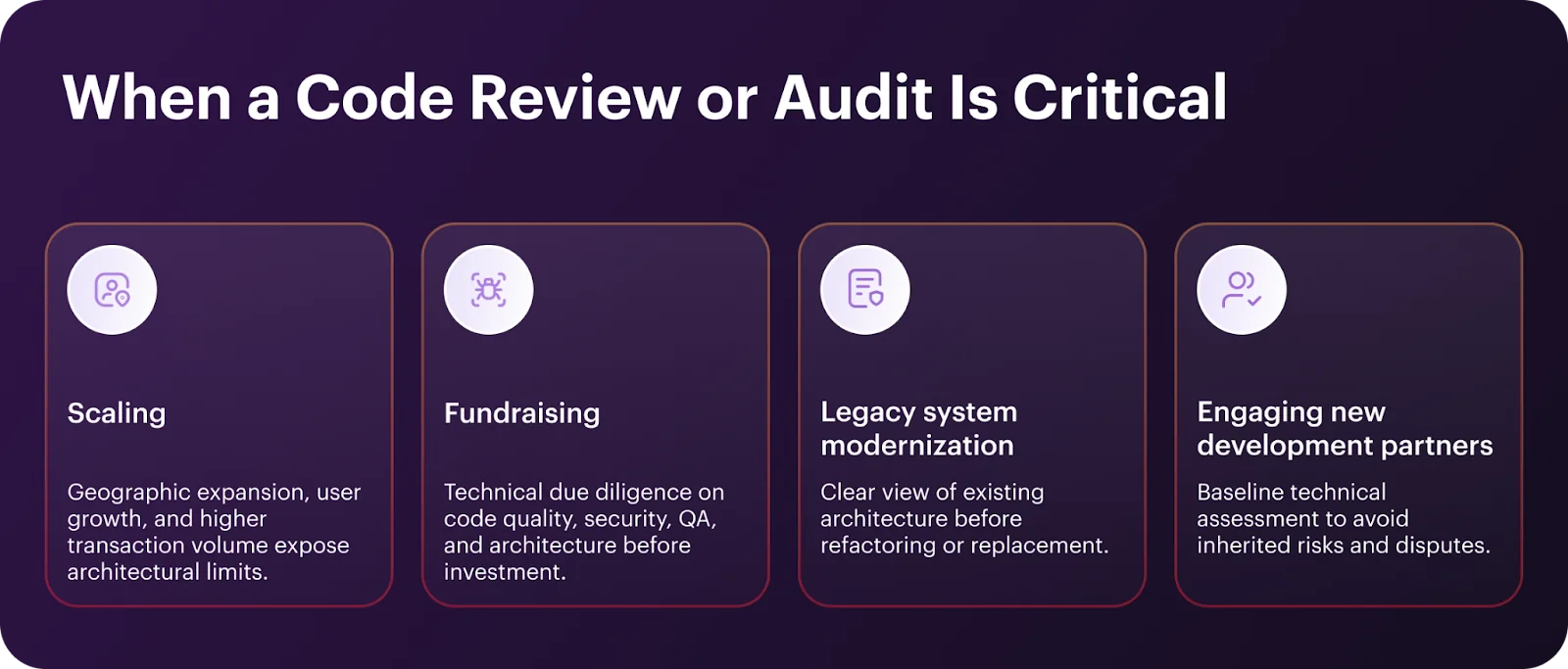
A software architecture audit becomes especially valuable at moments when business decisions depend on the system’s real technical condition.In general, an audit benefits any company at any point. Yet it requires time and budget, and running an occasional audit isn’t typical. The specific business events that demand technical validation before proceeding include:
- Scaling. Geographic expansion, user base growth, and increases in transaction volume expose architectural limitations. Audits identify whether systems can handle projected load or require architectural modifications.
- Fundraising. Investors will conduct technical due diligence anyway. They evaluate code quality, security and QA practices, and architectural soundness. Clean audits accelerate funding processes and improve valuation confidence.
- Legacy system modernization. Replacing or refactoring legacy systems requires a detailed understanding of the existing architecture. Audits document the current state, highlight modernization priorities, and establish success criteria for replacement systems.
- Engaging new development partners. Organizations that change vendors or add development partners need a baseline technical assessment. Audits establish the current system state and prevent disputes about inherited problems.
In all cases, a business gets a comprehensive understanding of its system — or rather, its current state. Since software evolves, it’s normal to lose control over some aspects of it. Audits put the team back in control and build a strong background for further operations.
Ensuring Quality Through Strong QA Processes
Teams without structured QA processes in software development accumulate technical debt faster than they deliver features. And a single test run before release isn’t enough. Quality emerges from systematic practices and shared accountability — throughout the entire development lifecycle.
Why QA Should Start Before Development (Shift Left Testing)
Late testing creates bottlenecks as defects surface during final validation. Shift-left testing moves quality assurance earlier in the project, preventing defects rather than detecting them after implementation. In the long run, it is a story about preventing project failure.
QA strategy and planning can — and should — start even before the development begins. In practice, it means the following:
- Requirements validation catches misunderstandings before coding.
- Test planning during design phases ensures testability.
- Automated test development parallel to feature coding enables continuous validation.
- Static code analysis during development identifies potential problems long before code review audit.
Defects caught during coding require localized fixes. Problems discovered during system testing demand extensive investigation, cross-component changes, and regression testing. Altogether, shift-left testing reduces defect costs through early detection. It significantly improves code quality by limiting the number of problematic areas and dependencies.
Types of Testing That Reduce Business Risk
Mature QA processes in software development define which risks are validated early and which are allowed to surface later in production. Comprehensive testing strategies address different risk categories through specialized test types. Development teams need to combine various kinds of tests to ensure sufficient coverage. The must-haves for every project include:
- Unit testing that validates individual code components in isolation.
- Integration testing for verifying that system components interact correctly.
- End-to-end testing to simulate real user journeys through complete systems.
- Functional testing for verifying software features against the requirements.
- User interface testing to make sure the visual elements look and work correctly.
- Performance testing that measures system behavior under various load conditions.
- Regression testing to ensure new changes and fixes don’t break the functionality.
There are also security, compliance, accessibility, compatibility testing, and a whole variety of performance testing subtypes. All serve early risk detection. Some fit into test automation coverage, fully or partially. The exact combination of QA checks depends on the project’s maturity and specific requirements.
QA Metrics That C-Level Must Monitor
Software development metrics give executives objective visibility into software reliability, delivery health, and readiness for release decisions.

How to Balance Risk, Quality, and Speed: Practical Framework
Businesses traditionally view speed, quality, and cost as competing factors. Modern development practices demonstrate that strategic investments in quality and technical risk mitigation actually drive time-to-market acceleration without increasing the price tag. The false trade-off, on the contrary, is a result of outdated development practices, such as:
- Waterfall methodologies.
- Fully manual deployment.
- Architectural shortcuts.
To solve this, companies should treat speed, quality, and risk management in software development as interdependent capabilities. Here’s why:
- Investments in test automation increase both speed and quality.
- Architectural planning prevents risks while enabling rapid scaling.
- Continuous integration compresses feedback cycles and improves code stability.
To succeed at this, prioritize investments that deliver multiplicative benefits across all dimensions, namely:
- Foundational capabilities. Automated testing infrastructure enables all subsequent improvements in quality and speed. CI/CD automation removes deployment friction and enables rapid iteration. Security-first architecture prevents vulnerabilities.
- Process optimization. Code review practices improve quality and knowledge sharing. Documentation practices reduce onboarding time and prevent knowledge silos. Monitoring provides visibility into production behavior and allows for performance optimization.
- Incremental enhancements. Advanced tooling and specialized testing techniques deliver marginal improvements in the later stages, after all of the above is implemented.
Effective prioritization requires an honest assessment of organizational maturity and project constraints.
Key Takeaways
Custom software development requires simultaneous attention to risk management, quality assurance, and software delivery speed.
Risk reduction begins before coding starts — with careful vendor selection, discovery, and architectural planning. Code reviews and architectural audits provide executive visibility into the technical health of your software throughout its entire lifecycle. Agile methodologies eliminate false trade-offs between speed and quality.
It’s okay if finding the balance seems overwhelming or complicated. If you don’t want to let preventable risks derail your software project, schedule a free consultation with Darly Solutions. Let’s establish quality frameworks and delivery strategies that protect your investment.


FAQ
Structured vendor evaluation and upfront planning are the most effective ways to do it. Make sure that a vendor has mature discovery and transparent risk management processes. Ask specific questions about architecture design, requirement validation, software development metrics, and quality assurance. It all reveals the vendor’s true capabilities.
A software architecture audit provides executives with an objective assessment of technical assets before critical business decisions. Any changes to a system require independent validation of software quality and scalability. Companies that conduct audits before expansions or scaling internal operations avoid costly discoveries.
Software delivery speed improves when quality issues are addressed early rather than deferred to late release stages. For example, shift-left testing catches defects during development when fixes require minimal effort. It prevents the accumulation of issues and defect dependencies. It also lets you avoid expensive late-stage corrections. The higher the quality, the quicker and more stable the release will be.
Time-to-market acceleration depends on practices such as continuous integration, small and frequent releases, continuous testing, modular architecture, and sprint-based delivery. All are about focused work on a specific part of the functionality and quick feedback. It’s best to combine all of these practices to deploy rapidly while maintaining code quality and stability.
Related articles
.webp)
.webp)


Connect with us
.webp)
We are a tech partner that delivers ingenious digital solutions, engineering and vertical services for industry leaders powered by vetted talents.

