


.svg)

Project overview
As promising as conversational AI assistants are, launching one is easier said than done. Even if you take an AI model already on the market (e.g., OpenAI’s GPT-5), you still need to integrate it with your website via API, train it on your data, and test and fine-tune it.
If that sounds like a lot of work, that’s because it is.
Large companies can afford to hire developers to do all that work and maintain the solution in the long run. Small and medium-sized business owners, on the other hand, rarely can. So, they end up at a disadvantage.
Our client, a U.S. conversational AI startup, saw this gap and decided to democratize conversational AI. Its flagship product would allow anyone to easily launch a conversational website on their own subdomain — without spending hours upon hours coding. No hosting hassles, either: all websites would live on our client’s multi-tenant backend, instead.
The MVP development was well underway, but our client’s initial partnership was riddled with problems. Poor code quality, lack of transparency, and slow communication were just a few. Finally, the team decided to cut its losses and switch partners.
That’s when Darly Solutions came aboard.
Client’s Review
Services


.webp)
.webp)
Challenges
Following the rupture with its previous development partner, our client was left with little documentation for the existing codebase. So, we couldn’t move forward without auditing it first. That said, even with the audit complete, integration presented a challenge, requiring some tweaks to the codebase.
Like many MVPs, the platform didn’t have a finalized scope when the client turned to us. So, we had to remain flexible and help clarify the scope continuously throughout the project. We integrated discovery and clarification loops into our agile sprints to accommodate scope changes.
Communication was also going to be a challenge — but one we were used to rising to. The contacts on our client’s end had busy schedules, so they couldn’t be available all the time. To accommodate availability gaps, we adapted to our client’s schedule for ongoing collaboration and weekly check-ins.
Finally, since users would use a conversational AI chatbot to build their websites, high latency and poor UI control could easily alienate them. So, we had to minimize response times, all while keeping designs consistent.
Overall, our collaboration was guided by the following business needs and technical requirements:
Strategic business needs
01 Launch a multi-tenant low-code/no-code conversational AI builder for small business owners
02 Salvage the codebase already written by the initial partner while minimizing rework and integration risks
03 Make the MVP lean while leaving the door open for future customization and scaling
04 Enable users to create and launch their AI-powered websites using a chatbot-based builder with dynamic rendering capabilities
05 Keep the MVP scope flexible during development
06 Offer multilingual support to attract more customers
Technical requirements
01 Audit the codebase from the initial development partner
02 Merge the renderer and the multi-tenant backend
03 Enable users to build mobile-friendly, fast-loading websites with customizable components
04 Keep latency under 100 ms for chatbot-powered dynamic rendering
05 Enable users to create custom GPT-based AI assistants and train them on custom data
06 Keep the error rate for chatbot-powered features under 5%
07 Enable users to embed custom AI assistants into external websites using multiple methods
08 Implement server-side rendering (SSR) and dynamic routing without detriment to tenant performance
09 Keep the design consistent across the website builder, chatbot interface, and generated websites
Got burned by an unreliable software development partner?
We’ll help you salvage everything that can be reused with a comprehensive codebase audit, careful refactoring where needed, and smooth integration.

.avif) Talk to an expert
Talk to an expertSolutions
Before we could start working on integration challenges or implement new features, we had to structure milestones and audit the codebase.
First, we outlined the cycles for each sprint, including discovery, delivery, and QA and testing. Thanks to the discovery being part of each sprint, we could easily navigate the shifting scope without introducing uncertainty and unpredictability into the rest of the processes.
Then, we got to reviewing the codebase. During the audit, we tested it end to end, evaluated its quality, and pinpointed key integration and performance challenges. All of our findings were thoroughly documented so that the client always had a tangible record to refer to.
By the end of the project, our client received a robust platform that enabled users to:
- Create custom AI assistants and train them on business-specific data
- Build and launch conversational websites using the platform’s chatbot; no coding necessary
- Integrate custom AI assistants into external websites
.webp)
.webp)
Smooth onboarding
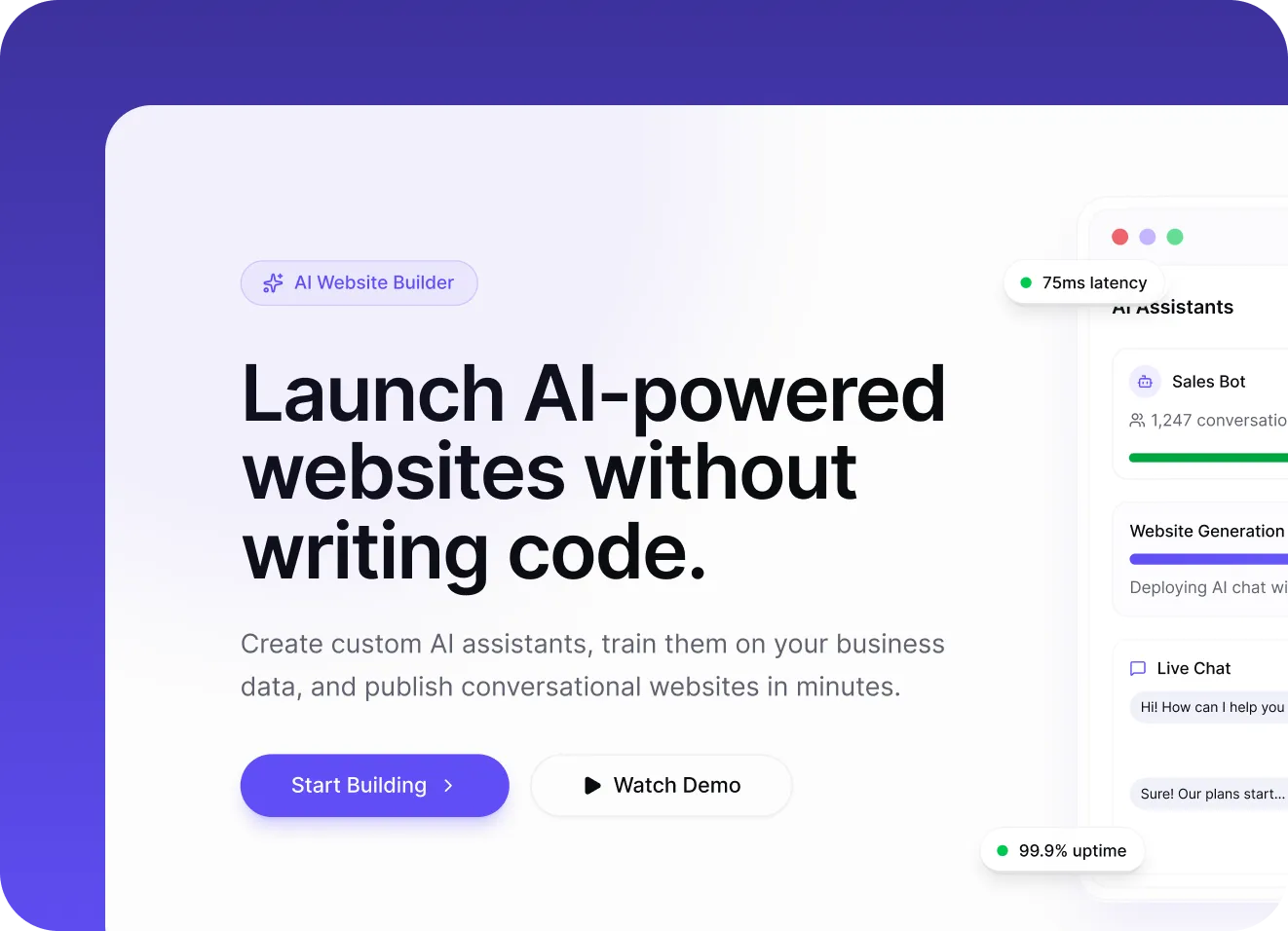
Even a platform that democratizes access to conversational AI features can present a steep learning curve for some users. That’s why we had to make getting started with it easy even for business owners who aren’t used to AI-powered features or conversational website builders.
To that end, we carefully removed friction from the registration user flow based on iterative A/B testing. That helped decrease drop-off during this user flow by 14%.
We also designed and implemented a quick platform tour to onboard new users. The tour increased feature adoption by 16% compared to the platform version without it.
No-code AI assistant creation
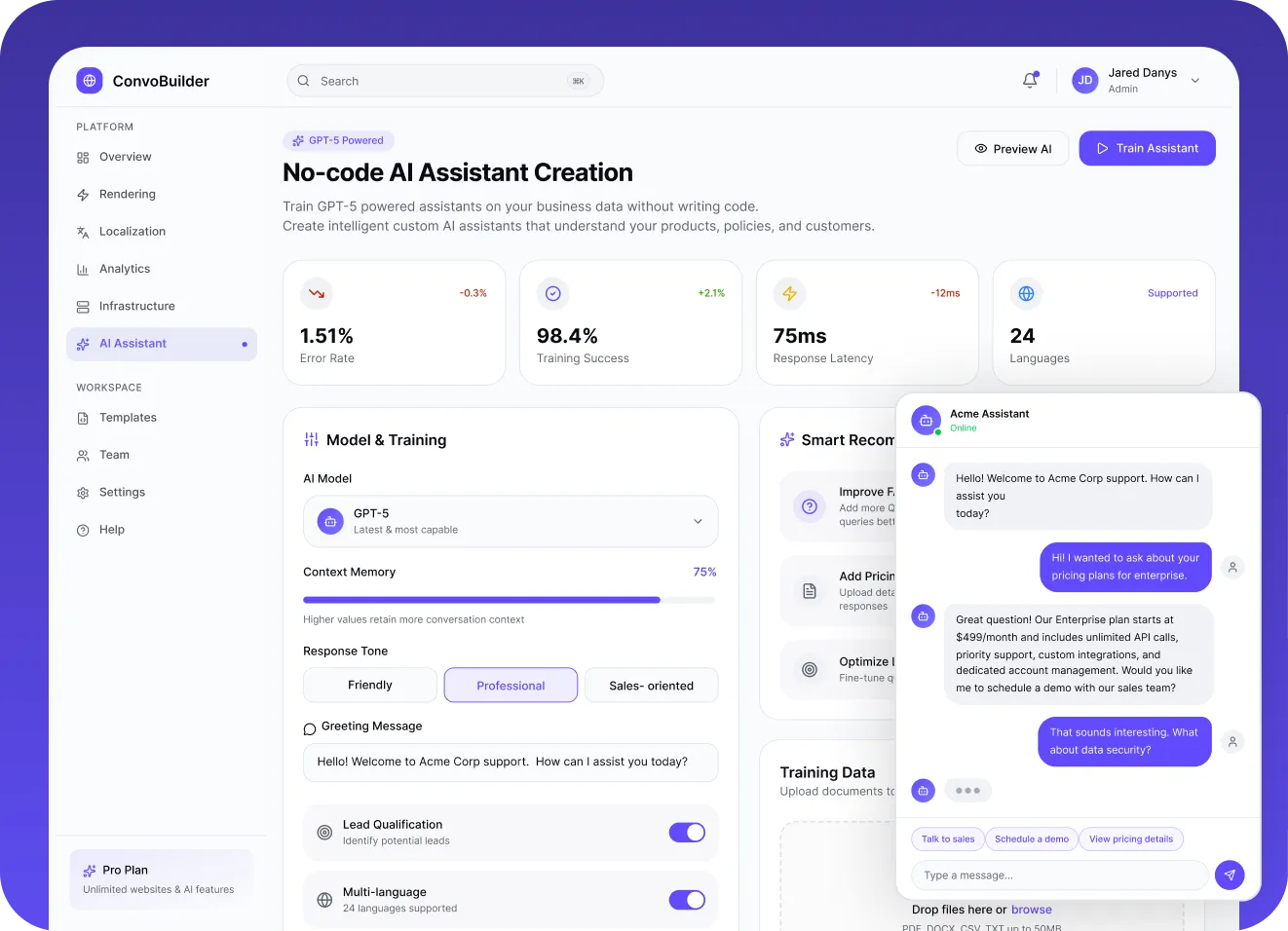
For business owners, an AI assistant that doesn’t know a thing about the company’s specific policies or products is useless. So, all AI assistants created with the platform use a retrieval-augmented generation (RAG) layer for custom training. OpenAI’s GPT-5, in turn, powers its core capabilities in natural language recognition and generation.
Thanks to the RAG layer, end users can upload their business-specific data to train the AI assistant. We ensured training goes without a hitch by thoroughly testing this functionality. We also brought down the error rate for custom AI assistants to 1.51%.
AI assistants remain highly customizable beyond the training data, too. For example, users can change the greeting message, set the tone, and define specific lead qualification rules.
Conversational website builder
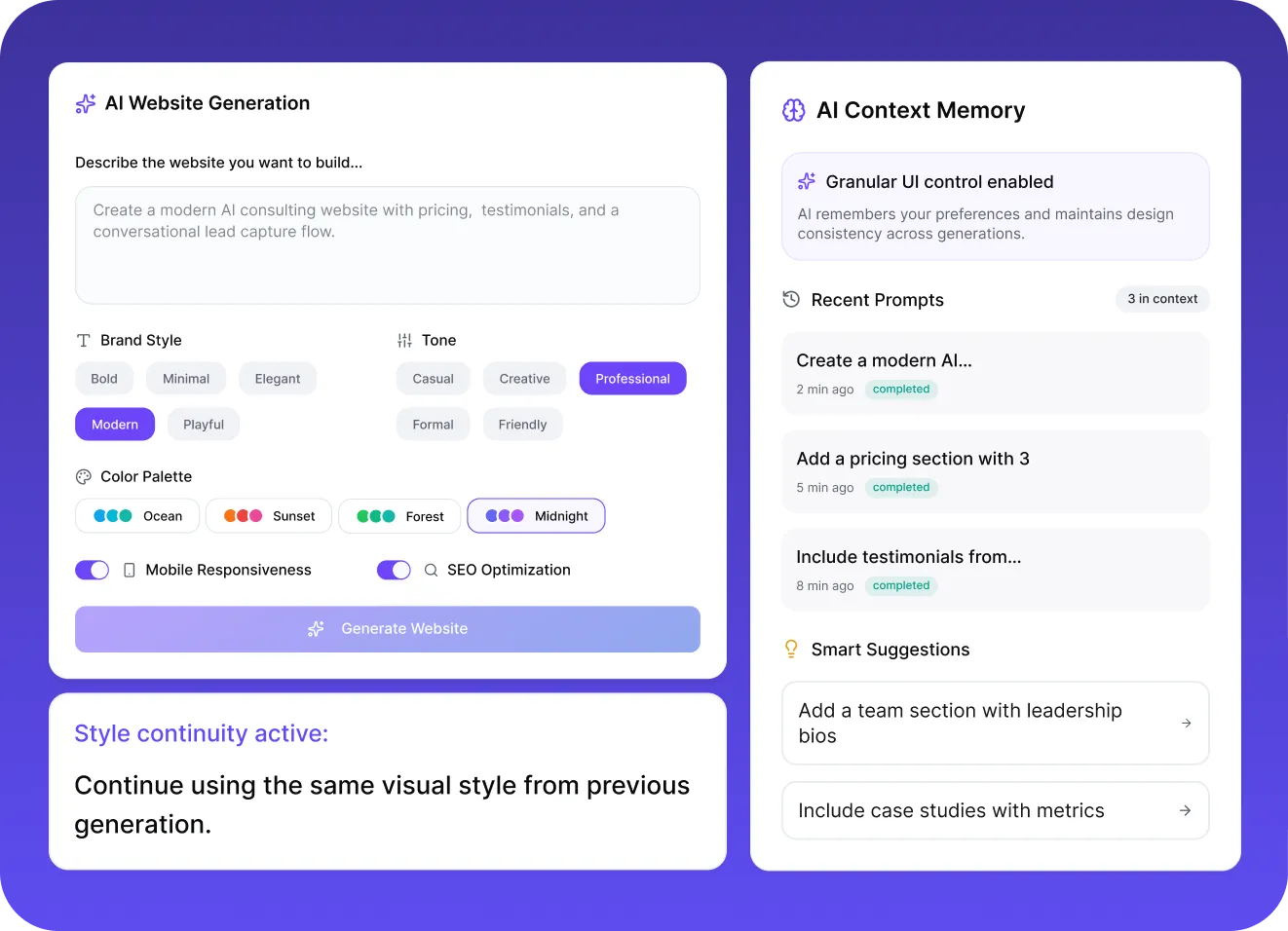
The website builder is the heart and soul of the platform, its most valuable feature. So, it had to work flawlessly. On our end, that meant implementing smooth dynamic rendering, minimizing errors, and enabling customization. Every generated website also had to comply with best practices like mobile responsiveness, design consistency, and fast loading.
Like with any AI tool, ensuring output consistency was a challenge. To overcome it, we expanded the context window, thus helping the chatbot “remember” the conversation and generate context-appropriate output. This meant users could enjoy a more granular control over the generated website’s UI.
At the same time, erroneous output would no doubt frustrate users and lead to churn. So, we tested and fine-tuned the builder until we could guarantee an error rate below 2%. We also introduced numerous guardrails for the model so that it always followed best practices (e.g., mobile responsiveness).
Dynamic rendering and multilingual support
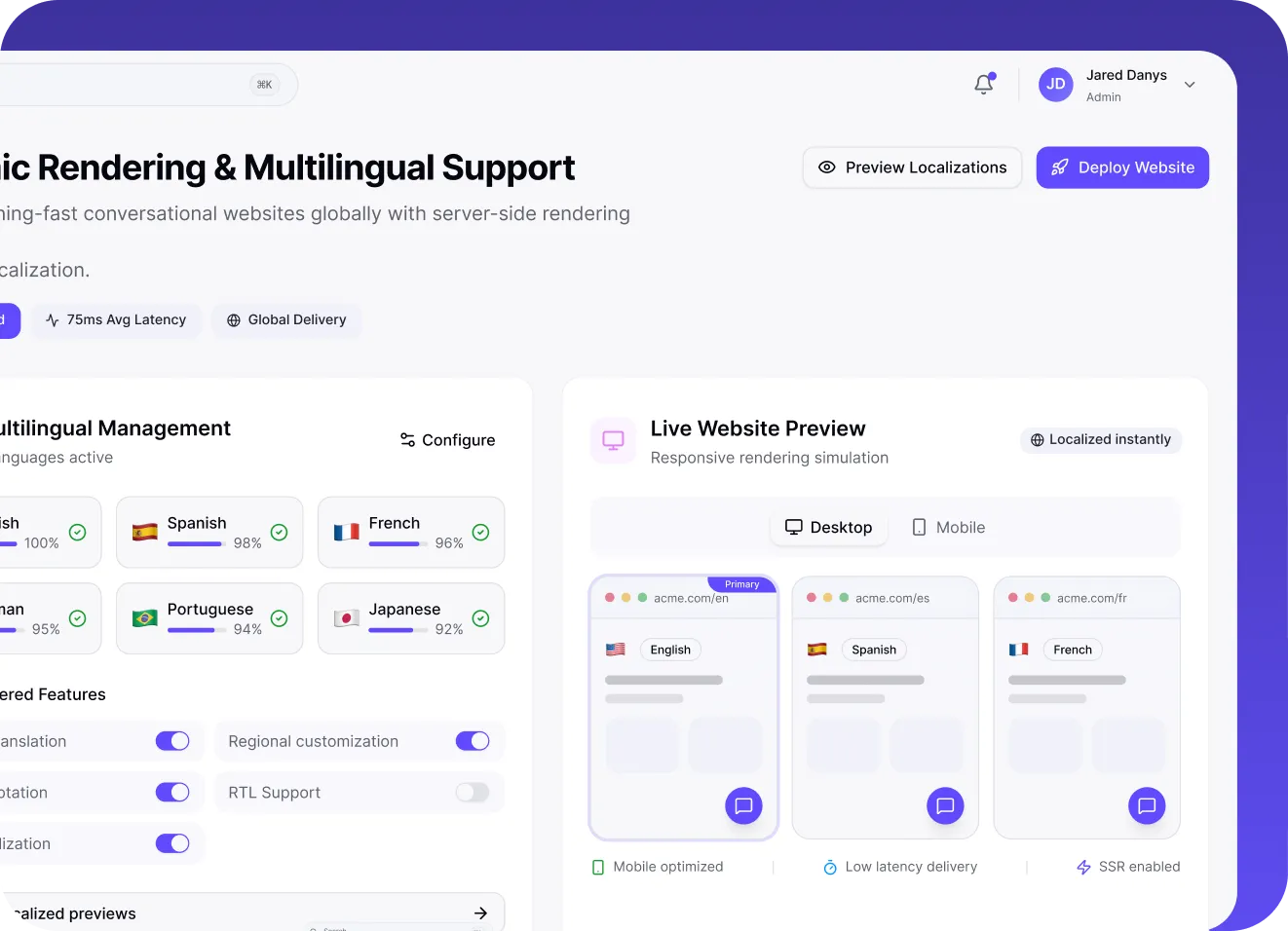
We implemented server-side rendering and dynamic routing to make building a website a smooth and frictionless experience. That brought the average latency to 75 ms, below the target goal. Introducing multilingual support, in turn, expanded the platform's reach beyond English-speaking markets.
Implementing any of these three features could have negatively affected tenant performance. We were well aware of that and, of course, mitigated the impact. As a result, the platform's application performance index (Apdex) score didn't suffer at all.
Multi-tenant hosting
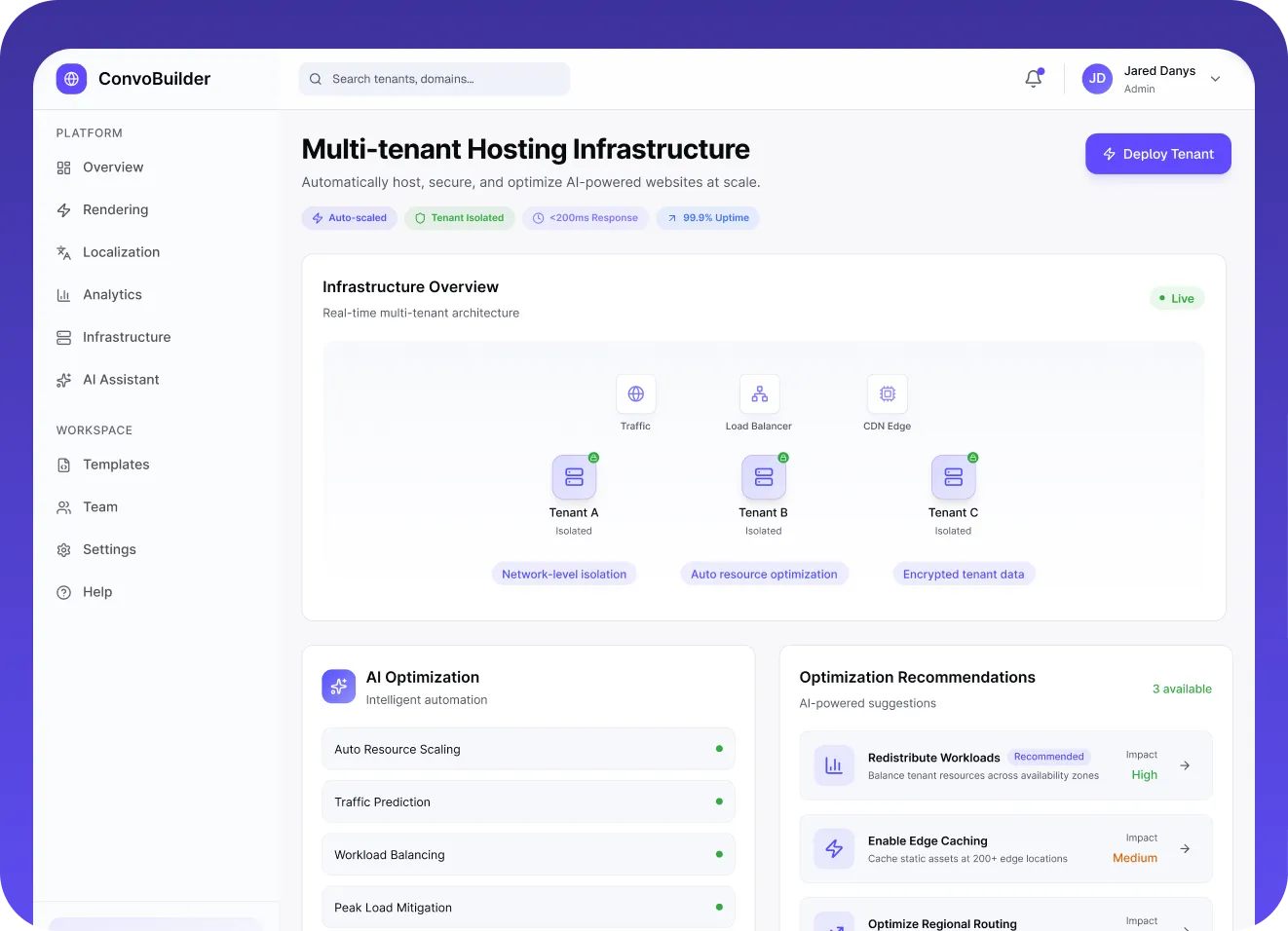
Most small business owners don’t have the time or resources to find the right hosting provider, configure all the settings, deploy the website, and install updates. That’s why out-of-the-box multi-tenant hosting was a must.
Despite its undeniable advantages (e.g., lower infrastructure costs, easier maintenance), multi-tenancy also comes with risks. The “noisy neighbor” effect can cause lag, for one. Plus, security risks are higher; so, every tenant’s data has to be encrypted and protected with access controls.
We addressed these risks with network-level tenant isolation and automatic resource optimization. As a result, response times for end users’ websites remain below 200 ms, even if request rates peak.
Integration with external websites
What if the user already has a website and simply wants to add a conversational AI assistant to it? Of course, this scenario was likely, and we had to account for it.
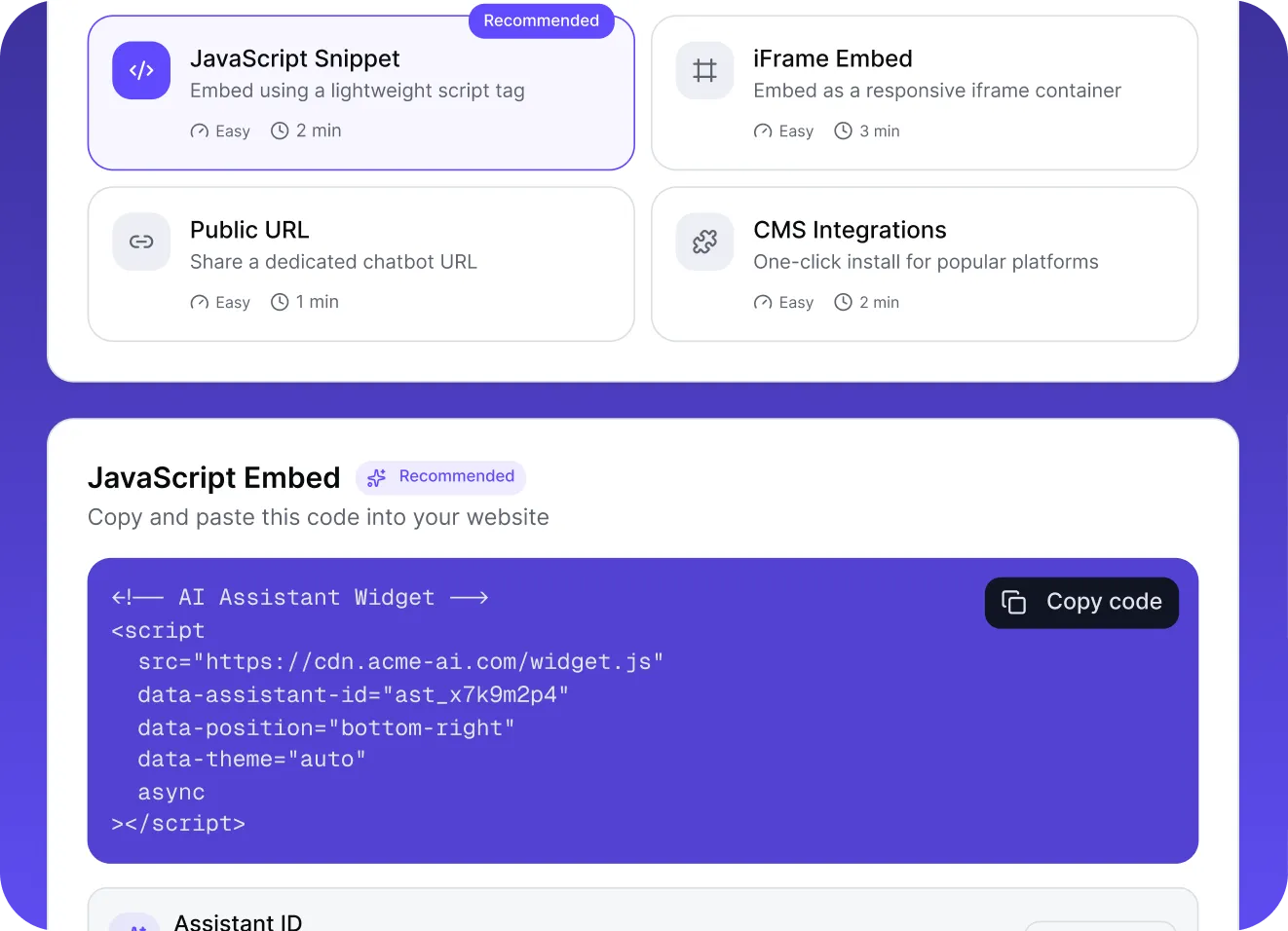
While adding a script to the HTML code is usually the best option, we realized quickly enough that it might not work for everyone. So, we implemented multiple embedding pathways.
So, the platform can generate a script or an iFrame tag that needs to be pasted into the website’s code. We added precise, clear instructions on how to do it, improving task success by 11% through iterative improvements. We also added public URL embed for edge use cases (e.g., linking to the chatbot on social media) and implemented a single-click integration with popular CMSs (e.g., WordPress).
Future-proof architecture
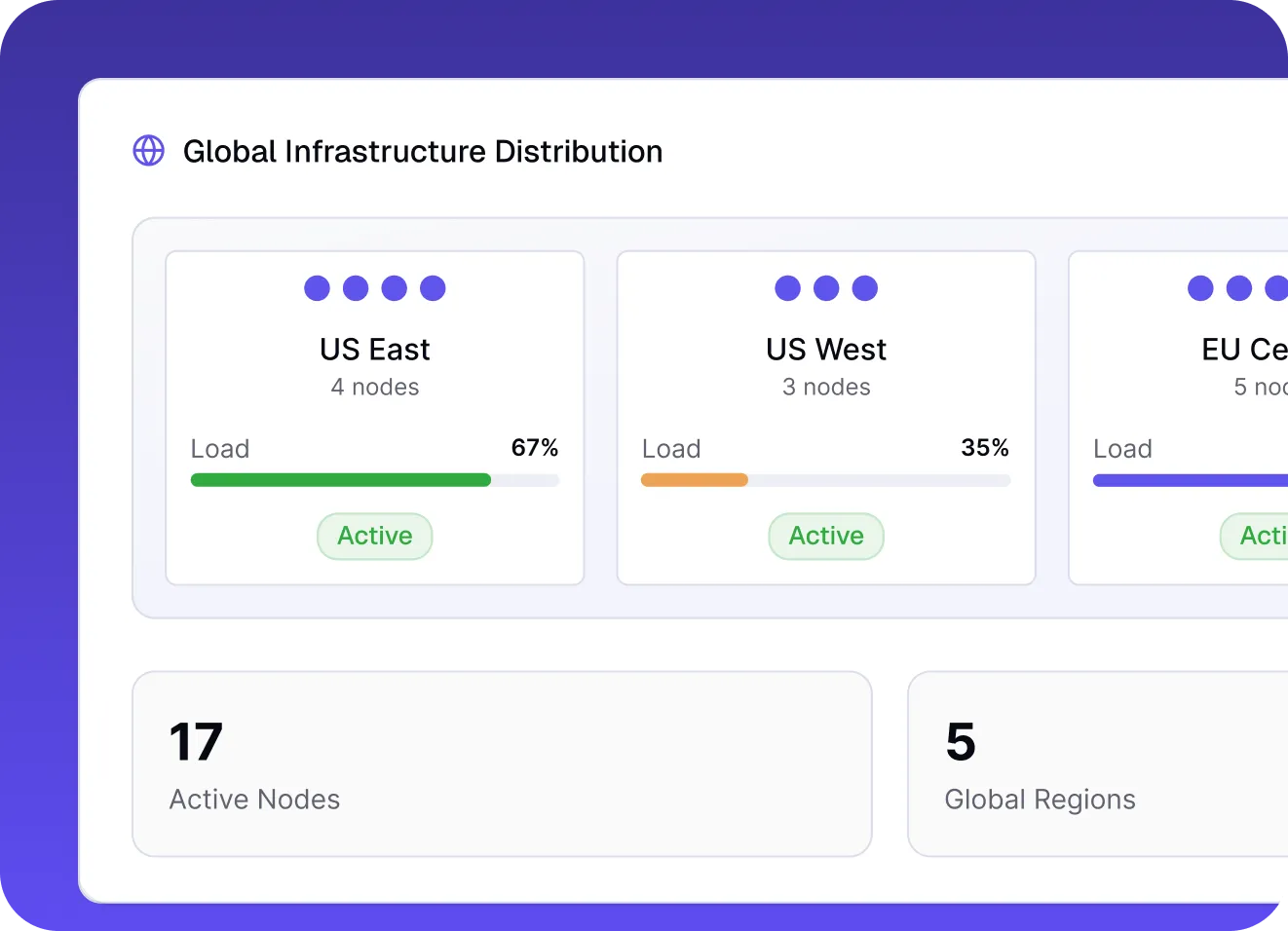
We built the whole platform as a lean MVP, but that doesn’t mean we paid no mind to our client’s long-term goals. Quite the opposite: we leveraged loose coupling, service-oriented architecture, and horizontal scalability to make sure the platform could easily grow and evolve.
First and foremost, we profiled the initial codebase and removed critical inefficiencies and performance bottlenecks. That alone helped boost performance by 9%, as measured by the Apdex score. Throughout development, we also tested the platform’s scalability and fine-tuned it based on hard data, increasing the scalability limit by 13%.

.webp)
Tech stack


Impact
As a result of our partnership, our client received a high-performance, scalable lean MVP ready to convert users, limit churn, and evolve over time. Our involvement translated into many benefits for the startup, including:
Don’t have a well-defined scope for your MVP yet?
That’s not a dealbreaker. We’ll use flexible discovery and clarification loops in our sprints to adapt to your evolving needs.
Contact usTestimonials

I love it! The team was thinking about the logic of the app first, instead of just making a code. They supported my vision.

I love it! The team was thinking about the logic of the app first, instead of just making a code. They supported my vision.
Anna Vashchuk
Startup Founder
Darly made me an app owner! The price we agreed is what I paid. I've already decided to work with them on my next project.
Darly made me an app owner! The price we agreed is what I paid. I've already decided to work with them on my next project.
Oliwia Kowalska
App Owner
We’ve been working together for over 2 years. Since then, our webpage has been ranking high on Google and bringing us leads.
We’ve been working together for over 2 years. Since then, our webpage has been ranking high on Google and bringing us leads.
Anastasiya Shitikova
Head of Marketing
We got the website ready and out of the gate in record time! Darly helps us maintain and refine the website for SEO purposes.
We got the website ready and out of the gate in record time! Darly helps us maintain and refine the website for SEO purposes.
Kavya Khattar
Product Owner
The responsiveness, attention to detail and high-level communication from Darly Solutions was outstanding. Communication with the team was all online and was absolutely seamless. They were highly responsive, worked to tight deadlines and provided great feedback and communication throughout the entire project to ensure it remained on schedule and all quality requirements were being met. They exceeded all of our expectations, from design through to delivery.

The responsiveness, attention to detail and high-level communication from Darly Solutions was outstanding. Communication with the team was all online and was absolutely seamless. They were highly responsive, worked to tight deadlines and provided great feedback and communication throughout the entire project to ensure it remained on schedule and all quality requirements were being met. They exceeded all of our expectations, from design through to delivery.
Kieran Donovan
Managing Director, Corporate Advisory Firm
LLC Darly Solutions's team performs well since the collaboration started. They are fluent in specific programming languages, they are also fluent in English, and they have a great response time. What is most unique and impressive about Darly Solutions is that everyone in the team is inherently communicative and understands the expertise of their respective fields. The team is very agile and can predict stress situations in which we work together to fix and maintain.

LLC Darly Solutions's team performs well since the collaboration started. They are fluent in specific programming languages, they are also fluent in English, and they have a great response time. What is most unique and impressive about Darly Solutions is that everyone in the team is inherently communicative and understands the expertise of their respective fields. The team is very agile and can predict stress situations in which we work together to fix and maintain.
Carol Arao
Product Owner, Software Development Company
Darly Solutions' work so far inspires confidence, as they're skilled and trustworthy. The health platform is incredibly happy with their work. The team at Darly is communicative, responsive, and responsible. I’d recommend them to people looking to do more than build a simple little software.

Darly Solutions' work so far inspires confidence, as they're skilled and trustworthy. The health platform is incredibly happy with their work. The team at Darly is communicative, responsive, and responsible. I’d recommend them to people looking to do more than build a simple little software.
Jürgen Bröker
Executive Director, Healthcare Platform Co.
By collaborating with Darly Solutions, there is a significant improvement in the project's quality of codes compared to their original codebase. They lead efficient project management and keep the client updated with their reports. They're a flexible team that delivers promising results. They don't just do as they're told, they actively participate in the design process, which is going to yield us a much better platform in the end.

By collaborating with Darly Solutions, there is a significant improvement in the project's quality of codes compared to their original codebase. They lead efficient project management and keep the client updated with their reports. They're a flexible team that delivers promising results. They don't just do as they're told, they actively participate in the design process, which is going to yield us a much better platform in the end.
PJ Fisher
Head of Tech, Software Consulting Firm
Darly Solutions was able to develop the site with all functions running. The team was responsive throughout the engagement. They excelled at scheduling and delivered projects on the specified timeline. The whole team was a pleasure to work with. I am very glad that I entrusted them with my project, this is the best company for me!

Darly Solutions was able to develop the site with all functions running. The team was responsive throughout the engagement. They excelled at scheduling and delivered projects on the specified timeline. The whole team was a pleasure to work with. I am very glad that I entrusted them with my project, this is the best company for me!
Inna Netudikhata
CEO, Mama Travel
The quality of their work is very high, and we get very good customer feedback on what our site looks like. They're very reliable and have a great overview of the technologies they're using. They meet our deadlines and are very accurate with their time estimations on a project. In addition, they're responsive and great with communication with a great command of English — it's very easy to talk to them. Moreover, we've integrated them into our development and scrum process, where we have daily stand-ups with their project manager and developers through Slack.

The quality of their work is very high, and we get very good customer feedback on what our site looks like. They're very reliable and have a great overview of the technologies they're using. They meet our deadlines and are very accurate with their time estimations on a project. In addition, they're responsive and great with communication with a great command of English — it's very easy to talk to them. Moreover, we've integrated them into our development and scrum process, where we have daily stand-ups with their project manager and developers through Slack.
Felix Leontyev
Head of Technology, PSS AG
LLC Darly Solutions are highly skilled at UI/UX and follow very good engineering standards, and have been very professional in its approach to all the work to date (including the initial consultancy, which was the deciding factor). They have taken ownership of the work in way that demonstrates how much they value the work they are doing and consequently the work we are doing. I am gaining confidence that the decisions they make are good decisions and that this will result in a product that will exceed our initial expectations.

LLC Darly Solutions are highly skilled at UI/UX and follow very good engineering standards, and have been very professional in its approach to all the work to date (including the initial consultancy, which was the deciding factor). They have taken ownership of the work in way that demonstrates how much they value the work they are doing and consequently the work we are doing. I am gaining confidence that the decisions they make are good decisions and that this will result in a product that will exceed our initial expectations.
Gordon Lang
CTO, Vidina Solutions Ltd
Darly Solutions developed the app in a quick manner, and the code quality was excellent. The professional team was committed to building a successful product. The code quality was good, and the app has been built in a little more than 1 month, which is a result I'm very happy with. They were laid back but professional at the same time.

Darly Solutions developed the app in a quick manner, and the code quality was excellent. The professional team was committed to building a successful product. The code quality was good, and the app has been built in a little more than 1 month, which is a result I'm very happy with. They were laid back but professional at the same time.
Piotr Nowakowski
Founder, 79 Characters, Inc.
Darly Solutions’ work helped my business tremendously. They were able to identify key areas for growth and improvement. The team was communicative and professional throughout the entire engagement. LLC Darly Solutions is a solutions-oriented vendor that drives results. They’re really professional and they know what they’re doing. The team knows how to identify my problems and solve them.

Darly Solutions’ work helped my business tremendously. They were able to identify key areas for growth and improvement. The team was communicative and professional throughout the entire engagement. LLC Darly Solutions is a solutions-oriented vendor that drives results. They’re really professional and they know what they’re doing. The team knows how to identify my problems and solve them.
Maiza Simeon
Founder, Food App Startup
Related case study


Connect with us
.webp)
We are a tech partner that delivers ingenious digital solutions, engineering and vertical services for industry leaders powered by vetted talents.

