
Why your release process is still broken after Series A



Series A often feels like the moment when delivery should become predictable. Teams expand, roles become clearer, and planning becomes more formal. Expectations shift toward stability, confidence in timelines, and fewer shipping surprises.
Core problem: after Series A, release processes break because delivery systems designed for founder-led execution fail to scale with coordination, parallel work, and external commitments.
This article explains why product releases after Series A slow down and how growth reshapes release dynamics.
Key takeaways
- After Series A, shipping slows as coordination and ownership scale faster than the delivery structure.
- Release reliability reflects system design rather than individual performance.
- Hiring more developers often increases delivery risk before processes evolve.
- Release issues afte growth signal a structural transition in how delivery operates.
Why Does Shipping Get Worse After Series A Funding?
Three changes arrive at the same time: scope expands, ownership spreads, and dependencies multiply. Work runs in parallel, decisions travel across more roles, and each release touches more surfaces: QA readiness, security checks, environments, customer commitments, and revenue timing.
What worked at seed stage relied on shared context and direct conversations. At Series A, shared context gets thinner, handoffs increase, and release readiness becomes harder to see from one place. Shipping turns from “finish and deploy” into “synchronize and release”.
This shift also changes the stakes. A release links to customer deadlines, renewals, and investor milestones. The release process becomes a business-critical operation, so any gap in ownership or visibility shows up faster.

What Are the First Signs of a Broken Release Process?
Early signals tend to surface before visible failures. They appear across delivery work and leadership routines. These signals reveal startup release process problems while teams continue operating at full speed.
Technical Warning Signs
Technical symptoms usually emerge inside the release flow before they reach leadership discussions.
- Deployments still failing or rolling back close to release
- Emergency hotfixes are becoming part of the regular release flow
- Long code freezes before shipping
- QA is overloaded at the end of the cycle
These patterns show a release process breaking under growing dependency and coordination pressure.
Business and Leadership Signals
As technical friction accumulates, leadership behavior begins to change. These signals reflect shifting confidence rather than isolated execution issues.
- Product managers avoid committing to dates
- Sales promises slip or require renegotiation
- Release status meetings increase
- Confidence in timelines drops
Shipping discussions move from outcomes to contingency planning and risk management
Why Release Processes Break Specifically After Series A
Release processes tend to break because several structural changes happen at the same time. Growth increases coordination demands, delivery complexity, and external pressure. Together, these shifts create release issues after growth that teams rarely faced earlier.
Organizational Changes
Team size grows quickly after funding. New roles appear, managers step in, external outsourcing or outstaffing teams are often introduced, and decision-making spreads across more people. Communication shifts from direct conversations to handoffs and coordination.
As teams expand, informal alignment becomes less effective. Shared context fades, ownership becomes distributed, and the scaling release process starts relying on structure rather than proximity. What once moved naturally now requires explicit coordination.
Delivery Complexity Increases
Delivery work changes shape as multiple initiatives run in parallel. Shared environments serve several teams at once, and releases depend on work finishing in a specific order.
Each release carries cross-team dependencies. Small delays compound, coordination overhead grows, and shipping speed becomes tied to alignment rather than execution. This is where release process chaos after funding begins to surface.
Expectations Shift
Funding also reshapes expectations around delivery. Investor milestones introduce external timelines. Customer commitments raise the stakes of each release. Tolerance for disruption during shipping decreases.
Releases move from internal progress markers to business events. Under this pressure, weaknesses in the release process become more visible, with greater impact.
What Causes Release Process Chaos in Scaling Startups?
As startups grow after funding, delivery responsibility spreads faster than clarity. Shipping becomes a cross-functional effort that depends on alignment across product, engineering, QA, and operations. This shift often leads to release process chaos after funding, even when teams continue shipping regularly.
- Ownership of the release outcome stays fragmented across teams
- Manual steps extend across multiple functions during shipping
- Handoffs between product, engineering, QA, and operations weaken accountability
- Visibility into what is actually shipping remains partial
- Definitions of “ready” differ between teams and stages
These patterns reflect recurring startup release process problems that emerge as scale increases. Delivery remains active, while shared understanding around responsibility and status steadily declines.
One-line summary: release disruption appears when ownership and visibility fail to scale with team size and delivery scope.
Is a Slowing Release Process a Growth Signal?
Delivery outcomes at scale depend on systems rather than individual performance. As teams grow, shipping quality reflects how work moves across roles, stages, and dependencies. Many startup release process problems surface at this stage, even when teams remain experienced and capable.
As scale increases, several patterns appear at the same time:
- Individual effort replaces the shared delivery structure
- Extra hours and manual checks become part of the release flow
- Last-minute fixes compensate for missing coordination
- Predictability gives way to recovery-focused work
These patterns explain why a release process breaking often coincides with growth rather than changes in team quality.
Why Hiring More Developers Often Makes Release Problems Worse
Hiring after Series A increases capacity and complexity at the same time. Delivery shifts from a small group with shared context to a larger organization that relies on coordination to move work forward. A common pattern in custom software development as products, teams, and systems grow together.
As teams grow, a clear pattern emerges:
- More people introduce more coordination paths across roles and teams
- More coordination creates additional dependencies between workstreams
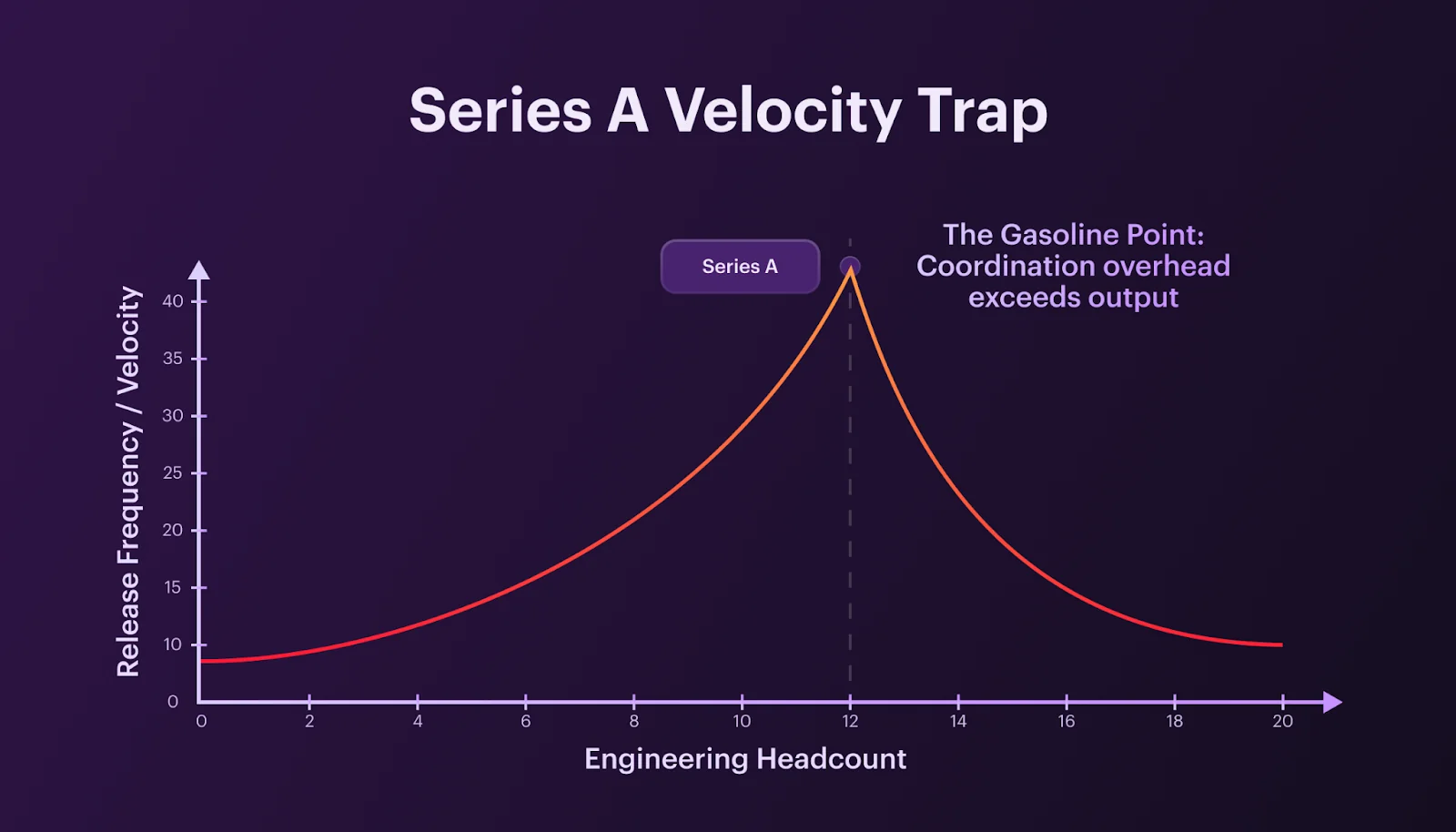
- More dependencies raise the likelihood of delays and release instability
- Existing release logic gets outpaced by the pace and volume of change
This pattern appears in growing B2B platforms. In one of our B2B call center enablement cases, release stability improved only after a codebase audit clarified ownership and exposed hidden dependencies.
Key insight: headcount scales faster than delivery structure.
What Happens When You Can’t Ship Features Reliably
When release reliability weakens, the effects extend beyond engineering. Shipping becomes a business variable that influences customer confidence, revenue planning, and leadership decision-making. At this stage, startup release process problems begin to shape outcomes across the organization.
Impact on Customers and Revenue
From the outside, unreliable shipping shows up as inconsistency. Expectations shift, timelines move, and confidence in delivery fades around product releases after Series A.
- Delivery promises get missed or revised late
- Features enter sales conversations before production readiness
- Roadmaps lose credibility as planning signals
Over time, customers adjust expectations downward. Revenue planning absorbs more uncertainty, and product commitments carry higher risk with each release.
Impact on Teams and Leadership
Inside the organization, delivery pressure reshapes behavior. Shipping turns into a moment of tension rather than progress.
- Deployment moments trigger hesitation and caution
- Sustained pressure leads to burnout and elevated stress
- Trust from investors and executives weakens as predictability declines
What Happens If Nothing Changes After Series A
When release dynamics stay misaligned with scale, outcomes follow a consistent pattern. Over time, a broken release process after Series A shapes delivery, planning, and market position in predictable ways.
- Releases grow rarer and carry a higher risk as the coordination load increases
- Product velocity collapses under accumulated dependencies and rework
- Planning turns political as teams negotiate scope, timing, and accountability
- Market momentum slows as delivery confidence weakens
These outcomes reinforce each other. As shipping confidence declines, organizations trade forward movement for caution. Over time, delivery becomes a limiting factor on growth rather than a driver of progress.
Is This a Common Phase for Series A Startups?
Answer: Yes.
Many scale-ups reach this transition soon after Series A. Growth accelerates delivery pressure as teams, scope, and coordination expand. Similar startup release process problems appear across industries and product types at this stage.
This phase signals that early delivery practices have reached their limits. Methods built on shared context and direct execution enable coordinated work across roles and teams.
The challenge is structural rather than personal. Outcomes reflect how releases are organized, owned, and coordinated as the company grows.
Moving forward requires rethinking how releases operate at scale — how ownership is defined, how work flows across teams, and how reliability is maintained as delivery becomes a business-critical function.
Final Thought
Series A reshapes how shipping operates across the company. Team growth, parallel execution, and external commitments turn releases into a business-critical system. Early delivery practices reach their limits as coordination, ownership, and risk expand together. Release reliability starts to reflect the system's design and coordination capacity, which explains why delivery slows, and confidence becomes fragile at scale.
This pattern aligns with findings from the 2025 DORA research, which shows that delivery instability increases when organizational systems fail to evolve alongside scale — even in teams adopting advanced tooling and AI.
This moment signals the need to align delivery with the company’s current stage. A scaling release process brings clarity around ownership, visibility, and flow across teams. Use this signal to reassess how releases operate today and decide how release operations should support the next phase of growth.
If this feels familiar, a 15-minute conversation can help identify where release structure stops matching your growth.


FAQ
Deployments break when coordination paths and ownership expand faster than the delivery structure can support. As teams grow, dependencies multiply, and handoffs increase. This is why deployments still failing becomes a recurring pattern even with more developers involved.
Early signals surface as missed delivery dates, QA overload near release, and emergency fixes becoming routine. Leadership starts questioning timelines and asking for more status updates. These symptoms usually mark a broken release process after Series A, while teams continue shipping.
Unreliable shipping reflects a structural delivery issue that spans engineering, product, and leadership. Outcomes depend on how work flows across teams and how ownership is defined. Many startup release process problems emerge from coordination gaps rather than isolated technical decisions.
A rethink becomes necessary when releases lose predictability after rapid team expansion and roadmap growth. At this point, existing practices struggle to support scale, underscoring the need for a scaling release process that aligns with current delivery demands.
Related articles


.webp)

Connect with us
.webp)
We are a tech partner that delivers ingenious digital solutions, engineering and vertical services for industry leaders powered by vetted talents.

