
Which types of startups most often outsource Mobile Development?



For Series A startups, the primary threat to growth remains the "hiring lag," which often overshadows market competition. When your core team is already redlined on the platform's backend or enterprise integrations, adding a mobile roadmap can paralyze your delivery. In the $1–5M ARR bracket, the decision to outsource mobile development is a tactical move to protect your internal team’s focus. It’s about ensuring that your core engineers aren't distracted by UI/UX nuances or device-specific edge cases while you’re trying to close your next enterprise deal.
This guide moves past the generic "cost-saving" fluff to analyze the actual strategic value of external engineering. We’ll break down which startup archetypes successfully use a mobile development partner for startups to hit aggressive milestones, how to de-risk these partnerships, and where the line is between "core IP" that stays in-house and "execution modules" that belong with a specialist.
Strategic Leverage: Why Scaling Startups Outsource Mobile Development
At this stage, building a product means managing a burn rate against an aggressive roadmap. For a B2B SaaS company, the decision to outsource mobile development is rarely about finding "cheaper" labor; it’s about finding a tactical shortcut to delivery. When your core team is already redlined on backend stability or enterprise-grade security, adding a mobile stack creates an immediate execution bottleneck.
The most successful founders treat external developers as a way to decouple their primary product discovery from the technical heavy lifting of device-specific platforms.
1. Eliminating the "Hiring Lag"
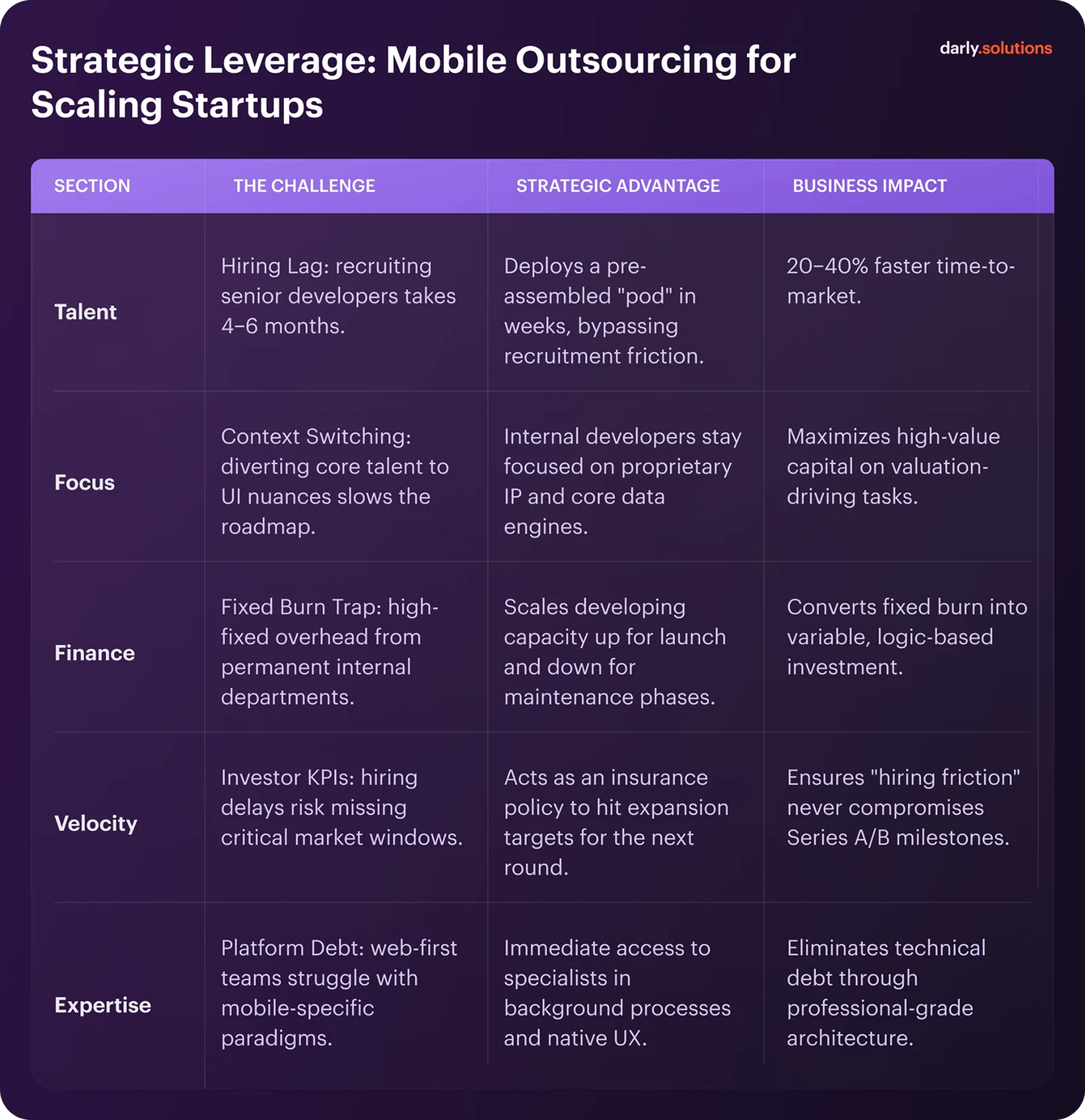
In the current market, recruiting a senior iOS or Android engineer takes an average of 4–6 months. For a startup with $1–5M ARR, that is a lifetime. Working with a mobile development partner for startups allows you to bypass the recruitment cycle, technical vetting, and onboarding friction. You get a pre-assembled "pod" that can start shipping code in weeks, not quarters, accelerating your time-to-market by an average of 20–40%.
2. Protecting Core Engineering Focus
Context switching represents the primary threat to the stability of a growth roadmap. If your lead developers are specialists in your proprietary data engine or complex integrations, forcing them to own a mobile UI is a poor use of high-value capital. Outsourcing keeps your internal talent focused on the core IP that drives your valuation, while the external team handles the nuances of push notifications, offline synchronization, and biometric authentication.
3. Converting Fixed Burn into Variable Investment
Building an internal mobile department adds permanent, high-fixed costs to your balance sheet (salaries, benefits, equity, and management overhead). For many SaaS products, the mobile app requires a massive initial push followed by a lower-intensity maintenance phase. When to outsource mobile development becomes a question of financial logic: it allows you to scale the team up for the launch and down for maintenance, ensuring capital is always aligned with current delivery needs.
4. Navigating Investor Milestones
Board meetings at the Series A/B level often center on "Product Expansion" as a prerequisite for the next round. If your roadmap demands a mobile extension by Q4 to win a specific market segment, but your hiring pipeline is dry, external engineering becomes your insurance policy. It ensures that "hiring delays" never become the reason you missed a critical market window or an investor KPI.
5. Access to Specialized Mobile Paradigms
Mobile isn't just "web on a smaller screen." It requires deep knowledge of background processing, memory management, and platform-specific UX patterns. Instead of training a web-first team through trial/error and accruing massive technical debt in the process, outsourcing gives you immediate access to specialists who have already solved the common pitfalls of iOS and Android architecture.
Bridging the Leadership Gap: Startups Without Internal Mobile Expertise
Even with a strong CTO, Series A startups often remain "mobile-blind." A web-focused founder usually lacks the specific architectural knowledge for native ecosystems. Without a dedicated Lead, building internally creates execution risk and future refactoring debt.
1. Technical Oversight as a Service
An external partner provides a technical blueprint, not just code. For Series A firms, poor architecture is costlier than development. To outsource mobile development means gaining access to senior architects who ensure seamless API integration and compliance (SOC2/HIPAA) from day one.
2. De-risking Product Discovery
Testing a mobile extension for retention shouldn't require a high-burn hiring strategy. A mobile development partner for startups allows for low-risk experimentation. You can transition to internal teams once the codebase is proven, avoiding permanent payroll bloat for specialized developers you no longer need.
3. Avoiding the "Generalist Trap"
Asking web developers to "figure out" React Native or Flutter often leads to overlooked nuances in memory management and background sync. Outsourcing allows your generalists to focus on core IP while specialists handle the device-specific complexities of professional-grade software.
Scaling at Speed: Post-Funding Execution
For Series A/B startups, time is the primary constraint. Once a round closes, investor milestones demand immediate delivery. With the U.S. Bureau of Labor Statistics projecting a 15% growth in demand for developers through 2032, waiting months for internal hires is a high-risk strategy.
- Bypass the Recruitment Bottleneck: A mobile development partner for startups deploys a plug-and-play developing pod in weeks, not months. This allows you to hit roadmap targets while HR continues the long-term search for internal anchors.
- Parallel Workstreams: Instead of sequential building, outsourcing enables parallel tracks. Your core team stays focused on proprietary IP, while specialists handle mobile-specific integrations.
- Burn Efficiency: Mobile developing often requires an initial "burst" followed by maintenance. Outsourcing allows you to scale capacity for launch and downscale afterward, converting fixed payroll into variable, logic-based investment.
- Architecture Insurance: Avoid the "bad hire" risk. A partner delivers a V1 based on proven standards, preventing years of technical debt and providing breathing room to find the right long-term cultural fit for your team.
Domain-Led Ventures: Navigating Complex Industry Requirements
In regulated sectors like HealthTech or FinTech, value lies in compliance and industry logic. For founders with deep market expertise but limited mobile backgrounds, managing an internal team is a distraction from securing partnerships and navigating regulatory hurdles.
1. Compliance-First Developing
In niches like HealthTech, a mobile app is a clinical tool requiring HIPAA or GDPR adherence. To outsource mobile development to a specialist means accessing established workflows for data encryption and audit trails. Instead of trial and error, you leverage a team that understands compliant architectures for the US market from day one.
2. Offloading Management Overhead
Managing a developing team requires specific operational skills. For industry-expert founders, sprint planning and technical reviews are often a poor use of time. Engaging an outsourced mobile app development company allows leadership to act as a "Product Owner" rather than a "Project Manager," keeping the focus on business development and fundraising.
3. Architectural Insurance for Scaling
Marketplace and FinTech platforms require high-availability architectures to handle traffic spikes and secure payments. Outsourcing provides the expertise needed to launch a robust V1. Many financial entities delegate app projects to external specialists specifically to ensure transaction safeguards and regulatory protocols are handled by experts who have built similar systems at scale.
4. Avoiding Execution Risk
In specialized industries, a generalist developer can be a liability. A mobile development partner for startups brings specialists who understand complex integrations — such as Electronic Health Records (EHR) or specialized payment gateways. This niche expertise prevents the integration bottlenecks that typically delay launches when handled by teams unfamiliar with these systems.
Market Expansion: Decoupling Geo-Specific Pilots from Core Engineering
When a scaling company enters a new geography, whether moving into the EU market or testing localized versions in high-growth regions like Latin America, the primary goal is to minimize entry risk. Hiring a permanent team for an unproven territory creates a "fixed-cost trap" that can be difficult to reverse if the pilot fails to hit its KPIs. Strategic leadership uses external engineering to facilitate these exploratory phases, allowing the core team to stay focused on the primary US market while a specialist partner handles the localization and regional nuances.
1. Navigating Regional Compliance and Technical Standards
Expanding into international markets introduces a layer of technical complexity that often falls outside the core team’s expertise. For example, deploying a financial app in the EU requires strict adherence to PSD2 payment directives and GDPR data residency rules. Rather than forcing your internal architects to spend months researching local regulations, you can outsource mobile application development to a partner already familiar with these regional frameworks. This specialized input ensures that your pilot is compliant from day one, mitigating the risk of legal bottlenecks or security failures during market entry.
2. Executing "Reversible" Market Tests
The "fail fast" mentality is harder to maintain when you have already committed to a permanent internal headcount for a specific region. By selecting a mobile development partner for startups to handle localized or white-label versions of your product, you maintain operational flexibility. This approach allows you to scale up the external pod to handle the initial surge of custom features and local integrations, such as local payment gateways or regional UX preferences, and then scale down or transition once the market's ROI is confirmed.
3. Maintaining Velocity in Mobile-First Economies
In mobile-first regions like Asia-Pacific, the standards for mobile UX are often higher than in the US due to a hyper-competitive ecosystem. For a US-based startup, leveraging a partner with experience in these high-velocity markets provides a strategic advantage: you gain access to UI/UX patterns that are already optimized for maximum user retention and engagement at scale.
Strategic Fit: When to Outsource vs. Build In-House
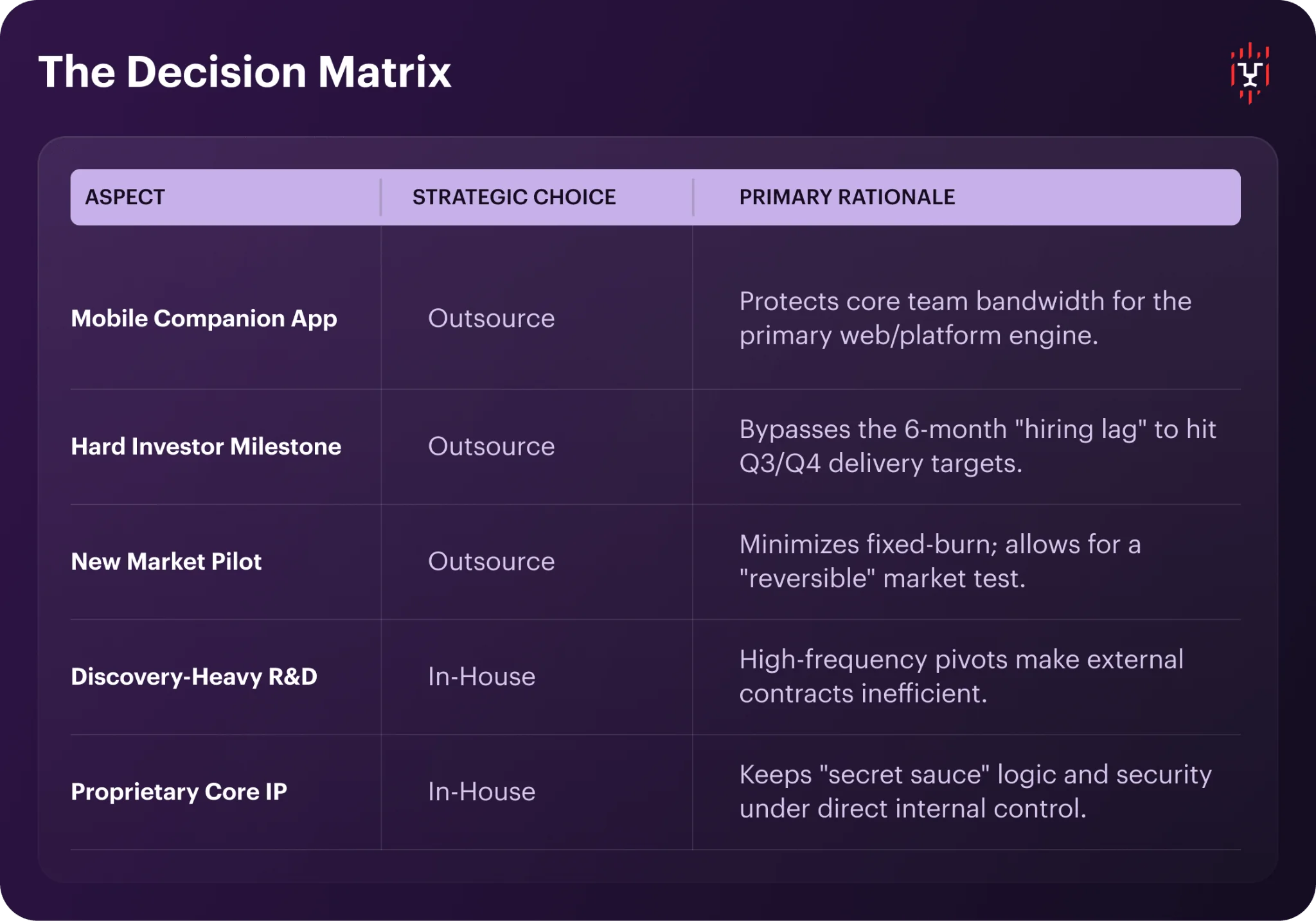
Deciding when to outsource mobile development is a calculation of opportunity cost. For a Series A leadership team, the goal is to separate "Standard Execution" from "Core IP." Outsourcing delivers the highest ROI when the project has high architectural clarity, allowing your internal team to remain focused on the proprietary logic that drives your company’s
Execution Guardrails
Successful engagement with a mobile development partner requires a stable technical foundation and clear internal ownership. Without defined requirements or a dedicated internal Product Owner, outsourcing risks scope drift and misaligned expectations.
However, when the roadmap is set, an external team functions as a powerful accelerator. Our mobile app development services deliver a market-ready solution significantly faster than a newly assembled internal team. We focus on improving 30-day retention by reducing crash risks, streamlining QA, and accelerating time-to-value in key user flows.
Debunking the Myths of External Mobile Teams
Outdated perceptions of outsourcing often center on "cheap labor" rather than "strategic partnership." For a Series A startup, these misconceptions create a psychological barrier to scaling. Modern, high-tier startups outsourcing mobile app development operate with a level of transparency and technical rigor that often matches or exceeds internal departments.
- Myth: Quality is compromised. In reality, a specialist mobile development partner for startups lives or dies by its reputation. Unlike a newly hired internal junior, an agency provides a vetted senior stack.
- Myth: You lose control of the product. Modern Agile workflows, integrated via Jira, Slack, and GitHub, ensure that the "external" team is effectively an extension of your own. You retain ownership of the roadmap and the code repository; the partner simply manages the execution of the sprints.
- Myth: Communication gaps are inevitable. Strategic outsourcing focuses on "nearshoring" or time-zone-compatible hubs. With scheduled syncs and CI/CD pipelines, "communication" becomes a matter of structured process rather than proximity.
- Myth: It is a short-term "fix." High-growth B2B SaaS companies often maintain multi-year partnerships with external teams. A sprint to launch frequently evolves into long-term collaboration for maintenance and feature expansion, providing sustained velocity without permanent headcount overhead.
Explore our proven mobile solutions to see how we turn concepts into products that solve operational challenges and scale alongside your business
Readiness Audit: Is Your Startup Ready to Outsource?
Before engaging a mobile development partner, you must move beyond the "we need an app" stage. Success depends on your internal readiness to manage external talent. For Series A teams, outsourcing fails when treated as a "black box" solution for a lack of product clarity.
1. The Validation Threshold
You are ready when you have a validated concept backed by user research or platform data. Engaging an external team during "heavy discovery" where the core problem is still undefined leads to scope creep. Outsourcing is most effective when the question shifts from "What should we build?" to "How do we execute this roadmap?"
2. Architectural and Roadmap Clarity
A defined roadmap with clear technical boundaries prevents the rework cycles that inflate budgets. Before the first sprint, ensure you have:
- Documented API endpoints: To allow the mobile app to consume existing platform data.
- Defined Milestones: A phased approach prioritizing high-impact features over secondary "nice-to-haves."
- Established Budget: A financial framework based on structured milestone payments to eliminate hidden costs.
3. Dedicated Internal Ownership
The "set it and forget it" model does not work for B2B SaaS. You need an internal Product Decision-Maker (PM or CTO) to:
- Review weekly builds and provide immediate feedback.
- Ensure the mobile product remains aligned with the company vision.
- Manage integration between the external team and internal backend engineers.
4. Measurable KPIs
Success must be quantifiable. Whether the goal is increasing mobile-driven MRR or specific user acquisition targets, setting KPIs upfront ensures the team is optimized for business outcomes rather than just "shipping code." Clear metrics allow you to hold a partner accountable for the strategic value they provide.
Vetting Your Partner: Beyond Technical Proficiency
Selecting an outsource mobile app development company is a high-stakes decision for a Series A founder. You are investing in an extension of your product team rather than just purchasing code. Industry benchmarks indicate that leading organizations prioritize a proven track record over cost, recognizing that the cheapest option often results in the highest technical debt.
1. Reputation and Vertical Depth
Generic expertise is a liability in B2B SaaS. Examine portfolios for projects within your specific sector. A strong partner demonstrates real-world results through user engagement metrics and successful enterprise integrations. Our experience includes delivering over 20 startups and 10+ mobile applications, focusing on maintaining apps through multiple OS updates and evolving market demands.
2. The Product-First Mindset
Avoid "feature factories." You need a team that understands how mobile features impact user retention and business KPIs. Since the majority of successful apps owe their retention to intuitive UX, your partner must contribute to user research and interface design to ensure the product solves the pain points of your ICP.
3. Architectural Resilience and Compliance
For startups in regulated industries, "good enough" code is a security risk. Your partner must demonstrate the ability to build compliant architectures such as HIPAA for HealthTech or SOC2 for enterprise SaaS. Prioritize teams that use modular, scalable designs to reduce future refactoring needs and ensure a clean transition to your internal team.
4. Process Transparency
Mitigate the "black box" effect by choosing a partner that utilizes:
- Agile Methodologies: Weekly sprints and demos to ensure alignment.
- CI/CD Pipelines: Automated testing and deployment for real-time progress tracking.
- Direct Communication: Slack and Jira integration to remove barriers between teams.
5. Long-Term Continuity
Mobile apps are living products. A reliable mobile development partner for startups provides a clear post-launch support framework including OS-level updates, bug fixes, and iterative feature development. With a team of 100+ developers and 150+ complex web projects completed, we ensure your initial investment scales alongside your growth without risks of obsolescence.
Final Thought: Turning Execution into a Competitive Advantage
Outsourcing is a high-velocity lever for growth. For Series A companies, it effectively decouples delivery from the constraints of the hiring market.
In 2026, market leaders win by integrating AI-driven personalization and automated workflows with speed and architectural stability. Choosing to outsource mobile development transforms a potential bottleneck into a strategic asset, keeping your product ahead while your internal team focuses on valuation.
With 20+ startups delivered, we provide the technical rigor required to scale. Let’s discuss how a dedicated mobile development partner for startups can accelerate your roadmap and secure your competitive edge.


FAQ
Series A startups and high-growth B2B SaaS companies often choose to outsource mobile development to maintain velocity. This approach allows teams with a validated product to execute their roadmap quickly while keeping the internal core team focused on high-level strategy and platform architecture.
Cost efficiency is a natural byproduct, but the primary drivers for a mobile development partner for startups are speed to market and technical depth. This model provides immediate access to senior engineering stacks and specialized expertise in complex integrations, ensuring the product scales as fast as the business requires.
Startups ensure full alignment through Agile methodologies, weekly demos, and direct integration into Slack and Jira. A dedicated internal Product Decision-Maker acts as the bridge, reviewing progress in real-time and ensuring every sprint contributes directly to the company's long-term vision.
Many Series A companies start with full-cycle development to launch a high-performance MVP or a major feature set. Over time, this often evolves into a hybrid model where the external team handles specialized mobile maintenance and feature expansion, providing a scalable extension to the internal engineering department.
Related articles

Data-Driven Product Strategy: How to Implement AI Modules That Actually Impact P&L


Connect with us
.webp)
We are a tech partner that delivers ingenious digital solutions, engineering and vertical services for industry leaders powered by vetted talents.

